
The Heinz Bet in Plain English: Six Picks, Fifty-Seven Bets
 Available in US
A Heinz is one named bet on six selections. Behind that one line on the betting slip sit 57 individual wagers — 15 doubles, 20 trebles, 15 four-folds, 6 five-folds and 1 six-fold. Every single one has to win for the biggest payout, but smaller combinations return money whenever enough legs come in. The Heinz is popular because it spreads risk across many combinations without the player having to build the slip by hand, and because a single short-priced favourite still produces a return on the combinations that involve it. It is also a bet where the headline stake and the real stake are two different numbers, which catches most first-timers off guard. This guide walks through what a Heinz is, how it settles, how much it really costs and which UK-licensed bookmakers will let you place one in 2026.
Current as of 27 October 2026 · Licence status checked against the Gambling Commission’s public register.
How the Heinz Is Built: Sixty Bets, Three Sizes Short
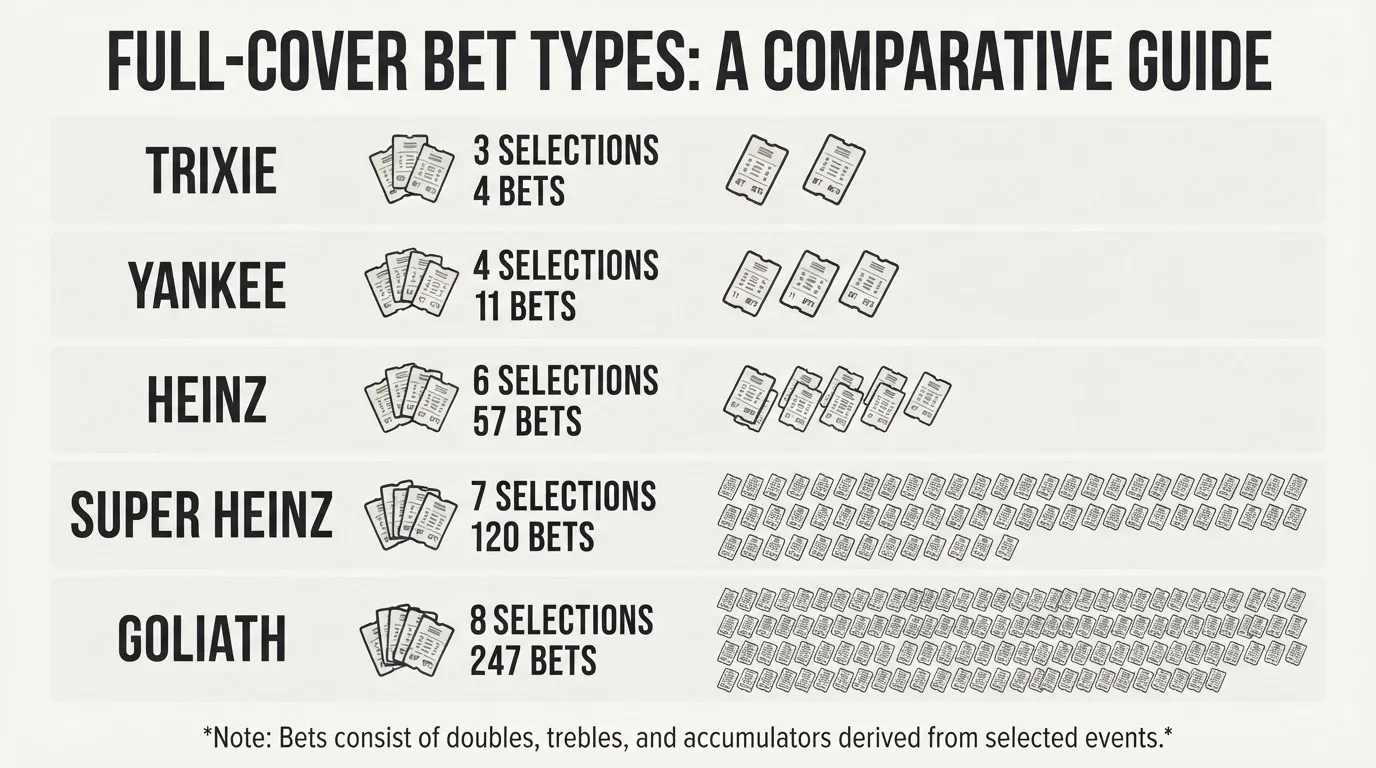
A Heinz sits in a family of full-cover bets that scale up by one selection at a time. A Trixie covers 3 selections in 4 bets, a Yankee covers 4 in 11, a Canadian — sometimes called a Super Yankee — covers 5 in 26, a Heinz covers 6 in 57, a Super Heinz covers 7 in 120 and a Goliath covers 8 in 247. The total jumps sharply with each step because every new selection fans out into every possible combination of the others; a 6-selection Heinz has 57 combinations, a 7-selection Super Heinz doubles that to 120 and an 8-selection Goliath more than doubles it again.
What the Heinz does NOT contain matters as much as what it does. It includes only multiples — doubles and upwards — and no singles. A Lucky 15, by contrast, covers 4 selections in 15 bets and does include 4 singles alongside its 6 doubles, 4 trebles and 1 four-fold. The Lucky 15 pays back something even when only one selection wins; the Heinz pays back nothing until at least two selections win, because the smallest combination in it is a double. That single difference shapes how each bet feels in practice. The Heinz is the bet a punter makes when they want every combination covered and they have decided the singles can stand on their own; the Lucky 15 is the bet a punter makes when they want a single winner to feel like progress.
Anatomy of the 57 Bets
Each Heinz bet distributes the same unit stake across the 57 combinations. Pick a unit stake of 10p and the total stake is £5.70. Pick £1 and the total is £57. Pick £2 and it is £114. The relationship is rigid: total stake = unit stake × 57. There is no slider, no menu, no “I’ll have it lighter on the trebles”; the operator’s bet slip makes every combination the same weight.
A useful way to count the combinations is to recognise the pattern rather than to memorise the numbers. Each multiple in the bet picks all possible groups of that size from the six selections:
- Doubles — choose 2 from 6 = 15 combinations.
- Trebles — choose 3 from 6 = 20 combinations.
- Four-folds — choose 4 from 6 = 15 combinations.
- Five-folds — choose 5 from 6 = 6 combinations.
- Six-fold accumulator — choose all 6 = 1 combination.
The numbers add up to 57 because they have to: together they cover every combination of two or more selections from a six-strong list.
The “All Bets Must Win” Mistake
Many beginners read “57 bets” on the slip and assume that all 57 must win for anything to come back. They don’t. Only the six-fold requires all six selections; the 6 five-folds only need five of the six; the 15 four-folds only need four; and so on down to the 15 doubles, which only need two. A Heinz that wins five of its six legs pays out on every combination that doesn’t include the losing leg. With five winners, every double involving those two winners still pays, every treble involving the three winning legs pays, and so on up the stack. The beauty and the cost of the bet sit in this gradation: most returns come from the lower combinations, while the six-fold at the top of the pile — the only bet that needs all six legs — provides the headline number that turns a Heinz from decent to memorable.
The flip side is just as important to understand. A bet that wins five of six legs pays handsomely on every combination among the winners, but a bet that wins only two of six legs pays only on the single double involving those two. From three to five winners the returns scale up steeply because the number of working combinations explodes: three winners leave 3 doubles, 1 treble and nothing above; four winners leave 6 doubles, 4 trebles and 1 four-fold; five winners leave 10 doubles, 10 trebles, 5 four-folds, 1 five-fold and still nothing on the accumulator. That is the Heinz’s payoff profile — small when only a few legs land, dramatic when almost all of them do.
How a Heinz Is Settled: Void Selections, Non-Runners and Rule 4
Most Heinz bets settle without incident because every selection runs and every selection either wins or loses. The two situations that catch people out are void selections and non-runners, and each one reduces the bet to the next multiple down.
When a selection in a multiple bet is void — for example a player pulls out of a tennis match before it starts, or a horse is declared a non-runner after the bet is placed — that leg is treated as if it won at the starting price for horse racing or as a winning selection with a stake returned for other sports. The bet then drops to the next smallest combination. A six-fold with a void leg becomes a five-fold. A treble with a void leg becomes a double. A double has no smaller multiple to drop to, so the stake on that combination is returned. The rest of the Heinz is recalculated across all 57 combinations using the new effective number of selections, with the voided leg removed.
Rule 4 is a different settlement, specific to horse racing in Britain and Ireland. When a horse is withdrawn from a race after the betting market has formed, the bookmaker reduces the odds on the remaining runners to reflect the smaller field, and that reduction is applied to any bets placed before the withdrawal. The deduction is quoted as pence in the pound — a 20p Rule 4 means 20p is taken off each pound of winnings on the affected combinations. Because a Heinz contains dozens of combinations involving every selection, a Rule 4 deduction on a popular horse in a multi-leg Heinz affects many of them at once. Reading the betting terms before placing a large Heinz on a race meeting is cheaper than discovering Rule 4 on the settlement screen afterwards.
Partials: Why a Heinz Is Not “All or Nothing”
The settlement engine on a Heinz does more work than the settlement engine on a single accumulator. A six-fold accumulator needs every leg to win and pays nothing otherwise. A Heinz treats the bet as 57 separate wagers sharing six selections, so every combination is settled in its own right. That structural difference is the reason a Heinz is sometimes described as “an accumulator with insurance,” though that framing oversells what the bet does. What it actually offers is the chance to win on a partial — to get something back for picking four or five winners correctly — combined with the cost of paying for all 57 combinations in advance. The insurance is paid for upfront by the larger stake; nothing is wagered for free.
This is also why a Heinz and a Lucky 15 look superficially similar but cost very different amounts. A Lucky 15 has 15 combinations instead of 57 and includes four singles. A £1 Lucky 15 costs £15 and can pay on a single winner. A £1 Heinz costs £57 and pays nothing on a single winner. The Lucky 15 is for the punter who wants frequent small returns; the Heinz is for the punter who wants a big swing on a day when most of their picks land.
How to Read and Place a Heinz on a UK Sportsbook
Every major UK sportsbook — and every major betting exchange — offers the Heinz as a named multiple. The slip itself usually handles the construction. Pick six selections, mark each one for the bet type “Heinz,” enter a unit stake, and the slip shows the 57 combinations, the total stake (unit × 57) and the maximum return if every leg wins. There is no manual assembly of 57 lines; the bet slip builds the structure automatically.
Different operators use slightly different vocabulary. Some call the bet a Heinz by default; others list it under “Full Cover” alongside Trixie, Yankee and Goliath; exchanges describe it in their help pages rather than as a button on the slip, because exchanges typically settle bet legs individually and the customer builds the multiple themselves. The mathematics are identical across all of them; what changes is how the bet is presented.
Staking matters more than most beginners realise. A £1 per-line Heinz costs £57 per bet, which already places the wager in a higher tier than most casual punters use. Racing through stake sizes until the total is comfortable is the right move: 50p a line is £28.50, 20p a line is £11.40, 10p a line is £5.70. The payout scales linearly with the unit stake, so a 10p Heinz that would have returned £500 at £1 a line returns £50. The shape of the payout is what matters; the unit stake just sets how much real money is on the table.
Cash-out, where offered, applies to a Heinz as it does to any multiple — the bookmaker offers a real-time value for the bet based on the selections that have already won and the implied odds of those still to come. Cash-out on a Heinz is usually available once a sufficient number of legs have settled, with the offered figure reflecting the value locked in by those wins against the risk on what remains. It is rarely available before at least two or three legs have been confirmed, and at that point the offered value is often much smaller than the headline payout the bet would return if every remaining leg won.
What Does a Heinz Pay? An Illustrative Payout
Worked example, from a single combination for illustration: a treble on three selections at decimal odds of 1.50, 2.00 and 2.50. At a £10 stake on the treble alone, the return if all three win is £10 × (1.50 × 2.00 × 2.50) = £10 × 7.50 = £75. The profit on the bet is £65 — £75 returned minus the £10 stake. That is what any single combination in the Heinz returns when its legs all win.
A full Heinz on those same six illustrative selections — three at 1.50, two at 2.00 and one at 2.50, for example — would settle 57 separate combinations, each at the same £10 unit stake, totalling £570 across the bet. The full payout figure depends on which legs won. Six winners returns the maximum, with the six-fold alone paying £10 × (1.50 × 2.00 × 2.50) × (2.00 × 2.50) — the product of the six illustrative prices combined. Five winners pays on the working combinations only, and the figure scales down sharply as legs drop out.
Stake and unit stake are the easiest figures to get wrong on a Heinz. A £10 Heinz is £10 per combination — £570 across the bet. A £10 “Heinz unit” is £5.70 across the bet. Operators tend to default to per-combination staking on the slip, which makes the headline stake look modest until the total is computed. Checking the total bet on the slip before confirming is the cheapest habit a Heinz punter can build.
The textbook point worth keeping is that the bet’s max payout is the product of all six prices multiplied by the unit stake. For a Heinz on six favourites at decimal odds of 1.50 each, the six-fold payout per £1 unit is 1.50⁶ = £11.39. For six mid-priced selections at 3.00 each, it is £729 per £1 unit. The other 56 combinations settle on whatever subset of selections wins, and their payouts add up to a meaningful return even when the six-fold does not fire.
How a Heinz Compares to Other Full-Cover Bets
A punter choosing between full-cover bets is really choosing between two trade-offs: how much stake they want across how many combinations, and whether singles are included. The trade-offs are clean:
- Trixie (3 selections, 4 bets, £4 at £1 a line). The smallest full-cover bet. No singles. Pays nothing on one winner. Useful when a punter has three confident picks and wants every multiple covered without singles inflating the cost.
- Yankee (4 selections, 11 bets, £11 at £1 a line). Adds the four-fold to the mix. No singles. Pays nothing on one winner.
- Lucky 15 (4 selections, 15 bets, £15 at £1 a line). Identical multi coverage to a Yankee but adds 4 singles. Pays on any single winner. A heavier stake for the same multiple coverage in exchange for the singles.
- Canadian / Super Yankee (5 selections, 26 bets, £26 at £1 a line). Often used by punters who want all multiples covered across five confident picks and are happy to pay £26 a go to do it. No singles.
- Heinz (6 selections, 57 bets, £57 at £1 a line). The bet covered in this guide. Pays nothing on one winner. The mid-range of the full-cover family.
- Super Heinz (7 selections, 120 bets, £120 at £1 a line). The natural step up. More combinations but a much larger total stake.
- Goliath (8 selections, 247 bets, £247 at £1 a line). The largest named full-cover bet. Reserved for punters with conviction on every leg and a bankroll that can take a £247-per-go stake.
The sweet spot for most Heinz punters is a balance between stake they can afford to lose (every Heinz has many losing combinations, paid for up front) and combinations rich enough that even a partial return justifies the bet. A £1-a-line Heinz at £57 is a serious bet for a casual punter; a 20p-a-line Heinz at £11.40 is the same structure at a more recreational price. Both are valid; the choice is about bankroll and ambition.
The Bookmaker’s Margin Inside Every Combination
Every price on a Heinz contains a margin — the slice of every pound wagered that the bookmaker keeps on average across the market. The margin is not stated on the betting slip; it is built into each decimal price, and the more selections a market contains, the harder it is for the punter to see it.
Calculating the margin on a single combination is straightforward: take the implied probabilities of each selection at the odds offered (1 ÷ decimal odds), multiply them together for an accumulator-style bet or sum them across an outright market, and subtract from 100%. For a six-fold accumulator at illustrative prices 1.50, 1.50, 2.00, 2.00, 2.50 and 2.50, the implied probabilities are roughly 66.7%, 66.7%, 50%, 50%, 40% and 40%, multiplying to about 4.44%. A “fair” six-fold accumulator would have those six selections paying around 1 ÷ 0.0444 = 22.5. Anything below 22.5 is the bookmaker’s edge accumulating across all six prices.
For a single betting market — say a Premier League match with home win at 2.50, draw at 3.50 and away win at 3.00 — the implied probabilities are 40%, 28.6% and 33.3%, summing to about 101.9%. The extra 1.9 percentage points is the margin, which is the bookmaker’s average take on every pound wagered on this market. Margins on Premier League 1X2 markets at major UK sportsbooks typically sit between 2% and 7%, with bigger prices and less popular leagues usually carrying a higher margin.
A Heinz inherits the margin on every combination. Because the bet contains combinations of every size, the effective margin across the whole bet is a weighted average of the margins on each combination, weighted by how likely that combination is to win. That calculation is well beyond the scope of a betting slip, but the headline holds: the longer the multiple, the higher the cumulative margin, and the more legs the bookmaker takes a slice from on every winning line. This is the silent cost of a Heinz and the reason the headline payout can look generous while the expected return is more modest. The arithmetic rarely delivers what the marketing suggests.
Why Licensed Bookmakers Matter for a Heinz Bettor
In Great Britain every commercial bookmaker — and every betting exchange — needs a Gambling Commission licence. That is a single, clean rule: at the point of consumption in Great Britain, the operator must hold a Commission licence or it must not take bets from customers here. It is not a question of where the operator is based, what software it uses, what its terms say, or how big its marketing budget is.
The Commission’s public register is the test. It can be searched by business name, trading name, domain or account number, and every online bookmaker licensed for Great Britain is on it, along with the category of licence it holds, the trading names it operates and the date the licence was granted. The relevant licence for any online sportsbook taking sports bets in Great Britain is a remote betting licence — a remote general betting standard licence for a fixed-odds bookmaker, a remote betting intermediary licence for an exchange, a remote pool betting licence for pool operators, and remote general betting limited for smaller-scope operators. The register entry also tells the customer which company is the named licence holder, because several brands can sit under one licence and several licences can sit under one company.
For Heinz bettors specifically, the licence matters because the same financial-protection rules apply regardless of the bet type. Identity verification takes place before the first deposit and the first bet, and a Heinz wager is treated identically to a single for the purposes of those checks. The Commission keeps a public register of betting licence holders, and that register is the single answer to whether a bookmaker is licensed for GB customers.
Responsible Gambling at the Heinz Stakes
A Heinz is a bet that, by design, costs more than most. At a £1-per-line unit stake the bettor commits £57 before any result is in, and the realistic outcome across a session of Heinz bets is that most of them return less than they cost. A £11.40 Heinz (20p a line) is easier to absorb but still lays out the full unit-stake total every time the bet is placed. The size of the bet, more than the bet type, is what raises the responsible gambling stakes.
UK rules around online betting protection run through three layers. The first is the operator’s own safer-gambling tools — deposit limits, time-outs, reality checks, product restrictions and self-exclusion — which licensed bookmakers must offer and a Heinz bettor should set before placing. The second is GAMSTOP, the national multi-operator self-exclusion scheme that every online GB-licensed bookmaker participates in. GAMSTOP exclusions run for six months, one year, five years, or five years with auto-renewal; after the minimum period, the exclusion stays in place for a further seven years unless removed at the customer’s request. The third is the support network — GamCare (which runs the National Gambling Helpline), GambleAware, NHS gambling clinics and Gamblers Anonymous.
Financial vulnerability checks apply to licensed remote betting when a customer’s deposits minus withdrawals exceed £150 in a rolling 30 days. The check is a public-record check (for example bankruptcy or county court judgments) and is not an income check or a credit-reference check. Financial risk assessments have been announced in stages with no confirmed start date as of 2026; reporting that they are “in force” overstates where the rules actually sit. Deposit limits (RTS 12) on operators are a customer’s own setting rather than a state-set ceiling; no statutory deposit or loss limit exists for sports betting in Great Britain.
The honest framing is that a Heinz bettor who wants to stay in control sets a deposit limit, monitors the size of the stakes they are placing, and treats a Heinz as entertainment rather than as an investment. A £57 bet on six selections is the price of the entertainment; the payout, when it comes, is the bonus, not the point.
Bonuses, Free Bets and Heinz Bets
Bookmakers do not run a “Heinz bonus.” What they do is run welcome offers, free-bet clubs, acca insurance, boosted odds, and loyalty rewards, and a Heinz bettor’s question is whether any of these add value to a full-cover multiple. The answer depends almost entirely on the offer’s terms, which vary enough that no summary covers them all.
Welcome offers usually come in two shapes. The first is a fixed-odds free-bet bundle — £X in free bets after a £Y qualifying bet — which is paid in free bets rather than cash. The free bets are typically usable on any sport and any market, including multiples, but the free-bet stake is usually not paid back with a win. The second is enhanced odds on a specific outcome, which is paid as cash winnings at the boosted price but subject to maximum-stake and maximum-winnings caps. A welcome offer can be used on a Heinz as the qualifying bet, after which the free bets earned can be deployed on whatever market the operator permits.
Acca insurance is the offer most directly relevant to a Heinz punter. BoyleSports, for example, runs Acca Insurance covering bets from a minimum stake through to a maximum refund paid as a free bet, requiring a minimum odds-per-leg and same-day placement and settlement. The conditions are specific — opt-in required, minimum stake of £5, minimum odds 1/2 per leg, maximum free-bet refund of £20, settlement within seven days of issue, bets placed and settled on the same day — and missing any one of them voids the insurance. The useful feature for a Heinz punter is that the insurance applies to one missing leg, so a six-leg Heinz that loses one selection by a narrow margin still gets something back, where an unprotected Heinz on the same selections pays nothing.
The regulatory side is worth keeping in mind. Wagering requirements on bonuses at GB-licensed operators are capped at 10x (a £10 bonus at 50x wagering needs £500 of bets; under the cap no more than £100 of wagering is needed for that £10 bonus). Mixed-product promotions — offers that require gambling across two or more product types, for example “bet on football to get free spins” — are banned. Whether the 10x cap applies to free bets with no wagering condition, and any cap on the money value of a bonus, are not established.
The honest assessment: most welcome offers at UK-licensed bookmakers can be used on a Heinz in one way or another, but the value calculation has to be made against the offer’s specific terms. Comparing “£X free bet” against “10x wagering on £Y” against “acca insurance on 5+ folds” is the work; the offer that looks the biggest at first glance is often not the one that pays out the most after the conditions are read.
Predicting Heinz Bets and Picking Selections
Searches around “Heinz predictions,” “Heinz betting tips” and “Heinz system betting” are common and the underlying logic is straightforward: a Heinz is paid by combinations, so the punter’s job is to pick selections with enough skill that enough combinations win. There is no short-cut system that flips that arithmetic around. There is no software that picks six selections reliably enough for a Heinz at scale, and there is no combination of form models, tipsters or staking plans that converts a Heinz into a positive expected-value bet when the underlying prices contain a margin.
What a Heinz punter can do is choose the right kind of selections for the bet type. The bet handles 57 combinations, so the leg-by-leg correlation matters less than the win-rate matters. Six selections at 1.50 each with a 66.7% true-probability win rate compound to roughly an 8.4% chance of all six winning, which is the chance of the six-fold firing. That is a low number, but it is paid at 11.39 per £1 unit, which is the long-tail payoff the bet is structured around. Six selections at 3.00 each with a 33.3% true-probability win rate compound to roughly a 0.14% chance of all six winning — so far away from certain that the bet should be priced accordingly, but with a six-fold payout of £729 per £1 unit if it lands. The shape of the bet rewards picking legs that could realistically all win together, which usually means reading the prices for value rather than looking for an all-or-nothing long shot.
The discipline that matters is bankroll, not prediction. A Heinz at a £1 unit stake is a £57 bet; placing ten Heinz bets in a session is a £570 outlay. Bankroll management means deciding the unit stake before the session, not after the first bet has been settled and chased. Heinz betting tips from any external source should be treated as one input among many — tipsters are not regulated for the quality of their picks in the way that bookmakers are regulated for the integrity of their markets, and there is no redress mechanism if a tip turns out wrong. The bettor makes the picks; the bettor takes the consequences.
What the Heinz punter controls is the price of the bet and the stake. What the Heinz punter does not control is the outcome. The arithmetic that turns a price into a margin turns a Heinz into a long-run cost for most bettors; the bet is structured for entertainment, not income.
Picking a Heinz-Friendly UK Sportsbook
UK sportsbooks at which a Heinz bettor might place a bet fall into three groups. The first is the long-established fixed-odds bookmakers — names that have been taking bets in Britain for decades. The second is the betting exchanges, which carry different economics and a different bet structure for Heinz-style multiples. The third is the newer mobile-first sportsbooks — apps that have grown with the smartphone era and that often layer extra features onto the basic Heinz structure.
A Heinz bettor comparing options should weigh four things. The first is whether Heinz is offered as a named bet — every major UK sportsbook supports it, but smaller operators sometimes do not list it on the slip, in which case the customer has to assemble the combinations manually. The second is the margin on the underlying selections, which varies from bookmaker to bookmaker and even between sports and leagues at the same bookmaker. The third is the in-play depth, because a Heinz wagered on selections that the bookmaker prices deeply in play can be settled live during the action rather than only at full-time. The fourth is the cash-out policy, where offered, because a bookmaker that holds cash-out on a multiple through to the last leg gives the punter more control than one that closes cash-out as soon as one leg settles.
Promotional offers should be read against the bet, not the other way around. A free-bet credit that can be used on multiples including Heinz is worth something to a Heinz punter; a free-bet credit that is restricted to singles or to specific events is not. Reading the offer terms before signing up is cheaper than realising the offer does not fit the bet style afterwards.
Heinz-Friendly Licensed Operators at a Glance
The table below brings together the brands covered in the reviews that follow. Each row carries the GB-licensed bookmaker, the Gambling Commission account number and named licence holder, and a brief description of what the operator’s published terms say about multiples, in-play, cash-out and Heinz-specific features. Where the published terms do not pin down one of those elements for a brand, the cell carries a dash rather than a guess.
| Operator | Gambling Commission licence | What the operator’s terms say |
|---|---|---|
| Midnite | Account 101839; Midnite Limited | Heinz as a named multiple; in-play events; acca builder; popular accas; price boosts with maximum-stake limits |
| Smarkets | Account 39173; Smarkets (Malta) Limited | Betting exchange (intermediary) — multiples built leg by leg; standard commission 2% on eligible bets |
| 888sport | Account 39028; 888 UK Limited | Pre-match and in-play; Cash Out; Bet Builder; racing streams; BetFinder; daily boosted odds |
| BoyleSports | Account 39469; Boylesports Enterprise | Acca Insurance on five-fold multiples and up — £5 min, 1/2 per leg, £20 max free-bet refund, 7-day expiry |
| William Hill | Account 39225; WHG (International) Limited | Heinz as a named multiple; Best Odds Guaranteed on UK/Irish racing from 8 AM on race day |
| LiveScore Bet | Account 56859; LiveScore Betting and Gaming (Gibraltar) Limited | Bet Builder up to 10 selections — match result, BTTS, corners, total goals, player scoring, cards |
| Betboro | Account 44181; Webmedia Development N.V. | In-play and cash-out on football, racing, tennis; boosted odds on selected singles from £10 |
| Spreadex | Account 8835; Spreadex Limited | Heinz as a named multiple across the fixed-odds product; also holds an FCA spread-betting licence |
| Lottoland | Account 38991; EU Lotto Limited | Casino, lottery betting, sportsbook and scratchcards under one Commission licence |
| Paddy Power | Account 39439; PPB Counterparty Services Limited | Bet Builder+; Popular Bet Builders; Super Sub; expanded Win More; player and ACCA stats |
The Reviewed Heinz-Friendly Operators
The reviews below work through the brands in the table above. Each review names the company that holds the licence, the licence itself, and what the operator’s published terms say about the features relevant to a Heinz punter.
Betboro
Betboro is operated under a Gambling Commission remote general betting standard licence covering real events, with the named licence holder Webmedia Development N.V. and the Commission’s account number listed on its GB-facing site. The published terms describe in-play betting and cash-out on football, racing and tennis, plus boosted odds on selected singles from £10 stakes, and the safer-gambling tools required under the Commission’s codes (deposit limits, reality checks, self-exclusion).
For Heinz bettors the relevant questions are whether the bet is on the slip as a named multiple — which it is on a standard modern sportsbook — and whether the underlying margins are competitive enough to make the bet worth the unit cost. Betboro is a smaller brand than most on this list, which usually means a narrower market depth rather than a different structure. The features most relevant to a Heinz punter are in-play cash-out and the boosted singles, which can be deployed on the legs of a larger combination before the combination is placed. Whether the boosted singles move the needle on a Heinz’s expected value depends on the price offered and the price of the underlying market. Betboro serves the niche as a smaller, focused sportsbook.
BetMGM UK
The BetMGM UK app is published by LeoVegas Gaming p.l.c., with the app listing the Commission’s account number for the relevant licence. The licensed entity is a major European operator running a UK-specific product, with the full catalogue of remote betting covered by the GB licence. The app carries the typical modern sportsbook features — single and multiple betting, in-play markets, bet builder, casino product alongside the sportsbook.
For Heinz bettors what matters is whether the multiple bet is available on the slip — it is — and whether the price depth and margin on the relevant sports are competitive. App-first sportsbooks tend to settle in-play quickly and to push price boosts through the day, which can affect the moment-to-moment value of a leg while a Heinz is in progress. The BetMGM UK product is one of the more mainstream mobile offerings on the GB-licensed list, with the casino product alongside the sportsbook that some Heinz punters prefer to keep separate. BetMGM UK offers a mainstream alternative for punters who like their casino and sportsbook side-by-side.
BoyleSports
BoyleSports is licensed by the Gambling Commission under account number 39469 (Boylesports Enterprise). It runs an extensive UK presence, including a significant retail estate in addition to the online product.
The BoyleSports offer most relevant to a Heinz punter is the Acca Insurance promotion. BoyleSports Acca Insurance requires opt-in, a minimum stake of £5, minimum odds of 1/2 per leg, and pays a maximum refund of £20 as a free bet that expires in seven days. The bet must be placed and settled on the same day. The structure is designed for accumulators of five folds or more, and a Heinz qualifies. The insurance applies when exactly one leg of an eligible multiple loses, with the refund paid as a free bet rather than as cash. For a Heinz bettor who often loses on one leg while the other five win, the insurance is meaningful insurance — it does not turn a losing bet into a winner, but it does put something back on the table. The seven-day expiry on the free bet is the part to plan around. The headline offer is genuine rather than marketing decoration, and the terms are narrower than the marketing implies, which is the usual shape of these things.
William Hill
William Hill holds a Commission licence (account 39225, WHG (International) Limited) and runs one of the largest retail and online betting estates in the UK, and that breadth shows up in the depth of the product.
The feature most relevant to a Heinz punter who ever puts a horse racing leg on the slip is Best Odds Guaranteed. William Hill’s published terms state that Best Odds Guaranteed applies on UK and Irish horse racing from 8 AM on the day of the race, on both single and multiple bets; the term does not apply to ante-post, tote or pari-mutuel bets. For a Heinz built with a racing leg among the six, BOG upgrades that leg’s odds to the starting price if the SP is higher than the price taken — a small but consistent uplift on the working combinations that include the leg. The arithmetic benefit depends on the price drift between bet time and the off; some days it adds nothing, some days it adds a non-trivial sum. For the Heinz punter whose combination includes a racing leg, William Hill is one of the comparison points precisely because BOG is one of the older promotions in the UK bookmaker market and is structured to behave predictably.
888sport
888sport is licensed by the Gambling Commission (account 39028, 888 UK Limited). The brand is part of a wider gaming group with a long-established UK presence.
888sport’s published product page lists pre-match and in-play betting, Cash Out, Bet Builder, racing streams, BetFinder form tools, a live bet feed and daily boosted odds. For Heinz bettors the relevant features are pre-match and in-play for leg-by-leg settlement, Cash Out for the moment-by-moment value on a Heinz in progress, Bet Builder where the Heinz is built around same-game selections rather than across events, and the daily boosted odds that can lift one of the legs in a working combination. Racing streams are relevant only if the Heinz includes a racing leg. The product is a mainstream fixed-odds bookmaker with the feature set a Heinz punter would expect from a major brand, and the licence is on the Commission’s register. 888sport is a solid choice for the punter looking for a wide feature set from a major brand.
LiveScore Bet
LiveScore Bet is licensed by the Gambling Commission for remote general betting standard (real events), with the named licence holder LiveScore Betting and Gaming (Gibraltar) Limited and the Commission’s account number listed on its published terms. The brand has grown around the live-scores service that gives it its name and routes users from results-tracking to in-play betting.
The published Bet Builder product covers match result, both teams to score, corners, total goals, player scoring and card markets, and supports up to 10 selections on a single slip. The Bet Builder route is a different way into a Heinz-style structure: instead of six legs from six separate events, the bettor takes six legs from a single match. Multi-match Heinz and single-match builder bets sit at different ends of the bet-construction spectrum. For the Heinz punter who wants to build a same-game multiple, the Bet Builder is the relevant product; for the six-legs-across-events punter, the standard Heinz on the slip is the relevant product. LiveScore Bet offers both. LiveScore Bet fits the punter who likes to bridge their in-play monitoring with their betting slip.
Lottoland
Lottoland UK is licensed by the Gambling Commission for customers in Great Britain, with the published licence covering remote general betting standard among other categories and the named licence holder EU Lotto Limited. Lottoland is best known for lottery betting, but the UK app combines casino, lottery betting, sports betting and scratchcards.
For Heinz bettors specifically the sportsbook is the relevant product. The relevant questions are the depth of the sportsbook, the margin on the underlying markets, and whether the Heinz is supported as a named multiple on the slip. Lottery-focused operators entering sportsbook often carry a lighter sports product than dedicated sportsbooks, which can affect market depth on smaller leagues. Existing Lottoland customers might find the integrated sportsbook a convenient consolidation, while pure Heinz bettors could prefer a dedicated sports-first platform.
Midnite
Midnite is licensed by the Gambling Commission for remote general betting standard (real events), with the named licence holder Midnite Limited and the Commission’s account number on its published terms. The brand is a mobile-first sportsbook with an emphasis on esports alongside traditional sports.
Midnite’s published site lists in-play events, an acca builder, popular accas and price boosts with maximum-stake limits. For Heinz bettors the relevant features are in-play for live leg settlement, the acca builder for combining selections into a multiple, popular accas for seeing which combinations other customers are putting together, and the price boosts that can lift one of the legs in a Heinz at the time the bet is placed. The app also runs a sports welcome offer for new customers: betting £5 or more on pre-match odds of EVS (2.0) or greater within 14 days of sign-up returns £25 in free bets and 50 free spins, valid for 7 days. The free-bet stake is typically not paid back with a win, which is the standard treatment. Midnite is the option for the punter who follows esports alongside traditional events.
Paddy Power
Paddy Power is licensed by the Gambling Commission for remote general betting standard (real events), with the named licence holder PPB Counterparty Services Limited and the Commission’s account number on its published terms. Paddy Power is one of the larger and more recognisable UK betting brands, with a significant retail estate alongside the online product.
The Paddy Power app offers Bet Builder+, Popular Bet Builders, Super Sub (a bet rolls over to the replacement if a selected player is substituted), expanded Win More markets, and player and ACCA stats. For Heinz bettors the relevant features are Bet Builder+ for same-game multiples, Popular Bet Builders for visibility into what other customers are betting, Super Sub as a player-substitution insurance mechanism on the legs of a bet, and the stats pages that help with pre-leg decision-making on which selections to use. Paddy Power runs alongside Betfair under the same parent group’s UK structure, which is a feature rather than a problem — the two products are separate, but the customer base is shared. Paddy Power is built for the punter who values deep features and a high-energy promotional environment.
Smarkets
Smarkets runs under a Gambling Commission remote betting intermediary licence (an exchange licence, not a fixed-odds licence), with the named licence holder Smarkets (Malta) Limited and the Commission’s account number on its published terms. An exchange takes bets from customers against each other rather than as the house on the other side of every wager, which gives a different pricing structure and a different bet construction.
For Heinz bettors the relevant fact is that exchanges do not offer a Heinz as a named slip by default. The customer backs six selections and assembles the multiple themselves, which means placing 57 separate back bets that multiply into the same structure. The advantage of the exchange route is lower margin — exchanges apply a commission on net winnings rather than building a margin into every price. The Smarkets published terms describe a standard commission of 2% on eligible exchange bets, with new customers having been offered 0% commission for 60 days against a minimum first deposit. Serious punters aiming to construct their own Heinz manually will find Smarkets a competitive low-margin choice.
Spreadex
Spreadex holds both a Financial Conduct Authority-spread-betting licence (for financial spread betting) and a Gambling Commission licence for fixed-odds betting. The two licences reflect two different products, and the company’s own published terms state that spread betting losses can exceed the deposit — a specific risk unique to the spread-betting side.
For Heinz bettors the relevant product is the fixed-odds sportsbook, which is offered alongside the spread-betting product. Spreadex’s published new-customer offer is £60 in free bets for a £10 fixed-odds bet, with the free bets usable across fixed odds and spread betting; the qualifying bet must be placed within 28 days of opening the account. The free-bet stake is typically not returned with a win. The combination of fixed-odds and spread betting under one account is unusual in the UK market, and the dual product is either a feature or a complication depending on what the bettor wants. Bettors interested in exploring both spread betting and fixed-odds multiples may appreciate the flexibility of these two product lines under one account.
Frequently Asked Questions About Heinz Bets
What is a super heinz bet?
A Super Heinz covers 7 selections in 120 bets — 21 doubles, 35 trebles, 35 four-folds, 21 five-folds, 7 six-folds and 1 seven-fold accumulator. The structure is identical to a Heinz but one tier larger, with no singles and a per-line unit stake. At £1 a line the total stake is £120, which puts a Super Heinz well past the casual punter’s comfort zone and into deliberate territory.
What is a heinz bet?
A Heinz is a full-cover multiple covering 6 selections in 57 bets — every combination of two or more of the six legs, with no singles included. The total stake equals the unit stake multiplied by 57. The smallest combination is a double, so a Heinz returns nothing on a single winner and starts paying from two winners upwards.
How many bets in a super heinz?
A Super Heinz contains 120 bets: 21 doubles, 35 trebles, 35 four-folds, 21 five-folds, 7 six-folds and 1 seven-fold. The total stake is 120 × the per-line unit. It is more than double the size of a standard Heinz (57 bets) and a step up from there into the Goliath family at 247 bets for 8 selections.
How can it be checked that a bookmaker holds a Gambling Commission licence?
The Commission’s public register is the test. It can be searched by business name, trading name, domain or Commission account number. Every online bookmaker licensed to take bets from customers in Great Britain is on it, alongside the licence category (for example remote general betting standard or remote betting intermediary), the named licence holder, the date the licence was issued and any conditions attached. A bookmaker not on the register is not licensed for GB customers, regardless of where it is based or what marketing it produces.
How is the return on a bet worked out from the stake and the odds?
For a single or any one combination, the return when the bet wins is the stake multiplied by the decimal odds. A £10 single at decimal odds of 3.00 returns £30 — £10 stake plus £20 profit. The same formula applies to each combination in a multiple bet, with the odds of that combination being the product of the leg odds. For a treble at decimal odds 1.50, 2.00 and 2.50, the combined odds are 7.50, so a £10 treble returns £75 when all three legs win.
What is the bookmaker’s margin and how can it be seen in the odds?
The margin is the slice of every pound wagered that the bookmaker keeps on average across a market, and it is built into every decimal price. For a three-outcome market (home win, draw, away win) at decimal prices of 2.50, 3.50 and 3.00, the implied probabilities are 40%, 28.6% and 33.3%, summing to 101.9%. The extra 1.9 points above 100% is the margin. On accumulators the implied probabilities multiply, so the cumulative margin grows with each leg — this is why longer multiples return more on a win but carry a steeper long-run cost to the punter.
Bet types & in-play – Darts betting
Content created by the «Darts betting» team
