
Snooker Betting Tips 2026
 Available in US
*Last updated: 27 October 2026 · Cross-checked against the Gambling Commission’s public register of remote operating licences.*
The cue ball sits on a baize of regulation 12 ft by 6 ft, 22 balls in play — 15 reds, six colours and the white. Maximum break 147, the best-of-19 to best-of-35 format that turns the World Snooker Championship at the Crucible into a four-day war of attrition. None of that decides who wins. The numbers a punter faces on a betting slip are the bookmaker’s opinion of who wins, dressed in margins the house keeps whether the bet wins or loses. A tip is what a reader does with that gap. The job below is to show how the gap is measured, where the marketing pulls a reader off it, and what each operator’s own terms make a reader pay for the privilege of placing a bet.

Where Snooker Sits in the Betting Calendar
Snooker runs a near-continuous professional tour between late spring and the following spring, with three peaks that move the betting volume: the World Snooker Championship at the Crucible Theatre in Sheffield, held there every April–May since 1977; the UK Championship in York around late November and early December; and the Masters at Alexandra Palace in mid-January, an invitation event for the top sixteen. Around those, the ranking events of the World Snooker Tour, the World Seniors, and the amateur circuit under the International Billiards & Snooker Federation fill the calendar month by month.
The Crucible is the one readers recognise fastest. Best of 19 frames in the first round, rising to best of 35 in the final across two days. Stephen Hendry and Ronnie O’Sullivan hold seven modern-era world titles each; Joe Davis won fifteen in a row between 1927 and 1946 before the modern circuit took shape. The professional game is governed by the World Professional Billiards and Snooker Association, which also owns the rules; the IBSF runs the amateur side. The 2026 final was settled at the Crucible on 4 May 2026, Wu Yize beating Shaun Murphy 18–17 from a £2,395,000 prize fund, the winner’s share £500,000.
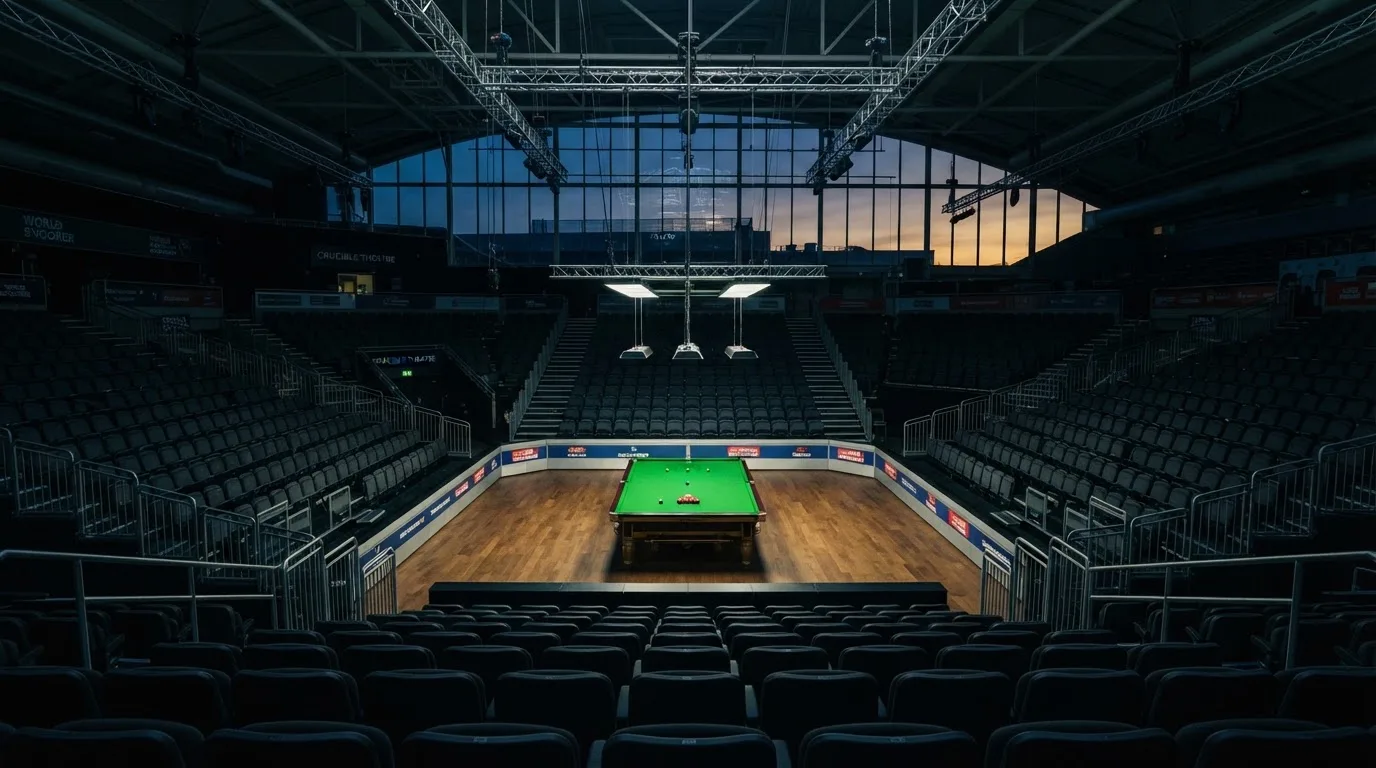
Three things follow for the punter. First, a tournament in mid-May is the calmest part of the calendar — the next ranking events are still weeks away, the outright book has been settled, and the only prices moving on snooker are the specials. Second, the format itself shapes what a bettor can bet on: a best-of-19 first round can be all over in a single session, while a best-of-35 final creates long stretches where one player has the run of the table. The frame-betting market is read differently at each end of that scale. Third, the season’s biggest events are also where the bookmaker’s in-play offering is thickest, because the television window is longest — live in-play pricing is the section of the page that most directly turns on the calendar.
The conclusion is not “wait for the World Championship”. It is that any reader who treats snooker as a year-round discipline is really treating it as four short windows, and the most useful preparation is the kind that happens in the gaps between them — recording how players handle pressure sessions, what their long-pot percentage looks like, and which ones tighten when the frame score goes against them. That is the work a “tip” is actually built on. The rest of the page is the rest of the kit.
The Ten Operators on the Slip, and What Sets Each One Apart
The comparison below covers ten brands whose domains are listed on the Gambling Commission’s public register against a licensee holding a remote general betting standard licence (or, in one case, a remote betting intermediary licence for an exchange). The columns carry what the register says and what each operator’s own terms say about the relevant point. A place in the ranking is not a licence and a licence is not a recommendation.

| Brand | Licence holder and Commission account | What the operator’s own terms state |
|---|---|---|
| Fafabet | Taichi Tech Limited, account 57385 | Best Odds Guaranteed on UK and Irish horse racing win and each-way bets from 9am on race days — bigger starting price paid if it exceeds the original price |
| Tote | TDCO Limited, account 54779 | Pool-betting heritage; bets settle on a pari-mutuel dividend, separate from fixed-odds trading |
| Swifty Sports | Swifty Global (UK) Ltd, account 58957 | Best Odds Guaranteed, Cash Out on markets including horse racing and football, daily price boosts, live streaming and in-play betting; Bet Builder listed as coming soon |
| BoyleSports | Boylesports Enterprise, account 39469 | Acca Insurance — opt-in required, £5 minimum stake, minimum odds 1/2, maximum refund £20 paid as a free bet expiring after 7 days; bets placed and settled on the same day |
| Smarkets | Smarkets (Malta) Limited, account 39173 | Betting exchange with two-factor authentication, live charts and an order book view, a quick trade-out option and 24/7 live chat support |
| VBet | SCGO Limited, account 44662 | Bet Builder, pre-match and in-play betting, live streaming and a live calendar with results and stats |
| QuinnBet | QuinnBet (Gibraltar) Limited, account 61011 | Free bets valid for 7 days from credit, usable on any market at odds of 1/2 (1.5) or greater, maximum odds 50/1; straight accumulators allowed but Trixies, Patents and Yankees excluded |
| Geoff Banks | GB Sports Advisors Limited, account 54095 | Live in-play prices and ante-post prices on future events |
| Midnite | Midnite Limited, account 101839 | Sports welcome offer: £5+ on pre-match odds EVS (2.0) or greater within 14 days of sign-up yields £25 in free bets and 50 free spins, valid for 7 days; in-play, an acca builder, popular accas and price boosts with maximum-stake limits |
| BetMGM | LeoVegas Gaming PLC, account 39198 | Sports welcome offer: £10+ deposit with a sports bet placed within 7 days yields four £10 free bets (two football accumulators of 4+ selections, two sports multiples of 2+), valid for 7 days with minimum odds and opt-in required |
The columns are not interchangeable. A pool-betting brand settles differently from a fixed-odds book. A betting exchange lets a punter lay a result as well as back it, which is a different product and a different risk. The table is the licences and the headline terms; the rest of the page is the part the table cannot hold.
The Shape of the Market, in Words Rather Than in Hype
Snooker is a small sport by betting-handle standards compared with football or horse racing, and the bookmaker’s offer reflects that. The most heavily priced tournament is the World Snooker Championship, where outright, match, frame, frame handicap, total frames, century breaks and a handful of session-correct-score markets run from the first round to the final. The UK Championship and the Masters sit just behind. Outside those three, the calendar’s ranking events typically support match, match handicap, frame total, and outright — the rest of the menu thins out.
For a punter, that is the trade. A thin menu means fewer opportunities to find a price that disagrees with the bookmaker’s, because the house’s own analyst has fewer comparisons to triangulate against. It also means live markets are more exposed to over-reaction: a player losing the opening frame can move a match price by ten per cent when there are twenty frames still to play, and the book does not always correct the line before the next interval. The opposite is true at the Crucible, where in-running traders are more numerous and prices stay closer to a model.
The first consequence is that a punter who tries to follow snooker tips weekly will spend most weeks watching the season’s long mid-table ranking events where the live trading is thinnest. The second is that the value in this market, when it appears, is most often an outright at a tournament where the favourite is over-baked by public money, or a frame handicap on a player with a known fast or slow start. None of that is a tip; it is where to look for a tip.
Legality, the British Frame, and What a Licence Actually Buys
Betting on snooker in Great Britain sits under the Gambling Act 2005, regulated by the Gambling Commission, a non-departmental public body sponsored by the Department for Culture, Media and Sport. Northern Ireland is outside the Act and has its own older law; a Great Britain licence does not extend there. Since the Gambling (Licensing and Advertising) Act 2014, an operator taking remote bets from customers in Great Britain needs a Commission licence wherever the company is based, so a Curaçao, Maltese or Gibraltar licence is not by itself enough to serve British customers.
Licence categories matter. The relevant ones for the comparison on this page are remote general betting standard (real events) — the standard sportsbook licence — and remote betting intermediary, which covers betting exchanges. Each operator’s card above states which category its licence falls under, and the Commission’s public register is searchable by business name, trading name, domain or account number. It is the whole test of whether a brand holds a licence. Domain endings prove nothing; licensed operators use both .com and .co.uk.
Identity checks happen before the first deposit, not at withdrawal. Name, address and date of birth are verified, with a free bet or bonus included in that rule. The minimum age is 18. Credit cards have been banned for gambling in Great Britain since 14 April 2020, including credit-card-funded e-wallet payments. The current advertising rules — promotion rules in force since 19 January 2026 — cap wagering requirements on bonuses at 10x and ban mixed-product promotions that require gambling across two or more product types.
What an unlicensed site loses is not a single thing. There is no GAMSTOP coverage, no Commission complaints route, no approved dispute-resolution body, no British consumer redress if funds are withheld, no 10x bonus cap, no financial vulnerability check. Section 33 of the Gambling Act 2005 makes providing gambling facilities in Great Britain without the appropriate licence a criminal offence aimed at the operator, on summary conviction up to 51 weeks’ imprisonment, a fine up to level 5, or both — six months in Scotland. There is no comparable offence aimed at the customer who bets on an unlicensed site, and the framing is never “safe” or “unsafe” by default; it is licensed = a known framework of checks, limits and complaints routes, unlicensed = none of those, and possible loss of funds if the operator decides not to pay.
Where Help Sits, and the Rules That Try to Catch the Customer Before They Fall
Three safety nets sit on top of the licence. The first is GAMSTOP, the national multi-operator self-exclusion scheme, a mandatory licence condition for online operators since 31 March 2020. Self-exclusion periods are six months, one year, five years, or five years with auto-renewal, and after the minimum period the exclusion stays in place for a further seven years unless the customer asks GAMSTOP to remove it. The second is the financial vulnerability check, a public-record check that applies to licensed remote betting when a customer’s deposits minus withdrawals exceed £150 in a rolling 30 days, in force since 28 February 2025. It is not an income check and not a credit reference check; it is a check for events like bankruptcy or county court judgments. The third is the deposit limit, which operators must offer on a fixed time frame — the first changes have applied since 31 October 2025, with a second phase postponed to 30 September 2026. Whether the second phase is currently live is not established, and the page does not pretend it is. Financial risk assessments — the “affordability checks” of the press — have been announced in a staged plan, with no start date.
For a punter, the practical order of the day goes like this. Set a deposit limit at the operator before the first bet, not after a losing session. Use the safer-gambling tools — deposit limits, product restrictions, time-outs — that each operator surfaces on its safer-gambling page. If those tools are not enough, register with GAMSTOP, which closes the door at every licensed operator at once. Help is a separate service: GamCare runs the National Gambling Helpline, the NHS gambling clinics take referrals, Gamblers Anonymous runs peer support groups, and GambleAware funds treatment. The point of the system is that the first move is the punter’s, and the system is set up so that a punter who makes that move is not the only one with the job of holding the line.
Crypto, Anonymity, and What “Betting with Bitcoin” Means in Britain
The headline search term is snooker betting with bitcoin, and the answer to it is short: a brand licensed by the Gambling Commission cannot run anonymous play. Identity is verified before the first deposit, and that rule includes anyone using a bonus or a free bet. Where the brand is licensed in Curaçao or another offshore jurisdiction, identity checks are set by the operator’s own house rules, and the same fact has a different meaning. A reader choosing an offshore book is choosing that frame, not a parallel one with the same outcome.
Three consequences follow. First, any “anonymous” framing of crypto betting at a licensed British brand is a marketing claim that does not match the underlying rule. The on-chain leg of a deposit is pseudonymous; the betting leg of the same transaction is not. Second, the regulator’s framework treats payments, identity and money-laundering rules as a single file, and a punter using crypto at a licensed book will still be asked the same source-of-funds questions at higher spend as a debit-card punter. Third, betting duty is the operator’s tax, not the punter’s; punting at a licensed or unlicensed brand does not change a reader’s UK tax position on winnings, because the player pays no tax on betting winnings in Great Britain.
The verdict, then, is not “don’t use crypto” and not “do use crypto”. It is that the marketing of “bitcoin betting” rarely says which frame the bet is happening in, and the answer matters more for what happens when a withdrawal goes wrong than for the deposit itself. The licensed frame has a complaints route and a regulator; the offshore frame has the operator’s own terms and whatever private dispute mechanism the operator chooses to honour.
What a Bonus Is Worth, and What the Page Will Not Print
A “free bet” at a British bookmaker is, by law from 19 January 2026, a promotional offer with a wagering requirement capped at 10x — a £10 bonus at 50x rollover would, under the cap, need no more than £100 of qualifying bets before withdrawal. That cap sits on the wagering requirement, and it is worth reading the operator’s own terms to check what counts as a “qualifying bet” before the wagering is met. Mixed-product offers that require gambling across two or more product types — “bet on football to get free spins” — are banned under the same rule. What the cap does not do is set a maximum money value on a bonus, and it is not established whether the cap applies to free bets with no wagering condition at all.
The free bet itself is a different object from a cash bonus. Where the stake is not returned with a win, the value of a free bet of amount F at decimal odds O on a market with payout share P is approximately F × (O − 1) ÷ O × P, an average over many bets rather than a guaranteed return. A £10 free bet at odds 3.00 on a market with a 95 per cent payout share is worth about £6.33 on average — not a £10 win. A punter who thinks a free bet is a £10 bet is thinking about a quarter of the picture. The arithmetic belongs in the section on calculation, further down, where it is given in full.
The other side of the same coin is acca insurance. BoyleSports’ terms, for example, require opt-in, a minimum stake of £5, minimum odds of 1/2, a maximum refund of £20 paid as a free bet, and settlement on the same day. A punter reading “acca insurance” as a guarantee reads the marketing, not the rule. The refund is a free bet, not money, and the cap on the refund and the minimum odds and the same-day window are all part of the cost. A free bet that returns a free bet is two steps of stake into a bonus rather than one.
Best Odds Guaranteed sits one rung up the same ladder. Fafabet pays it on UK and Irish horse racing from 9am on race days; other operators’ windows differ. The mechanism is straightforward — the starting price replaces the original price if the SP is bigger — but the bet is fixed to horse racing and, on most operators, to win and each-way singles and multiples. Ante-post bets, tote bets and pari-mutuel bets are typically excluded. A punter’s headline takeaway is that BOG is a real edge, but only on the markets it covers, and only on the races whose SP is genuinely being compared.
In-Play, the Frame, and Where the Margin Hides
In-play snooker is a particular kind of market. Frames settle fast, session breaks are predictable, and the bookmaker’s traders have less time to adjust a line than they do in a half of football. The book pays for that in margin, and the margin shows up in the spread between back and lay or in the overround on the three-way frame result. Where a brand’s exchange product is on the comparison, the same market has a tighter spread because the participants on each side are other punters, not a single house.
Cash Out is the second live-betting tool. The operator offers to settle the bet at a current price before the bet is settled by the event, and the price reflects the original stake, the current state of play and the operator’s own view of the remaining risk. A punter who Cashes Out at a profit locks in less than the maximum return; a punter who Cashes Out at a loss takes a smaller loss than the full stake. The mechanism is a price, and the price is the operator’s. The brand’s safer-gambling page sits a click away from the Cash Out button, which is the right order of things.
Live streaming and a live calendar are table stakes. Midnite’s site shows in-play events, an acca builder, popular accas and price boosts with maximum-stake limits; VBet offers Bet Builder, pre-match and in-play, live streaming and a live calendar with results and stats; Swifty Sports lists live streaming, in-play betting, daily price boosts, Cash Out and Best Odds Guaranteed. The detail that matters is the maximum-stake limit, because the price boost is only as useful as the maximum stake allows — a price boost of 100/1 capped at a £1 stake is a marketing line, not a betting opportunity. The operator’s own terms state the cap, and reading them is the difference between a tip and a claim.
Tips, Predictions, and the Part of the Page That Will Not Name a Winner
The page is a guide, not a tip sheet. No concrete match, no pick, no predicted result, no odds for a specific frame and no system that wins is named below — because no such system exists, and a reader who acts on a “sure” bet on this page’s word loses real money on a claim nobody can back. What the page does is lay out how a tip is built, and what each step costs the punter who does the work.
The first input is form. A player’s record over the last twelve months is not the same as a player’s record in the last calendar month; the second is closer to current form, the first is closer to true ability. The second input is the head-to-head, which in snooker is more reliable than in most sports because the players are not separated by team tactics, but which loses its edge once the two players are far apart in ranking. The third input is the format — best-of-7, 9, 11, 19, 35 — and the format tells the punter how forgiving a slow start can be. The fourth input is the venue, and the Crucible is its own event; the players who have won it once tend to handle the second week better than the players who have not. The fifth input is the line-up of the tournament, which in an invitational event like the Masters is a stronger signal than the ranking.
The arithmetic on top of those five inputs is the value-bet calculation, and it is short. The bookmaker’s price for a player implies a probability, and the implied probability is one divided by the decimal odds. The punter’s own estimate of the probability is the number the punter is willing to defend. A value bet is the case where the punter’s probability is higher than the bookmaker’s implied probability, after the bookmaker’s margin has been taken out. A punter who finds value on a 2.50 shot — implied probability 40 per cent — at their own estimate of 50 per cent has a bet that is worth placing at any sensible stake.
The cost of the discipline is patience. Value bets on snooker are not common, because the market is small and the analysts on both sides of the line are not many. A punter who places one bet a week at value will, on a season, place fewer bets than a punter who places a bet a day and hopes. The arithmetic is the same — the average is the average — but the variance is much lower for the patient punter. Staking discipline is the part of the discipline that holds the bankroll in one piece, and the rule is flat staking: the same unit stake on every bet, regardless of how confident the tip looks. A punter who doubles the stake on a “sure” bet is doubling the variance on the bet where the variance matters most, and the long-run edge is the same edge.
Bankroll is the bottom of the stack. A bankroll is the amount the punter is willing to lose, set before the first bet and not topped up mid-session. A unit is one per cent of the bankroll, and a stake is a small number of units. A punter who loses a session stops at the bankroll limit, not at a number chosen in the moment. The page recommends these rules not because they are the book’s, but because the punter who keeps the rules is the punter who survives the variance to place the next value bet.
Bet Types, Odds, and the Numbers on the Slip
The most common snooker bets are the outright, the match, the frame, the frame handicap, the total frames, and a handful of session specials. The outright is the tournament-winner market, settled on the trophy. The match is the winner of a particular match, settled on the player who wins the required number of frames. The frame is the winner of a specific frame — typically a session special — settled on the player who pots the black. The frame handicap is the same market, with one player given a head start in frames; a player −2.5 must win by three clear frames for the bet to pay. Total frames is over/under on the number of frames in the match.
A combination bet multiplies the odds of the legs into one price. A double on two matches at 2.00 and 3.00 is a 6.00 shot, and a treble at 1.80, 2.50 and 3.50 is a 15.75 shot. The combination’s margin is the sum of the individual markets’ margins, less the offsetting effect of independent outcomes, and is almost always higher than any single market’s margin. A punter who builds a five-fold acca is paying the bookmaker’s cut on each leg, and the long-run cost of the five-fold is heavier than the cost of any single leg. That is why the headline odds on an acca look generous and the long-run return still favours the book.
The bet builder is the same product, in a different wrapper. A same-game multi on a single match — the match result, the total frames, the player to make the first century — is a series of correlated outcomes priced into a single bet. The correlation matters because the bookmaker’s pricing is only as good as its correlation model, and the punter’s edge on a bet builder is most often a misread of how the outcomes are linked.
The each-way bet is two bets of equal stake — one on the win, one on the place — and the place terms vary by tournament and by operator. A each-way bet on the World Championship outright at 1/2 the odds for places 1–2 pays the win at the full odds and the place at half the odds. The stake is doubled, and the payout is asymmetric. A punter who reads “each-way” as a cheaper way to back an outsider reads the marketing, not the math.
The return on a winning single is stake × odds. A £10 single at 3.00 pays £30 — £10 stake returned, £20 profit. A winning each-way at 5.00 with 1/2 odds for places 1–2 on a tournament pays the win leg at the full odds and the place leg at half the odds, both settled on the result; a winning outright at the place only pays the place leg at half the odds, and the win leg is lost. A combination bet pays stake × the multiplied odds, with the stake returned on the win and the profit the difference. The arithmetic is simple; the discipline is to apply it on every bet and to log the result.
Worked Example: The Margin, in a Two-Way Market
A two-way market with decimal odds 1.90 on each side is the worked example the page uses. The implied probability of each side is one divided by 1.90, which is 0.5263, or 52.63 per cent. Two sides at 52.63 per cent each add to 105.26 per cent, and the 5.26 per cent excess over 100 per cent is the bookmaker’s margin. In a fair market — one with no margin — both sides would price at 2.00, which is 50 per cent each, summing to 100 per cent. The 1.90 shot is 5.26 percentage points away from fair.
A punter looking at 1.90 / 1.90 should read the 5.26 per cent margin as the cost of placing the bet. To find a value bet on this market, the punter’s own estimate of the true probability of one side must exceed 52.63 per cent, by enough to absorb the margin and leave a long-run edge. The exact threshold is a function of the punter’s edge and the staking discipline, but the principle is fixed: a 50/50 outcome at 1.90 / 1.90 is not a value bet at any stake.
A 5.26 per cent margin on a single market is, in practice, on the low end. A snooker outright on a 64-player field carries a much higher margin, because the bookmaker is pricing 64 runners and the sum of the implied probabilities is well over 100 per cent. A punter who reads an outright as “the bookmaker thinks the favourite is at 4.00” should read it instead as “the bookmaker thinks the favourite is at 4.00, and the 60-odd other runners are at whatever prices leave a 20-30 per cent margin on the book”. The cost of the outright is the cost of the field, and the value bet on an outright is a player whose true probability is materially higher than the implied.
The result of the worked example, then, is a band: a two-way market at 1.90 / 1.90 carries a margin in the region of 5.26 per cent, give or take rounding, and the band is the same number for any 1.90 / 1.90 line. The condition is that the line is genuinely two-way, with no third outcome priced in — a three-way market adds another probability and the band widens. The gloss is the cost the bookmaker charges to take the bet, and the punter’s job is to find prices where the punter’s own edge exceeds that cost.
Frequently asked questions
How do I bet on snooker?
Open an account with a Gambling Commission-licensed operator, complete the identity check, deposit with a debit card or a non-credit e-wallet, navigate to the snooker section of the sportsbook, and place a single, combination, or each-way bet on the market that fits the tip. The settled result comes from the official ruling of the tournament, and disputes go through the operator’s complaints route and, ultimately, an approved dispute-resolution body.
Can I bet on snooker in Great Britain?
Yes, on any operator that holds a remote general betting standard licence from the Gambling Commission and is listed on the Commission’s public register. Northern Ireland is outside the Gambling Act 2005 and is governed separately; a Great Britain licence does not extend to Northern Irish customers. Identity is verified before the first deposit, and credit cards are not accepted for gambling.
What is a value bet, and why is no tip ever certain?
A value bet is a bet where the punter’s own estimate of the true probability of an outcome is higher than the bookmaker’s implied probability — the bookmaker’s price, after the margin has been taken out. No tip is ever certain because every price carries the bookmaker’s margin, the bookmaker’s analysts are not infallible, and the result on the table is a sample of one. A value bet is a long-run edge, not a guarantee on a single event.
What is the bookmaker’s margin, and how can I see it in the odds?
The margin is the percentage the bookmaker keeps on every unit bet on a market, on average over many bets. It appears in the odds as the gap between the sum of the implied probabilities of all outcomes and 100 per cent. A two-way market at 1.90 / 1.90 sums to 105.26 per cent, a margin of 5.26 per cent; a market at 1.80 / 1.80 sums to 111.11 per cent, a margin of 11.11 per cent. The larger the margin, the more of every unit the bookmaker keeps, and the harder it is for the punter to find value at any price.
How is the return on a bet calculated from the stake and the odds?
The return on a winning single is stake × decimal odds, and the net profit is stake × (decimal odds − 1). A £10 single at 3.00 returns £30 — £10 stake and £20 profit. A combination bet’s odds are the multiplied odds of the legs, and a £10 five-fold at a combined price of 30.00 returns £300. A free bet whose stake is not returned pays profit only, and the average value is free-bet amount × (odds − 1) ÷ odds × payout share.
How can I check that a bookmaker holds a Gambling Commission licence?
Search the Commission’s public register by business name, trading name, domain or account number. Every licensed operator is on the register, with its account number, the categories of licence it holds, the licensee that holds the licence, and the trading names covered by it. A brand not on the register is not licensed for Great Britain, and the consequences of using it are described in the section on legality further up this page.
Tennis, darts & cue sports – Darts betting
Content created by the «Darts betting» team
