
Darts Betting Tips 2026: Value, Margins and How the Tip Is Actually Built
 Available in US
A search for “darts betting tips” usually ends in a list of predicted scorelines, a name to back at a price nobody quotes, and a screenshot of a winning slip. None of that is what this page is. A tip that lands once proves nothing, and a price that is “high” only proves what the margin in it ate. The work behind any honest darts tip is a handful of boring things: form, head-to-heads, average checkout percentage, tournament distance, the format’s first-to-X rule, and — the bit that almost nobody names — the bookmaker’s margin sitting inside every quoted price. Strip that out and you have a guess about a sporting outcome. Keep it in and you have a decision about whether a price is worth the stake. The rest of this guide walks the reader through how a price is built, what it really costs, where the in-play market gives an edge and where it does not, and which of the UK bookmakers actually carry a deep enough darts book to be worth opening an account with in the first place.

Data current as of 27 October 2026, verified against the Gambling Commission’s public register.
Legality, Licensing and What a UK Licence Actually Means
A bookmaker serving customers in Great Britain needs a Gambling Commission licence — that has been the position since the Gambling (Licensing and Advertising) Act 2014 amended sections 33 and 36 of the Gambling Act 2005, and it does not matter whether the operator is based in Gibraltar, Malta, the Isle of Man or a small office above a coffee shop in Willemstad. A Curaçao or Maltese authorisation on its own is not enough; the operator must hold a Commission licence for the remote activity it carries out. The categories the register recognises are general betting standard (real events), general betting standard (virtual events), general betting limited, pool betting, and betting intermediary — the last is the licence that runs a betting exchange. Several online brands run under one licence holder, which is why Paddy Power and Betfair, for example, are not separate legal entities for the Commission’s purposes.

The Commission’s public register is the test. It is searchable by business name, trading name, account number or domain, and it is the only thing that settles whether a brand holds a GB licence. That matters for the rest of this page because every operator reviewed below was checked against the register; the account number is listed beside each one so a reader can do the same check. Domains are not proof on their own: licensed operators use .com and .co.uk interchangeably, and the Commission has acted against sites whose domain read “safe” but whose licence status said something else. There is no state monopoly in Great Britain, and there is no cap on the number of licences. Naming one brand as the only licensed bookmaker is wrong; the register lists far more, and a place in a ranking is not the same as a place on the register.
The flipside is the financial-spread-betting distinction. Spread betting on a financial index is regulated by the Financial Conduct Authority, not the Commission, and that is why Spreadex — the only name in this guide’s ranking that offers spread products — holds both an FCA authorisation for spread betting on financial markets and a Commission account for its fixed-odds sportsbook. The two licences regulate two different products, and the loss profile is not the same: spread-betting losses can exceed the original deposit because the liability is on the size of the movement, not on whether a yes/no outcome lands. That is a real risk for the punter and a reason to read the product description even where the brand’s reputation is comfortable.
Minimum age is 18 across the board, and identity verification has been compulsory before the first deposit — and before the first bet, including a free bet — since 7 May 2019. No licensed GB site runs anonymous play. Where a higher spend pattern shows up, the operator is required under anti-money-laundering rules to ask where the funds came from; this is the source-of-funds check that surfaces at random and looks, to a punter, like the bookmaker suddenly being difficult. It is not suddenly. It is the rule.
What may be bet on is not a statutory list. The Commission licences operators to offer markets and the operator sets the menu under its licence conditions and codes of practice. In-play betting is permitted and is offered by every GB-licensed bookmaker in this guide. Esports sit under general betting standard (real events) for most titles. Politics, TV outcomes and novelty markets are offered by some GB bookmakers and no statutory bar was found. There is no state-set ceiling on stakes or winnings in sports betting, which means the operator sets both and may restrict individual customers. The cap on a single bet is the operator’s decision, not Parliament’s.
Player Protection: GAMSTOP, Deposit Limits and the New Vulnerability Check
Every GB-licensed online operator is part of GAMSTOP, and has been since 31 March 2020. The minimum self-exclusion period is six months; the longest is five years with auto-renewal; after the minimum period the exclusion stays in force for a further seven years unless the customer actively asks GAMSTOP to remove it. GAMSTOP covers online sites and apps. Betting shops use a separate self-exclusion scheme and are not in GAMSTOP. That is why a punter who has self-excluded through GAMSTOP and then walks into a Coral or a William Hill shop will not be blocked: the shop is a different system.
The deposit-limit rule sits under the Commission’s Remote Technical Standards (RTS 12): operators must offer a customer a gross deposit limit over a fixed period. The first changes have been live since 31 October 2025; a second phase was postponed to 30 September 2026, and whether it is now in operation is not established from a single source. The headline to remember is that the ceiling is the customer’s choice, not the regulator’s. The Commission does not impose a £500-a-week cap or any other figure; the operator offers the tool and the punter sets the number.
The financial vulnerability check came into force on 30 August 2024 under LCCP condition 3.4.4 and is now live for all licensed remote operators. It triggers when a customer’s deposits minus withdrawals cross £150 in any rolling 30-day window — the £150 threshold itself was brought in on 28 February 2025. The check is a public-record check: bankruptcy, county court judgments, similar register entries. It is not a credit-reference check and it is not an income check. The separate “affordability check” — the heavier financial risk assessment that has appeared in the press — was announced in a staged plan published by the Commission on 7 July 2026 and has no start date. The correct line is “announced, staged, no start date”, not “in force”. A punter who meets the £150 threshold on a rolling 30-day basis should expect the lighter public-record check to fire; a punter who sees a deeper income-and-expenditure conversation at higher spend is being asked for one because the operator has decided to do so under its own licence conditions, not because Parliament has set a number.
The help lines are unchanged. GamCare runs the National Gambling Helpline. GambleAware funds treatment and research. The NHS runs regional gambling clinics. Gamblers Anonymous runs peer-support meetings. None of these is a bookmaker and none of them is a regulator; they are the services a punter or a family member can call without that call appearing on a betting account.
Bonuses and the marketing code have moved. Since 19 January 2026, wagering requirements on bonuses are capped at 10x — a £10 bonus that demanded 50x wagering is now illegal, and the maximum bonus that can carry any rollover is £10 (any bonus above £10 cannot carry a wagering condition). Mixed-product promotions are out: an offer that requires gambling on two or more product types — for example, “bet on the Premier League to get free spins” — is banned. Free bets with no wagering condition are not affected by the cap in the same way; whether a free bet can carry a money cap is not established, and free-bet terms remain the operator’s own. The “whistle-to-whistle” rule on TV advertising — no gambling ads from five minutes before a live event to five minutes after — has been in force since 1 August 2019 for anything before the 9pm watershed, excluding horse and greyhound racing. The voluntary Premier League shirt-sponsor withdrawal from the front of matchday shirts starts in 2026/27, with sleeves and hoardings still permitted. None of this is law on the punter; it is rule on the operator.
Bonuses and Free Bets: What a “Free” Bet Actually Costs
The “free” in free bet is the marketing word that needs a calculator next to it. Two mechanics dominate, and they cost different things. The first is a fixed-odds free bet whose stake is not returned with a winning bet — the punter gets the winnings, not the winnings plus the stake, and the difference is exactly the free bet stake the punter never had. The second is a bonus, which credits the punter’s account with bonus money that has to be turned over — usually at minimum odds — before it pays out as cash, and the turnover figure (the wagering requirement) is where most of the cost lives.
Take Midnite’s welcome offer as the worked example. Midnite’s sports welcome is structured around a £5 qualifying bet at minimum odds of 1/1 (decimal 2.00, “evens”) placed within 14 days of sign-up, returning £25 in free bets and 50 free spins, valid for 7 days. That is a fixed-odds free bet of £25 whose stake is not returned. At decimal odds of 2.00, a £25 free bet pays back £50 if it wins (£25 × (2.00 − 1) = £25 profit). The stake disappears — the punter does not get back the £25 that was the bet credit. The 50 free spins are a casino product and sit outside the darts offer; their value to a darts-only punter is theoretical, not practical. The 7-day window is the part most readers skip: a free bet won in week three of a tournament is not the same offer as a free bet won in week one. The qualifying bet cannot be cashed out early; “cash out” voids the qualifying stake for nearly every welcome offer in this market, and that is the standard condition, not an exception.
The number that decides whether a free bet is worth claiming is its expected value, and the expected value depends on the odds at which the punter places it. A free bet at 2.00 that returns the winnings only has an expected value of £25 × (2.00 − 1) ÷ 2.00 × payout share of the market. On a two-way market at 1.90 / 1.90 the payout share is 1 ÷ (1/1.90 + 1/1.90) = 0.95, or 95%; the margin is the remaining 5%. Plug those in: £25 × 1 ÷ 2.00 × 0.95 = £11.88. That is what a £25 free bet is worth on average when used at 2.00 on a market with a 5% margin. Use it at 4.00 and the same calculation gives £25 × 3 ÷ 4.00 × 0.95 = £17.81; use it at 1.50 and it gives £25 × 0.50 ÷ 1.50 × 0.95 = £7.92. Higher odds, higher expected value — but the punter is also staking the free bet on a less probable outcome. The free bet is not “free” because it has no entry cost; it is free in the sense that the stake is the bookmaker’s, and the punter’s only risk is whether the bet lands.
Bonuses, the credit-money kind, work differently. A £10 bonus at 10x wagering — the legal cap from 19 January 2026 — means the punter has to place £100 of qualifying bets before the bonus pays out as cash. At a £5 stake per bet and minimum odds of 1.50 (decimal 1.50, fractional 1/2), that is twenty bets. The expected cost of clearing that £100 of turnover, on a market with a 5% margin, is £100 × 0.05 = £5. The punter pays £5 in expected margin to release £10. The cost is real, the bonus is real, and neither is what the marketing says. A bonus at the old 50x rollover — which is now illegal — would have been £10 to clear £500 of turnover, expected cost £25, with £10 left: a net loss for most punters. The 10x cap is the regulator closing a door.
Two more numbers matter. The minimum odds on qualifying bets decide which markets can be used to clear the bonus. A 1.50 minimum means everything from odds-on favourites up; a 2.00 minimum means evens or longer, which excludes a lot of short-priced darts markets. The deadline on the bonus decides how fast the punter has to move; 7 days and 30 days are common, and the deadline is not negotiable after the offer is claimed. A cap on free-bet winnings — the maximum the punter can walk away with — exists on some offers and not on others; where it exists it is stated in the offer terms and is final.
The deeper point is that a welcome offer is not the offer. The price a punter gets on the next 200 darts bets is worth more than the £25 free bet at the front door, because the margin inside every price compounds. A reader who chases welcome offers and ignores price is collecting £11.88 of expected value on the free bet and losing several pounds a week to a margin they never read.
Live Betting and Cash Out on Darts
Darts is one of the best sports for in-play betting, and the reason is structural: a leg lasts between roughly three minutes (a nine-darter) and perhaps ten, the score updates after every visit, and the state of the match is fully expressed in three numbers — the leg score, the set score and the points left on each player’s board. A tennis in-play bettor reads body language and holds on momentum; a darts in-play bettor reads the scoreboard and reacts to the state. That makes the market faster, more transparent, and harder for the bookmaker to lag in pricing — which is also why the in-play margin on darts tends to be tight.
The mechanics that matter on a darts in-play market are three. First, the suspension of the market between visits: the bookmaker takes the price down between throws, and the punter who tries to place a bet at the moment a player is about to throw for a double will find the market unavailable. Second, the cash-out button: the bookmaker offers a price to settle the bet early, derived from the current state and the original odds, and the punter can take it. Cash out is the bookmaker offering to lay the bet back at a derived price, and that derived price always sits inside the bookmaker’s margin — there is no such thing as a fair cash-out, only a less unfair one. Third, the bet delay: the seconds between selecting a price and the bet being confirmed, during which the price can change or the market can suspend. A punter who routinely bets the moment after a checkout will see rejected bets and price changes more often than a punter who waits for the market to settle.
Paddy Power’s in-play product carries Bet Builder+ (combining markets from the same match into one price), Popular Bet Builders, Super Sub (a player-prop that rolls over to the substitute if the named player is withdrawn), Win More markets and player and acca statistics on the same screen. Midnite lists in-play events on its home page alongside an acca builder and price boosts with stated maximum-stake limits. LiveScore Bet, DAZN Bet and William Hill carry a darts in-play book, though depth varies. Sporting Index is a spread-betting shop first and a fixed-odds bookmaker second; the in-play experience is the fixed-odds bookmaker’s, and a darts punter using Sporting Index is using its sportsbook product rather than its spread product.
The move worth naming is the one a punter who watches the live stream can make and the bookmaker cannot: a televised 180 is the most reliable signal in a leg, and the in-play market usually does not move on a single 180 the way it should. A player who hits a 180 with 170 left is on a finish; the market that offered the favourite at 1.80 before the 180 may still offer 1.80 a second after the visit. The punter who reads the scoreboard and bets at that gap is not predicting the outcome — the favourite may still miss — they are pricing the gap, and the gap is real. It also closes, and bookmakers price it tighter at the top of the market than at the long tail. The duration of that edge is short.
Cash out is the bookmaker’s answer to the in-play reader. A punter who has backed a player at 2.00 pre-match can cash out when that player goes 3-1 up in sets, and the cash-out price will reflect the new state minus the margin. The punter who took 1.40 to lock in £40 of profit on a £100 stake has paid roughly 4-6% of that £40 to the bookmaker for the certainty. A punter who lets the bet run to the end and the player wins gets the full £200 back (£100 stake plus £100 profit); a punter who cashed out at 3-1 got £140. The difference — £60 — is the price of certainty, and it is paid out of the punter’s pocket, not the bookmaker’s. Cash out is a useful tool for the punter who has changed their mind, and a poor tool for the punter who wants the same return with less risk. They are different bets.
A live-streamed match is the third leg of the stool. PDC.tv carries the Players Championship and the floor events; the World Championship is on Sky Sports in the UK and streams on the bookmaker sites that have a partnership. A punter betting in-play on a match they are not watching is pricing the market, not the match, which is fine but which is not the same edge. Watching matters because the scoreboard on the bookmaker’s site is two clicks behind the live feed on the broadcaster’s site, and a punter who reacts to what they see, not what the site shows, has the same information earlier than the market does.
Predictions and Strategy: What a Tip Actually Looks Like
A tip is not a prediction; it is a price. The difference is the bookmaker’s margin and the punter’s estimate of the true probability of the outcome, and the gap between the two is the only thing that matters. A tip that names a player to win a match without naming the price the punter should take is not a tip — it is a hunch. A tip that names the price, the implied probability at that price, the punter’s own probability estimate and the edge between them is a betting decision.
The arithmetic runs as follows. Take a two-way darts market priced at 1.90 / 1.90 (decimal), the example used throughout this guide because it is a useful round number. The implied probability of each outcome is 1/1.90 = 52.63%; the two implied probabilities add to 105.26%; the gap above 100% is the bookmaker’s margin, in this case 5.26% (often rounded to “5%” in the trade). The payout share — what the bookmaker returns to punters in the long run, before any individual punter’s skill — is 100% − 5.26% = 94.74%. The punter who estimates the true probability of one outcome at 55% (a five-percentage-point edge over the market) has a positive expected value at 1.90. The punter who estimates it at 52% does not: at a true probability of 52%, the expected value at 1.90 is 52% × 0.90 (the net odds minus the stake, expressed per unit) = 46.8%, which is below the 50% break-even.
The same example at 2.00 / 2.00 (decimal) gives an implied probability of 50% on each side, a margin of 0% — a market without a margin is a market the bookmaker is not making money on, and a punter who sees one is looking at a promotion, not a steady state. The punter’s break-even probability at 2.00 is 50%; at 1.90 it is 52.63%; at 1.50 it is 66.67%; at 4.00 it is 25%. Every step away from 2.00 in either direction raises the bar the punter has to clear to be a value bettor.
The illustrative band on a two-way market at 1.90 / 1.90 is a margin of roughly 5%, with the implied probability on each outcome at about 53%. The bookmaker keeps 5p of every £1 wagered across the market in the long run. A punter betting on this market has to estimate the true probability at least 3 percentage points better than 53% to have a positive expected value at the quoted odds. That is the value bet: a price at which the punter’s probability estimate is higher than the implied probability. It is not a guaranteed win. It is the only way the long-term picture has to be and the long-term picture is the only thing that matters.
Strategy is not a system; it is a discipline. The four rules below are the ones a darts tip with any backbone has to clear:
- Bankroll size: stake 1-2% of the bankroll per bet. A 1% stake on a 100-bet losing streak loses 63% of the bank; a 2% stake on the same streak loses 87%. Anything above 5% per bet is closer to a casino bet than a betting decision.
- Odds range: avoid odds shorter than 1.50 (decimal) or longer than 5.00 on a single bet. The shorter the odds, the higher the probability has to be to clear the margin; the longer the odds, the more the variance dominates. Most professional tipsters operate inside 1.80-3.50.
- Specialisation: pick two or three markets and stay there. The Premier League outright winner, the World Championship outright winner, the Match Winner in best-of sets and the 180s market are four different markets with four different bookmaker behaviours. The punter who tries to be an expert in all of them is an expert in none.
- Record-keeping: every bet, the price, the implied probability, the punter’s own probability estimate, the result and the closing line. The closing line — the price at which the market settles — is the sharpest test of value the punter has. A punter who consistently beats the closing line is making a market, not just betting on one.
A tip that promises a winner is not a tip. A tip that names the price the punter should take, the implied probability at that price, the edge between the punter’s estimate and the market, and the stake relative to the bankroll is a betting decision. The first is a guess dressed in numbers; the second is what a value bet looks like.
Bet Types and Odds: What a Darts Market Actually Offers
The bookmaker’s menu on a televised PDC event tends to break down into six blocks. The block the punter will use most is Match Winner (also called Moneyline): a bet on Player A or Player B to win the match, priced by format and seedings. In a best-of-sets final, the favourite’s price tends to sit between 1.50 and 2.20; the outsider’s, between 2.50 and 5.00. The margin on Match Winner is usually the tightest on the bookmaker’s darts page, often around 4-6% before a tournament starts.
The second block is the outright winner: a bet on the tournament winner before the event has started. Outrights carry the longest odds and the highest margin — a 96-player field has an overround well into double digits once the per-player prices are added together — and a punter betting an outright is paying for the privilege of having a position on a player weeks or months before the event. The 2026 PDC World Darts Championship, held from 11 December 2025 to 3 January 2026 at Alexandra Palace, had a 128-player field and a £5,000,000 prize fund (£1,000,000 to the winner), and the outright market on the first day was the deepest the bookmaker’s darts book would get all year.
The third block is the set or leg handicap. A -1.5 sets handicap on the favourite in a best-of-13 match means the favourite has to win 7-0; the +1.5 on the outsider means the outsider has to win at least one set. Handicaps stretch or compress the price the punter sees on the favourite without changing the match format, and the margin on a handicap market is similar to the margin on the Match Winner market. Handicaps are most useful when the punter has a strong view on the favourite’s ability to win inside the format and a weak view on the favourite’s ability to win the match outright.
The fourth block is totals. The bookmaker offers an over/under on the total legs in a match (over 13.5 legs in a best-of-7 match, for example) and on the total 180s in a match or a set. The 180s market is the most popular darts-specific market: a player hits a 180 by landing three treble-20s in a single visit, and a televised match will see between 4 and 12 180s depending on format and player. The margin on 180s totals is wider than on Match Winner — often 8-12% — because the variance is higher and the bookmaker’s pricing model is less certain.
The fifth block is the player prop. The bookmaker offers a price on Player A to hit more 180s than Player B, on Player A’s checkout percentage in a match, on the highest checkout in a match (over/under 130.5, for example) and on whether a player will hit a nine-darter (the minimum-possible leg, which finishes on a treble-20, treble-20 and double-12). Nine-darter odds are long — 200/1 or more, depending on the match — because the event is rare. The punter should expect the margin on a player-prop market to sit between 8% and 15%. Player props are where the bookmaker’s model is least efficient and where a punter who knows the players can have an edge — but they are also where the bookmaker’s stake limits are lowest, because the bookmaker does not want exposure to a specialist.
The sixth block is the bet builder. Paddy Power’s Bet Builder+ and Midnite’s acca builder let a price choose two or more selections from the same event and combine them into a single price, with the leg odds multiplied into one combined price. A bet builder on a darts match might combine “Player A to win” with “Player A to hit the most 180s” and “over 5.5 total 180s in the match” at combined odds of 4.50. The margin on a bet builder is the sum of the margins on the individual selections, plus the correlation the bookmaker has priced in; a punter who understands correlation — that a player winning and hitting most 180s is positively correlated — has an edge on a bet builder price that has not accounted for it. Bet builders also tend to exclude some markets in-play, and a punter who tries to bet-build at the moment of a checkout will find the menu locked.
The non-runner rule is the operator’s rule, not a regulatory one. When a player withdraws from a match before it starts, the bookmaker settles the market according to its non-runner rule, which on most books voids the bet and refunds the stake. Rule 4, a deduction from winning returns when a non-runner pulls out of a field event (mainly horse racing but occasionally applied to a darts outright), does not normally apply to individual darts matches but can appear on outright markets at the bookmaker’s discretion.
Sports and Tournaments: The Darts Calendar
Two governing bodies run professional darts. The PDC — the Professional Darts Corporation — is the higher-spending of the two and runs the World Championship, the Premier League, the Players Championship finals, the World Grand Prix, the Grand Slam and the World Series. The WDF — the World Darts Federation — runs its own World Championship and a tour. The two sets of rankings and tournaments do not interbreed. The Premier League runs from February to May across European arenas; the World Championship, the headline event, runs from mid-December to early January at Alexandra Palace in London, over the Christmas and New Year period when the darts calendar is at its thickest.
The 2026 PDC World Championship ran from 11 December 2025 to 3 January 2026 at Alexandra Palace and was the headline event of the season. The field expanded from 96 to 128 players, and the format scaled with it: rounds 1 and 2 were first to 3 sets, rounds 3 and 4 first to 4, the quarter-finals first to 5, the semi-finals first to 6, and the final first to 7. Luke Littler beat Gian van Veen 7-1 in the final; the prize fund was £5,000,000 with £1,000,000 to the winner. The wide-margin final is what made the outright market look silly in retrospect: Littler closed the tournament at about 1.40 pre-match in the final after drifting in the early rounds, and the price available on the day of the final was a long way from the price the outright market offered in November.
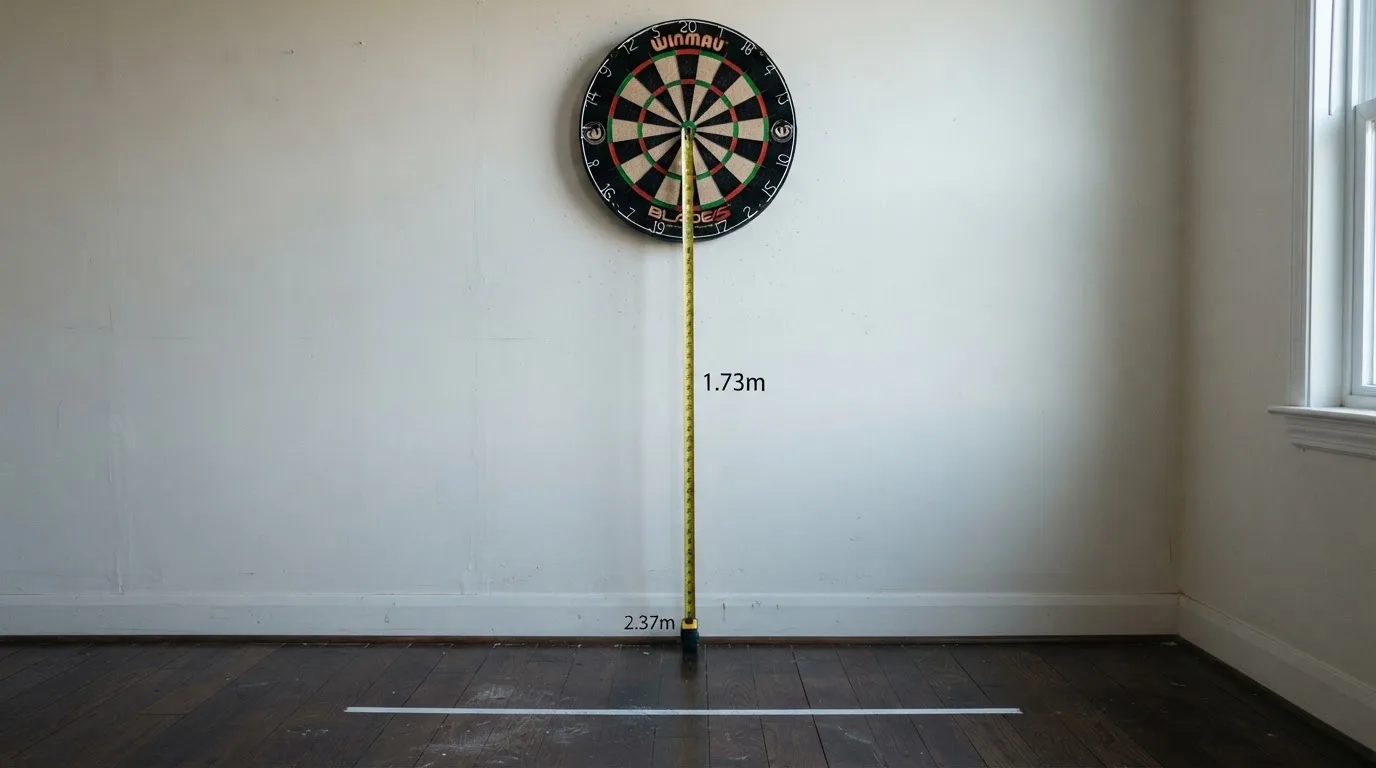
A 501 match starts at 501 and ends on a double or the bullseye (worth 50, with the outer bull worth 25). The highest possible three-dart finish is 170 (treble-20, treble-20, bullseye). The minimum possible leg is nine darts, and a televised nine-darter is a market-moving event in its own right — the in-play market on the player who has just hit a nine-darter will shorten even on a leg they end up losing, because the form signal is independent of the match result. The standard throw distance is 2.37 metres (7 ft 9 in) and the bullseye is 1.73 m above the floor; the geometry is part of the player’s craft and part of the punt’s read, because a player whose stance has changed is a player whose rhythm has changed and whose checkout percentage in the next set is uncertain.
The Premier League, the World Matchplay and the World Grand Prix run on different formats: the World Matchplay is first to 18 legs in a set format; the World Grand Prix starts every leg on a double; the Premier League uses a group stage followed by a knockout. A punter who backs a player on the outright market has to understand the format that tournament uses, because the player who thrives in the World Championship’s long-format sets is not always the player who thrives in the World Grand Prix’s double-in format. The bookmaker’s pricing model on each format is different; the value bet in one is not the value bet in another.
The Bookmaker’s Margin: How to Read It in the Odds
A bookmaker’s margin is the share of every pound wagered on a market that the bookmaker keeps in the long run, regardless of who wins. It is not a fee and it is not a commission; it is the difference between the sum of the implied probabilities of all outcomes (which is over 100% by design) and 100%. A market with a 5% margin returns 95p to punters in the long run and keeps 5p. A market with a 10% margin returns 90p and keeps 10p. The bookmaker’s margin is the cost of betting, before the punter’s own skill is taken into account.
The arithmetic on a two-way market at 1.90 / 1.90 runs as follows. The implied probability of each outcome is 1/1.90 = 52.63%. The sum of the two implied probabilities is 105.26%. The payout share — what the bookmaker returns to punters — is 1 ÷ (1/1.90 + 1/1.90) = 1 ÷ 1.0526 = 0.95, or 95%. The margin is 1 − 0.95 = 0.05, or 5%. Stated as a percentage the bookmaker keeps 5p of every £1 wagered across the market in the long run. The same arithmetic on a three-way market (Player A / Draw / Player B in a soccer match, which is roughly the structure of a darts match on the match winner market with a draw option) runs the same way with three outcomes.
The odds do not have to be the same on both sides for this to work. Take a market at 1.60 / 2.50 (decimal). The implied probabilities are 62.5% and 40%. The sum is 102.5%. The payout share is 1 ÷ (1/1.60 + 1/2.50) = 1 ÷ 1.025 = 0.9756, or 97.56%. The margin is 2.44%. A punter reading the odds on this market can see the margin in the gap between the sum of implied probabilities and 100% — a market where the sum is 102.5% has a 2.5% margin, a market where the sum is 110% has a 10% margin, and a market where the sum is 105% has a 5% margin. The punter who reads the implied probabilities before placing a bet is reading the margin.
The margin varies by market, by event and by bookmaker. Match Winner on a televised darts final sits at 4-6% before the event; the handicap market sits at 5-7%; the 180s totals market sits at 8-12%; the player prop sits at 8-15%; the outright market sits well into double digits because the field is wide. In-play margins tend to be a touch tighter than pre-match margins because the bookmaker’s pricing is more reactive and the sharp money is more present. Price boosts — a temporarily raised price on a specific outcome — are a marketing device that may or may not move the margin; a price boost on the favourite from 1.80 to 2.00 lowers the margin on that outcome but does not lower the margin on the other outcome, and the overall market margin stays roughly the same.
The cost to the punter is the compounded cost over many bets. A punter placing 100 bets a year at an average 6% margin loses £6 of every £100 wagered to the margin in the long run, before any individual bet’s outcome is considered. A punter placing 100 bets at a 10% margin loses £10 of every £100. A punter placing 100 bets at a 4% margin loses £4 of every £100. The difference between 4% and 10% on a £1,000 yearly turnover is £60, which is the price of choosing bookmakers and markets without reading the odds. The punter who reads the odds before placing a bet is paying less for the privilege of betting than the punter who does not.
The Top UK Bookmakers for Darts
The brands below are the ten operators on the Gambling Commission’s public register against a remote general betting standard (real events) licence, and each was checked against the register rather than against a marketing claim. The licence number and the licence holder are listed for each brand so a reader can verify the licence on the register. The order is a set order and is not a ranking of best to worst; each brand has its place, and the place a brand fits a particular reader is the verdict at the bottom of each block. The brand-by-brand cost a darts punter actually pays is on the margins, the in-play depth, the bet-builder functionality, the bonus structure and the safer-gambling tools — and the section below is built around those five.
The table below sets out the licence position and the brand’s own terms on the in-play and bet-builder depth that defines whether the bookmaker is worth opening an account with for darts in particular. The cells use no-data markers where research does not give a fact; they are not gaps to be filled by guesswork.
| Brand | Gambling Commission licence | In-play and bet-builder depth on darts |
|---|---|---|
| Paddy Power | Account 39439, held by PPB Counterparty Services Limited | Bet Builder+ with Popular Bet Builders, Super Sub for player substitution, expanded Win More markets, player and acca stats |
| Betmaster | Account 65699, held by BM Solutions GB Ltd | Darts book carried; in-play and bet-builder depth not separately stated |
| BetGoodwin | Account 2927, held by Goodwin Racing Limited | Best Odds Guaranteed on UK and Irish horse and greyhound racing only (up to £1,000) |
| Sporting Index | Account 27343, held by Sporting Index Limited | New-customer offer: £10 fixed-odds qualifying bet at minimum odds of 1/2 unlocks three £10 free bets, three £5 Total Goals spread bets, three £5 Winning Favourites spread bets and a £1 Race Index spread bet; qualifying bet cannot be placed in play or cashed out |
| LiveScore Bet | Account 56859, held by LiveScore Betting and Gaming (Gibraltar) Limited | Standard in-play menu on televised darts |
| Midnite | Account 101839, held by Midnite Limited | In-play events listed on home page; acca builder and price boosts with stated maximum-stake limits |
| DAZN Bet | Account 48756, held by DZBT Limited | Darts book carried; in-play and bet-builder depth not separately stated |
| Lottoland | Account 38991, held by EU Lotto Limited | Casino, lottery betting, sports betting and scratchcards in one app |
| Fitzwilliam Sports | Account 48760, held by SBKI Limited | Phone and live chat with the office open 09:00 to 21:00, Monday to Sunday; messenger replies generally within 90 seconds |
| William Hill | Account 39225, held by WHG (International) Limited | Best Odds Guaranteed on UK and Irish horse racing from 8 AM on the day of the race; standard in-play menu on televised darts |
The terms behind each licence line are not uniform, and the brand-by-brand review below picks out the difference.
Paddy Power
Paddy Power’s app carries the deepest darts bet-builder in the market on a televised event: Bet Builder+ combines match markets with player props and 180s markets, Super Sub rolls a player-prop over to the substitute if the named player withdraws, and the popular-bet-builders tab shows the market’s preferred combinations. Paddy Power’s safer-gambling tools include deposit limits, time-out, self-exclusion and GAMSTOP registration, and the marketing is constrained by the standard LCCP conditions. The welcome offer rotates; the current figure should be checked on Paddy Power’s site before claiming. The drawback on a brand this size is the margin on a small televised event — a Challenge Tour or a floor match without a TV deal — which is wider than the margin on a televised Premier League night, because the model is less reactive to lower-tier fields. The verdict: the right choice for a punter who backs combinations and player props on televised PDC events, less so for a punter who only bets the Match Winner.
Betmaster
Betmaster carries the standard remote general betting standard (real events) menu and is operated by BM Solutions GB Ltd, a Malta-registered company. The brand’s darts book on televised events runs Match Winner, set betting, 180s totals and a player-prop menu; depth on the floor events is thinner than on the televised ones, which is the standard pattern. Safer-gambling tools include deposit limits, time-out and self-exclusion. The drawback is depth on the bet-builder side — research does not separately state a bet-builder product, and a punter who plans to bet-build should check the menu on a specific match before signing up. The verdict: a viable second account on televised darts for a punter who already has a primary bookmaker, useful for cross-checking prices rather than for bet-building.
BetGoodwin
BetGoodwin’s signature is Best Odds Guaranteed on all UK and Irish horse and greyhound racing, up to £1,000, which is a horseracing product rather than a darts product and is mentioned because a reader who follows both sports has a question about whether BetGoodwin is the right bookmaker on the second sport. On darts the book is the standard Match Winner, handicap and outright menu. The drawback is that the bet-builder and in-play depth are not separately stated, and the brand’s centre of gravity is racing rather than darts. The verdict: a punter who follows racing and darts should consider BetGoodwin for the racing side and a different bookmaker for the darts side; a punter who follows darts alone should pick elsewhere.
Sporting Index
Sporting Index is unusual in this list because it is a spread-betting operator running a fixed-odds sportsbook on the same licence. The new-customer offer is fixed-odds: a £10 fixed-odds qualifying bet at minimum odds of 1/2 unlocks three £10 fixed-odds free bets, three £5 Total Goals spread bets, three £5 Winning Favourites spread bets and a £1 Race Index spread bet, and the qualifying bet cannot be placed in play or cashed out. A punter claiming the offer with a darts bet is using the fixed-odds sportsbook, not the spread product, and the offer structure is worth noting because the spread elements (Total Goals, Winning Favourites, Race Index) sit outside darts. The drawback is that Sporting Index’s centre of gravity is football and racing; darts depth is thinner than Paddy Power or William Hill. The verdict: a bookmaker worth knowing for the fixed-odds free bets and the spread product on football and racing, less so for a darts-only punter.
LiveScore Bet
LiveScore Bet is a fixed-odds sportsbook running a standard in-play menu on televised darts, with payment methods including debit cards (Visa and Mastercard), Apple Pay, PayPal, Pay by Bank (Open Banking) and Revolut Pay. The brand’s strength is the live score integration: a punter who watches the LiveScore app can move between scores and markets without leaving the product. The drawback is that the bet-builder depth on darts is not separately stated and the welcome offer rotates; a punter should check the current offer on the site before claiming. The verdict: a solid third account for a punter who values the live score integration and wants a clean in-play book on televised darts.
Midnite
Midnite is the smaller operator in this list and the one with the clearest marketing line: a modern app, a sports and casino product, and a stated welcome offer of £25 in free bets and 50 free spins after a £5+ qualifying bet at minimum odds of 1/1 (decimal 2.00) within 14 days, valid for 7 days. The in-play menu on darts is on the home page; the acca builder and price boosts carry stated maximum-stake limits. The drawback is that the book on lower-tier events is thinner than Paddy Power or William Hill, and the welcome offer’s 7-day window on the free bets is the kind of condition that bites a punter who places the qualifying bet and forgets to use the free bets inside a week. The verdict: the right choice for a punter who wants a clean modern app on televised darts and reads the small print on the free-bet window.
DAZN Bet
DAZN Bet is the sports-betting product of the DAZN sports broadcaster, and the deposit menu starts at £5 by debit card, Apple Pay, Paysafecard, Trustly and Skrill, and at £20 by PayPal, with no processing fees. The brand carries a standard Match Winner, handicap and 180s market on televised darts. The drawback is that the bet-builder and in-play depth on darts are not separately stated and the brand’s centre of gravity is football. The verdict: a viable second account on televised darts for a punter who values the deposit menu and wants a clean fixed-odds book, useful for cross-checking prices rather than for bet-building.
Lottoland
Lottoland is unusual in this list because it is primarily a lottery-betting operator that has added a sportsbook and casino to its app. The welcome product is lottery-led, and the darts book on televised events is a standard menu rather than a deep one. Safer-gambling tools are the standard remote operator set: deposit limits, time-out, self-exclusion and GAMSTOP. The drawback is depth: a punter looking for a deep darts book with a bet-builder and player-prop menu will not find it at Lottoland. The verdict: a brand worth knowing for the lottery-betting product rather than for the darts book, and a punter who follows both should treat Lottoland as a lottery product first and a darts book second.
Fitzwilliam Sports
Fitzwilliam Sports is an Irish bookmaker with a UK remote licence and a contact-led service model: phone and live chat with the office open 09:00 to 21:00, Monday to Sunday, and messenger replies generally within 90 seconds. The darts book on televised events is a standard menu; the bet-builder and in-play depth are not separately stated. The drawback is the smaller menu compared with Paddy Power or William Hill and the absence of a stated welcome offer in research. The verdict: a brand worth knowing for the phone-and-live-chat service model and the personal account handling; less so for a punter who wants a self-service modern app and a deep bet-builder.
William Hill
William Hill is the longest-established name on the list and the one with the deepest high-street legacy. The online product carries the standard Match Winner, handicap and 180s menu on televised darts, and Best Odds Guaranteed on UK and Irish horse racing from 8 AM on the day of the race — single and multiple bets, no ante-post, tote or pari-mutuel — is the marquee product. The drawback on a brand this size is the same as Paddy Power: the margin on lower-tier events is wider than on televised Premier League nights. The verdict: the right choice for a punter who values the brand’s longevity, the racing product and a standard in-play book on televised darts.
The Core Picture
A darts betting tip is a price, not a name. The work behind the price is the bookmaker’s margin taken out, the punter’s probability estimate put in, and the gap between the two taken as the edge. Where the edge is positive, the bet is worth staking; where it is not, the bet is a donation to the bookmaker. The cost of the bet is the compounded cost of the margin over many bets, and the difference between a 4% margin and a 10% margin on a £1,000 yearly turnover is £60 — the price of choosing bookmakers and markets without reading the odds.
The bookmakers reviewed above are the licensed GB operators on the Commission’s register against a remote general betting standard (real events) licence, and each was checked against the register rather than against a marketing claim. A place in this list is not a recommendation to sign up; it is a statement that the brand is licensed to take a bet from a customer in Great Britain. The licence is the floor, not the ceiling. The ceiling is the punter’s own discipline on bankroll, the punter’s own estimate of the price and the punter’s own willingness to walk away from a bet that does not clear the edge.
The deeper point is that no tip is ever certain and betting is no income. A tip that promises a winner is a guess dressed in numbers; a tip that names the price, the implied probability, the edge and the stake is a betting decision. The punter who learns the difference is the punter who survives the long run.
Frequently Asked Questions
How do you bet on darts?
A darts bet is placed through a bookmaker licensed by the Gambling Commission for customers in Great Britain. Open an account, verify name, address and date of birth, deposit by debit card or another accepted payment method, navigate to the darts event, pick a market (Match Winner, handicap, 180s, outright or bet builder), enter the stake and confirm the price. The bet settles when the match ends; in-play bets settle as the match progresses and can be cashed out early at a price derived from the current state.
What is darts betting?
Darts betting is wagering on the outcome of a darts match or on a market within it. The common markets are Match Winner, set or leg handicap, total 180s, highest checkout, player to hit the most 180s, tournament outright winner, and bet builders combining two or more markets from the same match. The bookmaker sets the odds on each market, the odds contain a margin, and the punter’s decision is whether the implied probability at the quoted odds is below the punter’s own estimate.
How does darts handicap betting work?
A handicap evens out a mismatch. A -1.5 sets handicap on the favourite in a best-of-7 match means the favourite has to win 4-0; a 7 vs Player B; the outsider has to win at least one set for a +1.5 handicap bet to land. The handicap stretches or compresses the price on each side without changing the match format, and the margin on a handicap market is similar to the margin on the Match Winner market.
What is a value bet and why is no tip ever certain?
A value bet is a price at which the punter’s own probability estimate is higher than the implied probability at the quoted odds. On a market at 1.90 / 1.90 (decimal), the implied probability of each outcome is about 53%; a punter who estimates the true probability at 55% has a value bet. No tip is ever certain because the outcome of a sporting event is uncertain; the edge is statistical, not guaranteed, and the punter’s discipline is to place bets only where the edge exists and to accept losing bets as the cost of being in the market.
What is the bookmaker’s margin and how can it be seen in the odds?
The bookmaker’s margin is the share of every pound wagered on a market that the bookmaker keeps in the long run. It is derived from the gap between the sum of the implied probabilities of all outcomes and 100%. On a market at 1.90 / 1.90, the implied probabilities are 52.63% on each side, the sum is 105.26%, an overround of 5.26%, and the margin is 5.0%. The wider the gap above 100%, the higher the margin and the more the punter is paying for the privilege of betting on that market.
How is the return on a bet worked out from the stake and the odds?
The return is the stake multiplied by the decimal odds; the profit is the stake multiplied by (odds minus 1). A £10 stake at decimal odds of 2.50 returns £25 (£10 × 2.50) and shows a profit of £15 (£10 × 1.50). For a combination bet the odds of the legs multiply into one combined price, and the return is the stake multiplied by the combined price. The return is what a winning bet pays back; it is not a forecast of whether the bet will win.
Tennis, darts & cue sports – Darts betting
Content created by the «Darts betting» team
