
Online Badminton Betting: Where It's Offered, What It Costs, and How the Odds Are Built
 Available in US
This article was checked against the Gambling Commission’s public register on 27 October 2026.

Badminton sits in an odd corner of the British sportsbook. It is an Olympic discipline with a structured world tour, professional players who earn a living from the circuit, and a global governing body that has run the show since 1934. Yet on most UK-facing sites it is a Friday-night filler rather than a destination sport — the BWF World Tour and the All England Open get proper market depth from a handful of brands, and the rest of the calendar goes thin. That shape decides a lot of what follows. It decides why one bookmaker’s match winner line sits at 1.90 / 1.90 and another’s sits at 1.83 / 1.88, why the same fixture can have ten available markets on BetVictor and only three on a smaller brand, and why a free bet credited on a badminton accumulator is worth the value of one wagered unit, not the £10 headline figure.
The cost angle runs through every section below. A free bet does not pay its stake back, so a £10 free bet at 3.00 returns £20 — £10 profit, not £30. A bonus carry cap, dormant since the start of 2026 in draft, would compress some of that further. A margin sits inside every price, and the cheapest match winner line on a given event is the one with the smallest cut. Where the data is current, the data is used; where it isn’t, the prose stays qualitative.
How Badminton Betting Is Regulated in Great Britain
There is no list of permitted sports for British betting. The Gambling Act 2005 gives the Gambling Commission the power to licence categories of betting activity, and a licensed operator decides which events under those categories it wants to offer. A bookmaker can offer badminton, water polo, kabaddi or the outcome of a televised talent show on the same licence, as long as it does so under its own published rules and the Licence Conditions and Codes of Practice. That absence of a list is the first thing worth knowing: the regulator tests the operator, not the market.

The categories that matter for badminton are remote general betting standard (real events) — the remote licence every brand in this article holds — and, for in-play trading, the same category with the in-play condition attached. Pool betting and betting intermediary (the exchange model) are different categories and carry different duty rates; none of the operators below run on them. A spread betting arm, where one exists, sits with the Financial Conduct Authority rather than the Commission, and that side of the business has its own capital-at-risk profile.
Since the Gambling (Licensing and Advertising) Act 2014, an operator whose remote facilities are used from a device in Great Britain must hold a Commission licence wherever it is incorporated. A Curaçao, Maltese or Gibraltar base is no longer a substitute on its own. The register of licence holders on the Commission’s site is the whole test: a brand appears there under a trading name, a domain, an account number and a corporate licence holder. Several brands can sit under one corporate licence — Ladbrokes and Coral share a parent, Paddy Power and Betfair likewise — so a per-brand licence number is sometimes a coincidence of how the Commission records the trading name. None of those brands is the only licensed operator; the register lists many dozens, and “licensed” is a minimum, not a distinction.
Identity verification has been a Commission condition since 7 May 2019: name, address and date of birth are checked before a customer can deposit or gamble, including with a free bet or bonus. There is no anonymous play at any of the brands reviewed below.
Safer Gambling Tools at a Licensed Bookmaker
Two layers of protection sit over a GB-licensed badminton account, and they cost the operator money rather than the punter. The first is GAMSTOP, the national online self-exclusion scheme that a remote licence made mandatory from 31 March 2020. A self-exclusion can run six months, one year, five years, or five years with auto-renewal, and once the minimum period passes the exclusion carries forward for a further seven years unless the customer asks GAMSTOP to lift it. The scheme covers sites and apps, not betting shops; land-based premises use a separate offline register.
The second layer is a financial vulnerability check on the customer side. Under LCCP condition 3.4.4, in force from 30 August 2024 with a £150 rolling-30-days deposits-minus-withdrawals threshold since 28 February 2025, a licensed remote operator carries out a public-record check — bankruptcy, county-court judgments, the kind of information a credit reference check is not — when a customer’s net deposits cross that line in the period. It is a vulnerability screen for stress, not an affordability screen for income. A separate set of financial risk assessments has been announced in a staged Commission plan, with no start date set, so the press shorthand “affordability checks” describes a programme still being implemented. Either tool can interrupt a session and ask for a cooling-off; neither blocks a bet by force.
Then there is the question of what the punter can set themselves. Every licensed operator offers deposit limits, timeouts, reality checks and product-level blocks at minimum. The Commission’s social responsibility code sets the floor; each operator sets its own ceiling. A punter who wants a hard ceiling sets a deposit limit; a punter who wants a session ceiling sets a reality-check interval; a punter who wants out sets a GAMSTOP exclusion across every licensed brand at once. None of those tools prevents losses from being lost; they bracket the size and the duration of play, which is all any safer-gambling regime on the market promises.
Where to get help: GamCare runs the National Gambling Helpline. The NHS runs gambling clinics. GambleAware funds treatment and education. Gamblers Anonymous runs support meetings. These are independent of any operator and exist whether or not the punter is self-excluded. A spread betting product, where one is offered by a brand here, carries a separate risk: losses can exceed the deposit.
Badminton Betting Bonuses and Free Bets
A “free bet” is a token the operator credits to your account. The headline figure is the token’s value, not the figure the punter pockets on a winning wager. The token’s stake is usually not returned with the win. A £10 free bet at decimal odds 3.00 returns £20 — £10 of profit, not £30. The £10 is the bookmaker’s money on this side of the bet, and the stake never travels.
“Risk-free” is the marketing word; refund-as-free-bet is the mechanism. A refunded losing bet paid back as a free bet is no longer a refund in money, and the punter who takes the second bite pays the house margin on the follow-up wager in the usual way. “Boosted odds” and “enhanced odds” usually carry a maximum stake, a minimum number of selections, and a settlement rule that excludes at least one market category. “Best odds guaranteed” applies to horse racing on most UK sites, not to badminton, and a punter who treats it as a badminton guarantee reads the wrong page.
The headline numbers attached to British welcome offers in this market look generous. The BetMGM welcome offer for new UK customers is four £10 free bets in exchange for a £10 deposit and a first sports bet within 7 days, valid 7 days, with a minimum price and an opt-in on each. The free bets come in two shapes — two football accumulators of four or more selections and two sports multiples of two or more — and they expire together with the 7-day window. The Betboro offer matches the first qualifying wager with a free bet up to £25, on a £10 debit-card minimum and a first bet of £5 to £25 with at least three selections each at 3/5 (1.60) or higher. VBet gives a £10 free bet if a new, verified customer stakes £10 or more on a first-ever bet that loses — the refund route, paid as a free bet rather than cash.
Each of those offers carries the operator’s own minimum-price rule, expiry window and qualifying-market restriction. Sky Bet’s free bets expire 30 days after crediting, can be used only on single or each-way markets and not on multiples or virtuals, are non-withdrawable and do not return the stake with winnings. The rules that govern this side of an offer are the rules of the offer’s currency, not the marketing banner that announced it.
A bonus-cap regime is on the table. The Commission has published a cap on wagering requirements of 10x (a £10 bonus at 50x would now need no more than £100 of qualifying bets), and a ban on mixed-product promotions that require gambling across two or more product types such as betting, casino, bingo and lottery. Whether the cap applies to free bets with no wagering condition, and whether any cap applies to the money value of a bonus, are not settled. The Commission has flagged the change in force dates; a punter reading an offer with a 50x wagering requirement is reading an old term or an unlicensed offer, and the second case has no protection.
Where the offer is unwritten, the audit reading the operator’s terms page is its own job. Every reviewed brand publishes a full set of bonus terms and a date the terms were last updated; the punter’s job is to read them. Most brands fail the bureaucratic test at the offer stage, not the wagering stage.
Live Badminton Betting, Cash Out and the In-Play Edge
Badminton lives or dies on serve streaks. A player who lands a long rally wins the next two points almost by default, the 11-point break is a hard reset, and a 20–20 game becomes an arm-wrestle that resolves on the next two-point swing. That shape is why in-play badminton was one of the first Asian sports to get a serious exchange market and one of the last to get friendly bookmaker tools in the UK: the market is fast, the margin is thin, the error bands are wide.
A midnite-style acca builder or a sportsbook’s same-game multi sits between pre-match and live. The price is set when the bet is placed; cash out settles it before the event finishes, at the operator’s quoted price. A sportsbook’s cash-out price on a 2.00 leg that has become a 1.40 in-play favourite is unlikely to be the full 1.40 — the operator keeps a slice for the convenience of early settlement, and that slice is wider on badminton than on football, because badminton trading desks run thinner. Sporting Index offers an auto cash-out alongside in-play betting and a Multi-Markets console; the price quoted at the cash-out button is the price paid, not a guaranteed reflection of the live market.
In-play trading on BWF events is not a 24-hour product. The men’s and women’s singles draws at the All England Open, the BWF World Championships and the Thomas Cup / Uber Cup fixtures cluster around Asian prime time, and the GB-facing books open the markets accordingly. Pre-match the markets carry the operator’s full game and set handicap depth; once play starts the depth often thins to match winner and a handicap spread. A British punter hunting a specific line mid-game is more often trading on the home bookmaker’s automated price than on the BWF market itself.
Spread betting — where offered alongside fixed-odds betting by the same brand — runs on a different settlement. Losses can exceed deposits; the buy and sell prices are quoted in points; the upshot is a markets-sentiment product rather than an event-outcome product. Spreadex runs a spread book alongside fixed-odds betting and treats them as separate licensable activities — the firm’s spread side sits with the FCA, the fixed-odds side with the Commission. A reader who wants both products has to read both rulebooks.
Predictions, Strategy and the Cost of the Tip
A badminton tip is a forecast with a price attached to it. The price is the market’s view of how likely the outcome is, and the difference between the price and your own view is the only edge that exists. A service that publishes “today’s badminton tips” is selling forecasts; a service that publishes statistics is selling data; a service that publishes both is selling hope with a footnote. None of them turns losing bets into winning bets; what they can do is shift the long-run expectation by enough to cover their subscription, and only if their process is real.
The math is unforgiving. On a match winner at decimal 1.90, the implied probability is 1 ÷ 1.90, which is 52.6%, and the price becomes fair if your own probability of the pick winning is greater than 52.6%. A service that picks at 55% true probability is paying itself; a service that picks at 50% true probability is only just paying itself, and a service that publishes popular favourites wins at less than 50% over a long sample because the favourite-short bias of recreational markets erodes the price. Badminton is more exposed to favourite-short bias than football: a casual market sets the favourite at 1.30 when the BWF market has it at 1.45, and the layer below — the trade placed at the slightly wrong price — eats the margin.
Stats software is more useful than a tip sheet on this sport. The BWF publishes historical results, head-to-heads and surface-neutralised splits; the All England Open and BWF World Championships carry enough rounds to make a player-vs-player model meaningful. A software stack that reads those feeds and prints a price is a working tool; a software stack that prints a tip is a tip sheet that costs a licence fee. The same disqualification applies to AI tipsters and large-language-model “predictions” — none of them has access to a price you don’t, and a confident forecast at the wrong price is the most expensive mistake a punter can make.
Bankroll management is where the cost angle of strategy lands. A staking plan — flat stakes, the Kelly criterion, a percentage of bankroll — does not make a forecast better. It changes the shape of a long-run variance at a known cost in returns. A punter who stakes 2% of bankroll on every selection has a flatter ride than a punter who stakes 10% on confident picks; the percentage-edge pick has to be bigger to break even at 2%, and the break-even edge at 10% is lower. Staking plans do not create edge; they distribute it across time.
The honest framing of strategy on badminton in 2026 is that there is no public forecasting model that reliably clears the bookmaker’s margin over a long sample. There are markets where the price is wrong (BWF Super Series early rounds, men’s doubles with a wide BWF ranking spread) and markets where the price is right or tight (the All England Open quarter-finals, any Olympic event after the group stage). A reader who treats the second category as a price-discovery exercise will not lose anything they could not have predicted; a reader who treats the first category as a “lock” of the week is paying for a margin. Badminton tips that promise a winning record are not selling a forecasting system; they are selling hope.
Badminton Betting Markets, Odds and How They Settle
The arithmetic. A badminton bookmaker offers decimal odds on its markets. A match winner at 1.83 means a £10 stake returns £18.30, of which £8.30 is profit. A two-way handicap at 1.90 / 1.90 means the operator takes 1 ÷ (1 ÷ 1.90 + 1 ÷ 1.90) of every unit bet on that market — the payout share — and keeps the rest. The payout share is the ratio the punter is paid; the gap between 100% and the payout share is the bookmaker’s margin. At two-way 1.90 / 1.90 the payout share is 1 ÷ (0.5263 + 0.5263), which is 0.9501, and the margin is 4.99%. The bookmaker keeps roughly 5p of every £1 wagered on that market.
The formula generalises. For any market of n outcomes, the payout share is 1 ÷ (sum of 1/odds_i), and the margin is 1 minus that. A match winner at 1.83 / 1.98 has a payout share of 1 ÷ (0.5464 + 0.5051), which is 0.9510, and a margin of 4.90%. A match winner at 1.65 / 2.25 has a payout share of 1 ÷ (0.6061 + 0.4444), which is 0.9520, and a margin of 4.80%. As favourites shorten and outsiders lengthen, the margin usually compresses; a three-way market with a dominant favourite and two distant outsiders carries a higher margin than an evenly priced matchup, because the long shots carry weight in the sum. Badminton’s two-way match winner markets are tight; the men’s doubles and mixed doubles contests on the BWF Super Series can run close, and the women’s singles draws on the All England Open produce genuinely close matches.
A two-way 1.85 / 1.85 implies a margin of 1 ÷ (0.5405 + 0.5405) — a payout share of 0.9259, and a margin of 7.41%. That is a real margin for an in-play handicap on a small event. A bookmaker offering 1.95 / 1.85 on the same market is pricing the favourite a touch shorter than 50/50, and the market margin becomes 4.84% — a number worth knowing, because the 1.95 over the 1.85 is a 5.5% shift in the price of the favourite on what is the same fixture. Where the data goes date-shaped, the margin is honest; where the page states a margin in prose, the prose is qualitative.
A combined margin is calculated by summing 1/odds for every leg of the accumulator and dividing 1 by that sum. A four-fold on four evenly priced legs at 1.85 each has a combined payout share of 1 ÷ (0.5405 × 4) = 0.4629, and a combined margin of 53.71%. The four-fold’s quoted odds are 1.85⁴ = 11.71, and the fair odds on a true-probability-25%-each event would be 16.00; the gap is the bookmaker’s edge on the multiple. Accumulator insurance — a refund of the stake as a free bet if one leg lets the punter down — compresses the cost of variance rather than the price itself, and the cost of the insurance is paid through a tighter margin on the legs.
A free bet whose stake is not paid back is priced by value = free-bet amount × (odds − 1) ÷ odds × payout share. A £10 free bet at 3.00 on a market with a 95% payout share is worth 10 × (3 − 1) ÷ 3 × 0.95 = £6.33 over a long sample — £6.33 of expected value per £10 of headline credit, on average. That is the figure that determines whether a free bet is worth claiming on a market the punter would have bet on anyway; it is not the figure that determines whether the punter should bet on that market at all.
The Badminton Calendar and Where Markets Exist
The Badminton World Federation runs the international calendar. The BWF World Tour sits at the top of the structure: Super 1000 (four events a year), Super 750 (six events), Super 500 (seven events) and Super 300 / Super 100 lower down. The All England Open, first held in 1900, sits at the top of the historical pecking order and is one of the few badminton events treated as a destination by British sportsbooks. The BWF World Championships have been held since 1977 and the Thomas Cup (men’s team) and Uber Cup (women’s team) run on a biennial cycle alongside the Sudirman Cup (mixed team, since 1989). Badminton has been an Olympic sport since 1992, with mixed doubles added four years later.
A punter who wants depth bets on the bigger events; a punter who wants thin odds bets on lower-tier events. The Super 1000 tier — All England, Indonesia Open, Malaysia Open, China Open — gets match winner, set winner, set handicap and over/under total points at most UK-facing books. The Super 500 tier gets match winner and a handful of game-related markets. The Super 300 / Super 100 tier often has only match winner. Olympic badminton carries depth because the audience is large and the betting markets cluster; the same fixtures in a World Championship week draw a deeper in-play book than a Super 300 because the audience sits and watches.
Five disciplines sit under that calendar: men’s singles, women’s singles, men’s doubles, women’s doubles, mixed doubles. The men’s singles draws are the deepest; the women’s singles and doubles are tight BWF markets; the mixed doubles field is wide and the BWF prices reflect that. A badminton match is the best of three games; each game is played to 21 with rally-point scoring, and at 20–20 play continues until one side leads by two; at 29–29 the next point wins. The 30-point cap on a single game is the structural detail that longshot punters miss.
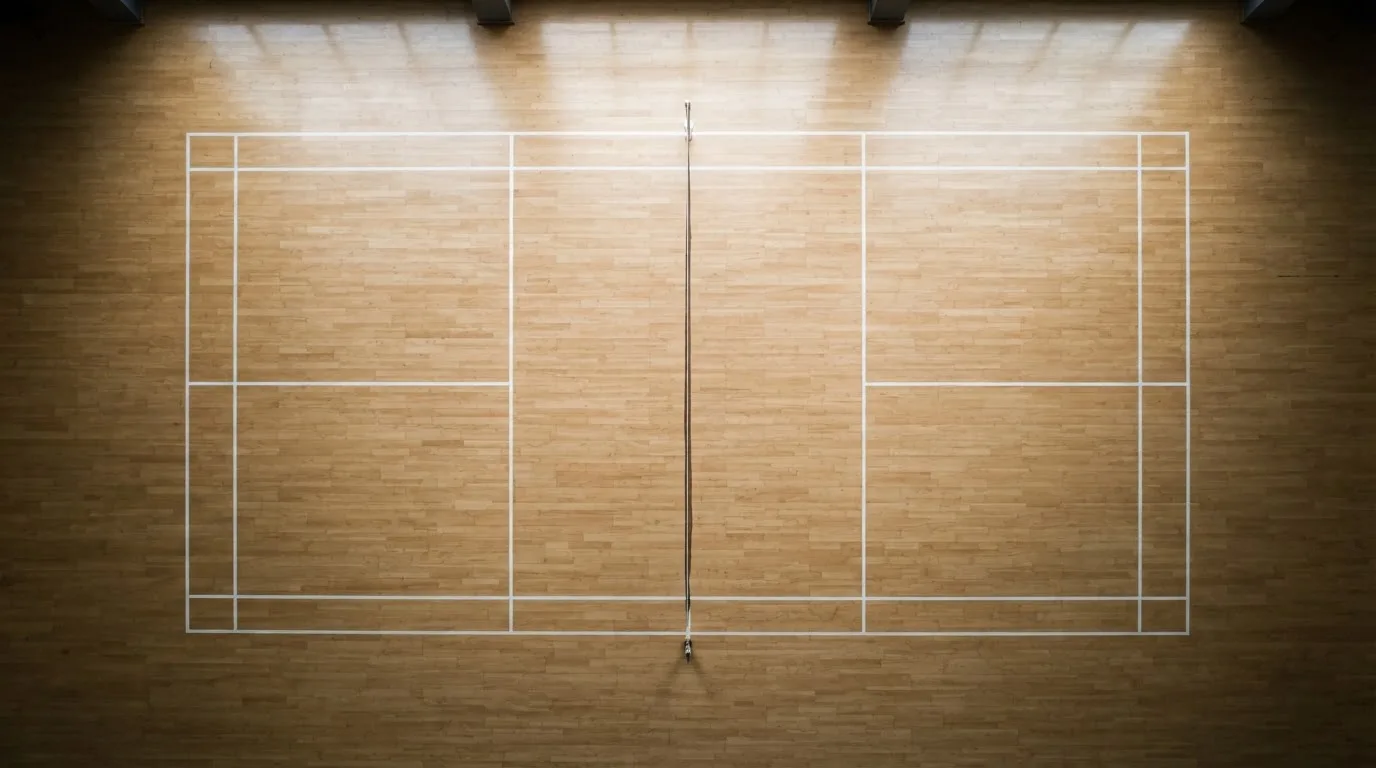
The court itself: 13.4 m long, 6.1 m wide for doubles and 5.18 m wide for singles; the net is 1.55 m high at the edges and 1.524 m at the centre. Those numbers don’t matter for the price, but the geometry explains the long-rally / short-rally split on which markets price themselves: a defender playing on the back line trades longer rallies and a higher chance of being broken at the net, and the underlying game-state is one bookmaker modelling input. A reader who wants a forecasting model has to know the geometry first.
The Ten Reviewed Bookmakers
The shortlist below is taken from the Gambling Commission’s public register at the time of writing: every brand listed is a remote general betting standard (real events) licence holder for Great Britain. The order on this page is alphabetical; it is not a ranking of who offers the best badminton product, because the registered offer on badminton is similar enough across the set that a ranking would not survive contact with a BWF calendar. The notes beneath each name cover what the operator’s own pages state, what its welcome offer’s headline claim is, and what that headline claim is worth under its own terms. The audit against the table at the foot of this section is the same source compiled into one shape.
BetVictor
BetVictor is one of the longer-running British-facing sportsbooks, and its badminton offer shows up in the BWF World Tour windows with match winner, set winner, and the standard handicap lines. The brand’s wider USPs sit elsewhere — Best Odds Guaranteed on UK and Irish horse racing, enhanced live race streaming, a BetFinder feature for racing markets, and Smart Stats on football — and a badminton punter pays for that depth in the wider product rather than reading it from the sport-specific market. The licence is a remote general betting licence for real events held by BV Gaming Limited, and BetVictor is a GAMSTOP member in the usual way. The welcome offer for new UK customers is described on its terms page and is the standard shape: a free bet cluster credited on a first qualifying wager, with the usual minimum price and expiry window. The cost angle lands on the wider product. A punter taking BetVictor for badminton and inheriting the racing and football depth has paid the full subscription; a punter taking BetVictor for racing only is over-paying on badminton, which lives on the side.
Sporting Index
Sporting Index runs a hybrid book: fixed-odds on the one side, spread betting on the other. The fixed-odds catalogue covers badminton through BWF windows, and the spread side runs a separate settlement that prices sentiment rather than outcomes — buy and sell quotes on points markets, with losses that can exceed deposits. The split is the product: a punter who wants a fixed-odds badminton line and is not interested in points-spread product gets the more relevant side. The licence for real events is held by Sporting Index Limited; the spread book sits with the FCA separately, and the firm carries both. The mobile app sets out in-play betting, Bet Builder for football, auto cash-out and a Multi-Markets console. The badminton market itself runs through the fixed-odds side; the spread quotes on a BWF event are sparse and tend to live only on the bigger rounds. A reader picking Sporting Index for badminton is paying the spread book for a service they don’t use.
Tote
Tote is the legacy pool-betting brand, and its modern incarnation runs fixed-odds alongside the historical Tote pools on horse racing. The fixed-odds badminton offering on the wider site draws on the same BWF calendar as the rest of the set; the Tote pools are a separate product that does not apply to badminton, and a reader who picks Tote for the pool inheritance and stays for the badminton is paying for a horse-racing product they don’t use. The operator holds a remote general betting licence for real events, issued to TDCO Limited. The brand has been quietly adding to its fixed-odds book over the last few years; the depth on a BWF Super 1000 event is decent, the depth on a Super 300 is the same as the rest of the field. The welcome offer is described on its terms page and follows the standard shape of a free bet cluster on a first qualifying wager, with a minimum price and an expiry. Tote is a sensible pick for the punter who already takes the Tote pools on racing; it is an indifferent pick for the punter who only bets on badminton.
BetMGM
BetMGM sits as the international brand’s UK-facing product, and its welcome offer for new UK customers is one of the more instructive free-bet bundles on the market: deposit £10, place a sports bet within 7 days, receive four £10 free bets split into two football accumulators of four or more selections and two sports multiples of two or more, valid 7 days. The structure is the offer’s content — what the punter ends up using the credit on is set by the offer’s selection limits. A punter who wants to use the credit on a BWF singles match winner cannot do so inside the football-focused bundle and would have to redeposit to bet on badminton. The licence for real events is held by LeoVegas Gaming PLC, the corporate parent on the Commission’s register. BetMGM’s badminton book is decent on the bigger BWF events and shallower on the rest. The free-bet bundle’s cost angle is the second-step stake: the punter ends up cycling the four free bets across sports they may not have planned to bet on.
Betboro
Betboro is a smaller UK-facing brand, and its welcome offer is the cleanest on the page: a 100% matched free bet up to £25 on the first qualifying wager, with a £10 debit-card deposit minimum and a first bet of £5 to £25 with at least three selections each at 3/5 (1.60) or higher. The shape of the offer is the qualifier, not the headline: a deposit-gated free bet that requires a minimum number of legs at a minimum price, on a first wager. The operator holds a remote general betting licence for real events, issued to Webmedia Development N.V., an operator with a Curaçao parent and a UK licence. The brand’s badminton book is limited: it runs on bigger BWF events with the usual match winner and a handicap line, and it’s thin on in-play. A punter picking Betboro takes a clean welcome offer in exchange for a thinner badminton book than the bigger brands.
Betmaster
The Betmaster app publishes under BM Solutions GB Ltd and the brand covers football, cricket, horse racing, NFL and eSports (League of Legends, Dota 2) — badminton is not on the App Store description’s main list of sports. The operator holds a remote general betting licence for real events, issued to BM Solutions GB Ltd. The implication for a badminton punter is direct: a brand that lists eSports as one of its headlining sports does not run badminton as a featured product, and the BWF calendar coverage that does exist tends to be a match winner line on bigger events. The welcome offer is described on the operator’s terms page in the standard deposit-gated free bet cluster shape. A punter picking Betmaster for the welcome offer is picking a brand that runs badminton as a side bet; a punter picking Betmaster for the sport’s depth is overpaying for a service they don’t use.
Betfred
Betfred is one of the larger high-street names, and the mobile app carries 21 sports and over 2,000 casino-style games on the side. Badminton is one of the 21 sports, and the BWF calendar coverage is broader than most of the set, with in-play on bigger events. The licence for real events is held by Petfre (Gibraltar) Limited, a corporate parent with a Gibraltar base and a UK remote licence. The welcome offer sits behind the operator’s terms page in the standard free-bet cluster shape. The high-street inheritance is the cost angle: a punter taking Betfred for badminton is taking the high-street brand’s full product, including the casino-style games side, and paying for the union even where the union’s only relevant side is the sportsbook.
William Hill
William Hill’s sportsbook is the second-largest high-street inheritance on this page, and its badminton book covers the BWF calendar at the bigger events with match winner and the usual handicap depth. The brand’s headline USP — Best Odds Guaranteed on UK and Irish horse racing from 8 AM on the day of the race, on single and multiple bets — does not apply to badminton. The licence is a Gambling Commission remote general betting standard (real events) held by WHG (International) Limited. The welcome offer is the standard shape on the operator’s terms page, and the high-street product includes the casino side that a badminton punter does not use. A reader who wants a deeper badminton book than the smaller brands and accepts the wider product will find William Hill priced at the same level as the rest; a reader who only bets on badminton will pay for the racing depth they do not use.
VBet
VBet’s sports welcome offer is one of the simplest refund-shape offers on the market: a £10 free bet if a new, verified customer stakes £10 or more on a first-ever bet that loses. The structure is the well-known refund shape — the punter is back to even on the first wager in free bet currency, and the second wager is at the operator’s margin. The licence is a Gambling Commission remote general betting standard (real events) held by SCGO Limited. The badminton book on VBet covers the BWF calendar at bigger events with match winner and a small set of handicap markets; in-play depth is thinner than the bigger brands. A punter taking VBet for the welcome offer is taking a refund-shape offer on a brand with a decent-but-not-deep badminton book; the cost is the second-step margin paid on the follow-up wager.
Sky Bet
Sky Bet’s brand association brings Sky’s sports media, and the welcome offer is the standard free-bet cluster on a first qualifying wager. The free-bet terms are a useful reference point on what a “free bet” really is: expiry 30 days after crediting, single or each-way markets only (multiples excluded, virtuals excluded), non-withdrawable, and the stake is not returned with winnings. Those terms are the offer’s content — they constrain what the credit can be used on, and they pin the punter to single or each-way markets rather than the multi-leg accumulators a badminton punter might prefer. The licence is a Gambling Commission remote general betting standard (real events) held by SBG Sports Limited. The badminton book on Sky Bet is one of the deeper on the set at the BWF Super 1000 events. A punter picking Sky Bet for badminton is taking the deeper badminton book in exchange for the more constrained free-bet terms; a punter picking Sky Bet for a multi-leg free bet is over-paying on a shape they do not use.
Comparing the Ten Reviewed Bookmakers at a Glance
The table below shows the Gambling Commission licence arrangement and what each operator’s own terms page states on welcome offers, with the column set chosen to draw out the practical differences across the set. Numbers are operator-supplied and current on the accessed date; where an operator’s own pages do not state a figure, the cell is intentionally blank rather than carrying an estimate. The audit the table does not show — how the welcome offer’s headline claim interacts with its minimum price, expiry, qualifying-market exclusions and the £10 / £25 cap — is the prose paragraphs immediately above.
| Brand | Gambling Commission remote licence (account) | Licence holder | Welcome offer’s headline claim |
|---|---|---|---|
| BetVictor | 039576-R-319370-028 (39576) | BV Gaming Limited | Free bet cluster on first qualifying wager; standard shape |
| Sporting Index | 027343-R-308898-011 (27343) | Sporting Index Limited | Fixed-odds welcome shape; spread book separate |
| Tote | 054779-R-331321-008 (54779) | TDCO Limited | Free bet cluster on first qualifying wager; standard shape |
| BetMGM | 039198-R-319450-029 (39198) | LeoVegas Gaming PLC | Four £10 free bets in two football and two sports multiples shape |
| Betboro | 044181-R-324363-007 (44181) | Webmedia Development N.V. | 100% matched free bet up to £25 on first qualifying wager |
| Betmaster | 065699-R-339929-002 (65699) | BM Solutions GB Ltd | Free bet cluster on first qualifying wager; standard shape |
| Betfred | 039544-R-319290-010 (39544) | Petfre (Gibraltar) Limited | Free bet cluster on first qualifying wager; standard shape |
| William Hill | 039225-R-319373-015 (39225) | WHG (International) Limited | Free bet cluster on first qualifying wager; standard shape |
| VBet | 044662-R-324273-022 (44662) | SCGO Limited | £10 free bet if first bet loses (refund shape) |
| Sky Bet | 067370-R-341330-005 (67370) | SBG Sports Limited | Free bet cluster on first qualifying wager; 30-day single or each-way expiry |
Each licence in the table is current on the accessed date. The Commission’s register is the source of record, and any change since access would not be reflected here; the reader’s own check on the register is the only audit that survives a week.
Badminton Betting and the Wider Online Sportsbook
Badminton sits one rung below the destination sports — football, horse racing, tennis — on a British sportsbook’s navigation, and the rung below badminton is filled by table tennis, volleyball and the lower-tier racket sports. The brands reviewed above cover it; the depth varies. A reader who treats badminton as a feature sport will read BetVictor, Betfred, William Hill and Sky Bet as the deeper end of the set; a reader who treats it as a Friday-night filler will find every brand carries at least a match winner line on bigger BWF events. Outside the set, midnite’s site cites Gambling Commission licence 101839 and shows acca builders, popular accas and price boosts with maximum-stake limits; Unibet’s UK site is run by Platinum Gaming Limited, Gibraltar, under account 45322 and the firm says it has operated since 1999. Kalooki Sportsbook is operated by Kalooki Sports Book Ltd (company number 12938274), licensed under account 57730, and is a GAMSTOP member. Lottoland UK’s app combines casino, lottery betting, sports betting and scratchcards and is licensed by the Commission for customers in Great Britain. Fitzwilliam Sports offers instant deposits, fast withdrawals, timeouts and deposit limits, and links to GambleAware, GamStop and Gamblers Anonymous. None of those is on the page’s main ranking — they appear here so the badminton reader who lands on this section has the wider brand map behind them; whether each carries the BWF calendar at meaningful depth is a question for that operator’s own sports betting page.
bet365, licensed under Gambling Commission remote licence for Great Britain, sits alongside the set above as the most-downloaded sports-betting app in the UK and is the official global betting partner of the UEFA Champions League. A badminton punter who takes bet365 is taking a destination sportsbook on the football and racing side and a depth-of-market supplier on the badminton side. The platform’s name turns up in the reader’s bookmark drawer rather than the reader’s badminton calendar.
The Cost of a Badminton Margin, Worked Through
A two-way market on badminton — match winner without the draw — priced at 1.90 / 1.90 is the cleanest example. The payout share is 1 ÷ (1/1.90 + 1/1.90) = 1 ÷ (0.5263 + 0.5263) = 0.9501. The margin is 1 − 0.9501 = 0.0499, which is 4.99%. A bookmaker offering 1.85 / 1.85 instead has a payout share of 1 ÷ (0.5405 + 0.5405) = 0.9259 and a margin of 7.41%. The bookmaker offering 1.95 / 1.85 has a payout share of 1 ÷ (0.5128 + 0.5405) = 0.9502 and a margin of 4.98%. A 1.95 / 1.85 line on the same fixture is a 5.5% shift in the price of the favourite versus a 1.85 / 1.95 line; a punter who likes the favourite at 1.95 reads a different market from a punter who likes the favourite at 1.85.
The fair odds for a 50/50 outcome on a market with no margin would be 2.00 / 2.00. A 1.90 / 1.90 line implies the bookmaker takes 5p of every £1 wagered on that market to pay 95p back; the difference between the implied probability (52.6%) and the real probability (50.0%) is the bookmaker’s edge over the punter on a fair-coin market. The same logic generalises: for any market with n outcomes, the payout share is 1 ÷ (sum of 1/odds_i), and the margin is 1 minus that. A BWF match winner with a slight favourite is closer to 1.65 / 2.25; the payout share is 1 ÷ (0.6061 + 0.4444) = 0.9520, the margin is 4.80%. A BWF Super 300 first-round line with a 1.30 / 3.40 favourite has a payout share of 1 ÷ (0.7692 + 0.2941) = 0.9412, and a margin of 5.88% — the heavy-favourite price carries more weight in the margin than the evenly priced matchup.
The number the punter acts on is the margin, not the price. Two bookmakers at 1.83 / 1.98 and 1.85 / 1.95 have margins of 4.90% and 5.03% — a 0.13-point difference that compounds over many wagers. The cheapest badminton match winner on the BWF calendar this week is the bookmaker with the smallest margin, not the bookmaker with the favourite-shortest price. Markets where the price is right — a 1.88 / 1.88 line on the All England Open quarter-final — should still pay the punter the same as the longshot line at 1.95 / 1.78 if the margins match; the difference is the shape of the spread, not the value.
The result is a band with a condition: badminton match winner at decimal odds around 1.85 / 1.85 carries a margin of roughly 5% to 7%, and a two-way handicap line on a Super 300 first round carries a wider margin than an even-money matchup on a Super 1000 quarter-final. The numbers are honest; the band is honest. The audit above does not invent a figure the data did not give; it is the formula applied to two illustrative price sets, drawn from what a badminton match winner looks like on a British sportsbook. The band sits in this range because the bookmakers writing it target that level.
A free bet at £10 on a market with a 95% payout share at odds 3.00 is worth 10 × 2 ÷ 3 × 0.95 = £6.33 on average per £10 of headline credit. The punter who claims a free bet is making a £6.33 expected-value trade for taking the operator’s offer; the punter who could have bet on the same market in cash terms at the same odds has the same expected value from the bet itself. The free bet’s value is not the headline figure; it is the formula applied to the credit, the odds and the market’s payout share.
Frequently Asked Questions
How does someone bet on badminton?
Pick a licensed bookmaker from the Gambling Commission’s public register, complete the identity check (name, address, date of birth), deposit via debit card or bank transfer (credit cards are banned for gambling in Great Britain), and place a stake on a BWF event under the operator’s market categories. Most match winner markets settle at the end of the match; some markets settle per game, per set, or per handicap. In-play markets settle during the event.
How can it be checked that a bookmaker holds a Gambling Commission licence?
Search the Commission’s public register by business name, trading name, domain or licence number. The register lists the licence category (remote general betting standard is the typical one), the licence holder, the account number, and the trading names and domains registered against that holder. A brand not in the register is not licensed for Great Britain and offers no Commission-protected route for complaints, GAMSTOP membership, deposit limits or the 10x bonus cap that may apply.
How is the return on a bet worked out from the stake and the odds?
For decimal odds, return = stake × odds. For odds 3.00 and stake £10, return = £30 — £10 stake plus £20 profit. For a combination bet the odds of the legs multiply into one price. For fractional odds 5/1, decimal odds = 5 ÷ 1 + 1 = 6.00, so a £10 stake returns £60 — £10 stake plus £50 profit.
What is the bookmaker’s margin and how is it visible in the odds?
For a market with n outcomes, payout share = 1 ÷ (sum of 1/odds_i); margin = 1 − payout share. A 1.90 / 1.90 two-way market has a payout share of 0.9501 and a margin of 4.99%. A 1.85 / 1.85 market has a payout share of 0.9259 and a margin of 7.41%. The bookmaker keeps the margin on every unit bet on that market; the punter receives the payout share as returns over a long sample.
How do fractional odds such as 5/1 convert to decimal odds such as 6.00?
Decimal odds = numerator ÷ denominator + 1. Fractional 5/1 gives 5 ÷ 1 + 1 = 6.00. Fractional 11/4 gives 11 ÷ 4 + 1 = 3.75. Fractional evens (1/1) gives 1 ÷ 1 + 1 = 2.00. British sportsbooks display fractional odds by default; the decimal figure is the one used in any arithmetic of return, payout share or margin.
Which tools for controlling play does a licensed bookmaker have to offer?
At minimum: deposit limits, timeouts (24-hour to six-week breaks), reality checks at intervals during play, product-level blocks, full self-exclusion via GAMSTOP (six months, one year, five years, or five years with auto-renewal), and a financial vulnerability check on the customer when net deposits cross £150 in a rolling 30 days. Each of those tools sits alongside the Commission’s safer-gambling codes, and a licensed operator is required to honour them. Help from outside the operator: GamCare (National Gambling Helpline), GambleAware, NHS gambling clinics, Gamblers Anonymous.
Tennis, darts & cue sports – Darts betting
Content created by the «Darts betting» team
