
Tennis Betting Online 2026: Markets, Odds and How the Numbers Are Built
 Available in US
In a market where the rules of tennis are older than the internet but the markets are younger than most bettors, the work for 2026 is not to find a winner — it never is — but to read what a bookmaker is offering and decide whether the price on offer is fair, the licence is real, and the offer’s small print does not cancel its headline. Most readers coming to online tennis betting already know who plays; the part that costs money is everything else around it. This guide covers what the markets look like at licensed UK bookmakers, where the margin hides in the odds, and what to check before staking a penny on the next set of finals.

Current as of 27 October 2026 against the Gambling Commission’s public register and each operator’s stated terms.
Reading Live Tennis Prices Before the Next Point
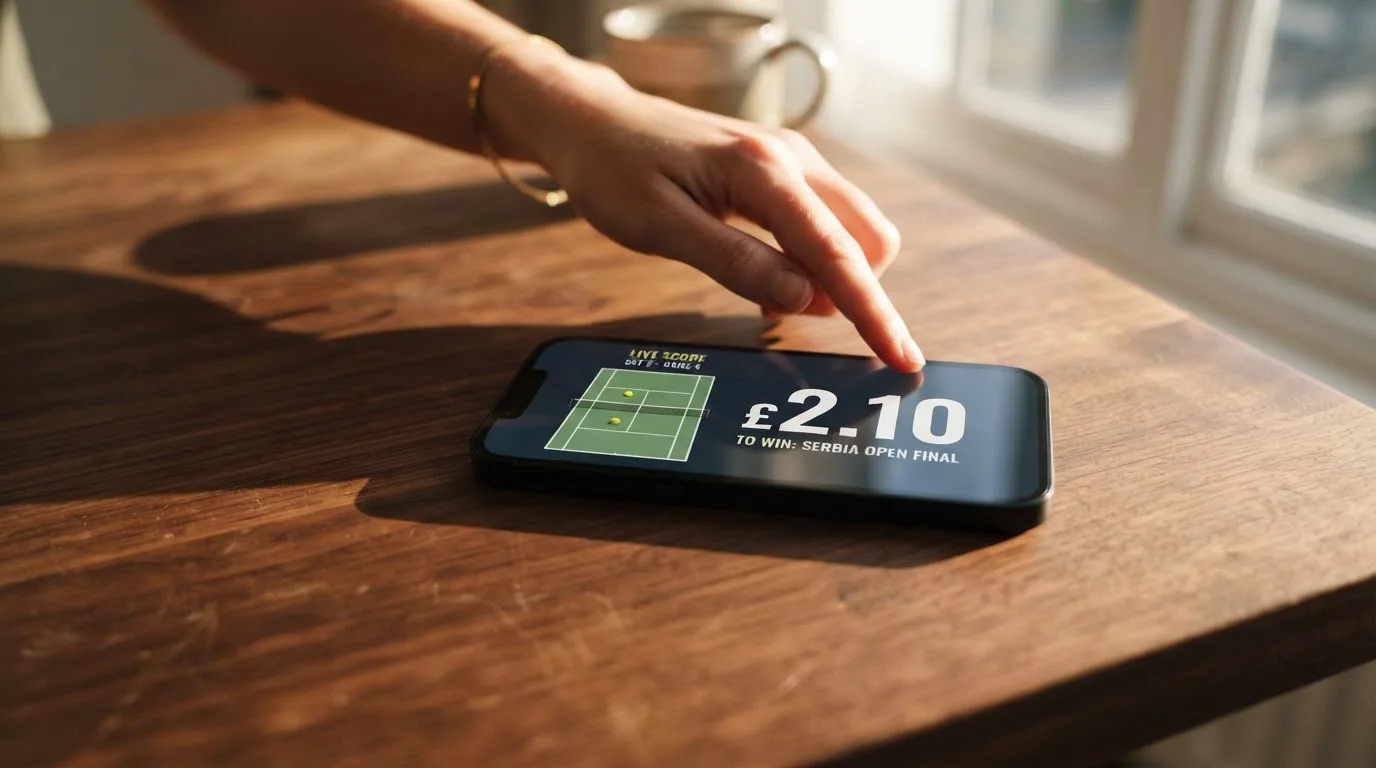
Live tennis betting is where the headline number changes every few seconds, and where a bettor who has not thought about the mechanics pays the price twice — once through the in-play margin, and a second time through the cash-out value the bookmaker offers while the set is still in play. Tennis suits in-play betting unusually well because the action is continuous, the score is granular, and momentum has a visible shape: a break of serve, a tiebreak, a deciding set, a player changing ends. That granularity is exactly why the bookmaker’s margin in-play tends to sit higher than the pre-match margin on the same match.

The available live markets mirror the pre-match menu, but mostly in a tighter form: match winner, set winner, next game, game handicap, total games in the set, and a tiebreak yes/no. Each one settles on something a single point can swing. The bookmaker updates the market through the trading screen a fraction of a second behind the data feed, and what is on offer at any moment is a snapshot rather than a price the bettor can pin.
A tennis match lends itself to live betting for a reason that is not, on its face, a betting reason: momentum in tennis is unusually legible compared with most team sports. A single break of serve in a set is the closest thing tennis has to a goal, and a player who converts one often holds the rest of the set. That pattern is why in-play markets are busy at changeovers rather than during points, and why the market thins on serve: there is little to price. The bookmaker knows the same.
Cash-out attaches to that picture in a particular way. A full cash-out settles the bet at the price offered on screen, locking in a profit if the selection is ahead or cutting the loss if it is behind. A partial cash-out lets the bettor take a fraction of the offered value and leave the rest running. Auto cash-out is the same mechanism on a trigger the bettor sets — a target return, a stop-loss — and it fires when the live price crosses that line. Each of them is a tool the same back-end provides, and what it costs is the gap between the price the feed shows and the price the trader is offering after the bookmaker’s slice. On tennis, where the line moves continuously across long stretches without a point of meaningful action, that gap is where the cash-out edge sits.
Live streaming inside a licensed app is part of the same package for most of the leading brands, and it often hinges on whether the bettor has placed a stake or holds a positive account balance. That is a settled product feature, not a promotional gimmick, but it shifts the comparison: a brand with good live data, low in-play margin and a working cash-out button is a different proposition from one with the same pre-match menu and no live trading desk. The page’s later sections return to which brands do what here, and where each one’s offer actually sits.
What a Tennis Tip Actually Tries to Be
Tennis tips are pitched as predictions. The trade they ask a bettor to make is simple: pay a tipster for the name of the winner, follow the staking plan, beat the bookmaker. That pitch never quite holds up, and the part that never holds up is the part that matters most. A model that picks winners at, say, 55% would, on flat stakes at fair odds, make money — but the price the bettor takes is never fair, because the bookmaker’s margin is in every number. A 55% strike rate at 6/4 (decimal 2.50) sounds impressive until the margin is taken off, at which point it becomes a slowly leaking bankroll. The “system that wins” pitch sells the strike rate and hides the price.
The honest framing is the unfashionable one: a tip is a hypothesis about the price, not about the outcome. The bettor is not paying for a name; they are paying for a reason — a serve stat, a recent injury, a surface transition — that justifies taking the price the bookmaker offers rather than passing on it. Where the tip carries the reasoning, it is a piece of research; where it carries only the name and the price, it is a coupon. Plenty of both circulate under the same word, and the difference between them is the difference between a useful tool and an expensive habit.
Strategy writing on tennis tends to cluster around a few recurring themes: pre-match favourites are easier to back because pricing models have more data; underdogs get more attention in the early rounds of small events; set betting, handicap betting and over/under games prices carry a higher margin and are best treated with caution by anyone whose bankroll does not have a margin of safety. None of these is a winning system, and none of them is sold as such by anyone who has actually run the numbers. The useful strategy is the one that picks a small set of markets, learns the closing line on each, and stakes a fixed percentage of bank on every bet. That is not glamorous. It is the answer to a question that has been asked in finance for longer than tennis has been televised.
A tipster record is verifiable on its own terms but rarely is, in practice, verified. Some publish to independent monitoring services; others simply claim a record without the service. The cost of being wrong on this point falls on the tipster’s subscriber rather than on the tipster, because tipsters charge up front and pay nothing for being wrong. That asymmetry is the single most important fact a tennis tip carries, and the page returns to it under the responsible-gambling heading, because it is the shape the harm to a problem gambler most often takes.
A bankroll size set aside for tennis — small, ringfenced, and topped up only from money the bettor can lose — is the only guardrail that survives a long losing run. Tennis offers no cash-out before the next point, and a bookmaker takes no responsibility for the bettor’s bankroll strategy beyond a deposit limit the customer sets themselves.
What a Tennis Bet Actually Is — and What the Odds Are Saying
A tennis match carries a small number of markets an inexperienced bettor will meet first: match winner, set winner, set score, total games over/under, game handicap, each-way on a tournament winner, and the bet-builder combinations. Each is built on the same underlying scoring structure, and each one carries its own margin. Match winner is the simplest — back one player, settle on the winner — and, on major matches, carries the thinnest margin the bookmaker offers. The other markets exist for two reasons: to give a bettor more ways to express a view, and to give the bookmaker more surface area to take a margin on.
The mechanism at the heart of any tennis market is the conversion of price into implied probability. Decimal odds convert one-to-one into probability: 1.50 means 66.7% (1 ÷ 1.50), 2.00 means 50%, 3.00 means 33.3%. Fractional odds of 6/4 say the same thing in a different notation: a stake of 4 wins 6, plus the stake back. A bookmaker’s margin, sometimes called the overround, is the gap between the implied probabilities of every outcome and 100%. On a match winner priced at 1.80 / 2.00, the implied probabilities are 55.6% + 50.0% = 105.6%; the 5.6% gap is the bookmaker’s margin. On a set score market with three or more outcomes, the gap is similar in shape but harder to read. Tennis markets sit, in the main, between 4% and 8% margin on match winner at major events, and noticeably higher on derivative markets. A bettor who never sees those numbers is paying the margin and never noticing.
Handicap betting is the standard tool for backing a heavy favourite without offering a near-1.01 price. A -1.5 set handicap on a 6/4 favourite says that selection has to win the match by two sets. The price rises because the task is harder, and the margin on the line is usually around 5%. Over/under games in a set — over 9.5, under 9.5 — is a market on how tight the set is; it pays less attention to who wins than to how many service holds there are, and the line tends to be tight. Each-way betting on a tournament winner splits the stake into two bets: one on the player to win, one on the player to reach the final. The second leg carries longer odds and a smaller fraction of the stake by default.
A bet-builder combines a handful of markets from the same match into one price. The legs multiply into a single accumulator, but with a shared match — and the legs almost always exclude the match winner itself, because that would be a different bet. Bet-builders are where tennis betting gets most lucrative for the operator: each leg adds a margin to the line, the assembled price is rarely better than the price a sharp bettor could construct from singles, and the headline looks generous. The product has its uses; the use it does not have is finding value the bookmaker missed.
Settling a tennis bet is mostly straightforward. The umpire’s call on each point is the source of truth, and the markets settle on the result that was on court when the match concluded. Retirements are the standard edge case: most bookmakers void the bet if a player retires before the first set is complete, settle on the score at retirement once play has been meaningful, and decide on a per-market basis otherwise. The operator’s rule on retirements is the kind of term worth finding before a stake goes down, because it is the case where the rules and the bettor’s expectation most often disagree.
Fixtures, Tournaments, and Where Tennis Betting Meets the Calendar
The tennis calendar is built around the four Grand Slams — the Australian Open on hard courts in January, the French Open (Roland-Garros) on red clay in late May and early June, Wimbledon on grass from late June to mid-July, and the US Open on hard courts in late August and early September. Outside the Slams, the tour runs across indoor and outdoor hard courts, clay, and grass, week in and week out, through the men’s ATP and the women’s WTA. The ITF oversees the whole structure. The Davis Cup, the Billie Jean King Cup, the ATP Finals and the WTA Finals sit above the weekly tournaments and feed into the end-of-season rankings.
Wimbledon 2026 was played from 29 June to 12 July 2026. Jannik Sinner beat Alexander Zverev in the men’s final; Linda Noskova beat Karolina Muchova in the women’s final. The grass-court swing that runs through Halle, Queen’s Club and Eastbourne in the weeks before Wimbledon is the busiest two months of the British betting year for tennis, because the surface is short, the fields are small, and the form books built up over clay or hard courts reset quickly.
The rules that govern how the markets settle are short and worth knowing. A tennis game goes 0 (love), 15, 30, 40; the first player to win at least four points with a lead of two takes the game; a tie at 40-40 is deuce, and play continues until one player leads by two. A set is usually won by the first player to six games with a margin of two; at 6-6 a tiebreak is played, first to seven points with a two-point lead. Matches are best of three or best of five sets; men play best of five only at the four Grand Slams, women play best of three everywhere. Some events now play a match tiebreak — first to ten with a two-point lead — in place of a deciding set; the betting implications are real and worth checking event by event, because some markets are tied to total sets played and a match tiebreak changes the answer.
A tournament winner market is settled on whoever wins the trophy. A futures bet placed at the start of the Australian Open pays out if the player selected wins the title. An each-way bet on a tournament winner splits the stake into a win leg and a place leg, where the place leg pays on reaching the final; the place terms vary by event and operator, and the dead heat rule applies when more than one player shares a place. Tiebreaks and retirements get their own rules inside each tournament’s market, and the operator’s rulebook is where those details live.
The lower-tier events on the ITF circuit and the WTA 125 / Challenger tours carry thinner markets — match winner is sometimes the only market offered live, and tournament winner futures are sometimes absent — because the trading room is thin and the volume per match is low. A bettor who lives on these events will find fewer bookmakers and longer odds, because the prices reflect the information available rather than the form of the player.
How the Comparison Sets Its Criteria — and What It Looks At
A comparison of tennis bookmakers can be sorted by any number of things, and the order they are sorted in says what the comparison is for. The page ranks them by a small, deliberate set of fields that a reader can verify themselves and use directly. The licence is the first criterion, because a bookmaker without a Gambling Commission licence for Great Britain is not a tennis bookmaker the page treats as one, regardless of how good the rest of its offer looks. The market depth — match winner, set score, total games, handicap, tournament winner futures, bet-builder — sits second, because a brand with thin tennis markets forces the bettor into the operator’s preferred shape and onto the operator’s preferred margin. In-play liquidity and cash-out reliability come third; they are where the tennis product is tested on its own terms, because tennis is a sport that runs continuously through changeovers and setters can be studied minute by minute. Welcome terms, free-bet treatment and minimum price on qualifying bets are listed not for value but to make the headline and the small print comparable on the same page. Promotional activity beyond the welcome — boosts, acca insurances, leaderboards — is the last field, because it moves fastest and tells the reader least about the regular offer.
No single field above — not the bonus, not the live streaming, not the margin, not the welcome — would on its own place a brand at a particular rank. The order in this ranking is the order the page sees the brands after weighing all of these together, and where two brands fall close together they may have done so for very different reasons, which the per-brand notes set out.
A comparison is a snapshot. Welcome terms change, margins shift on the next major event, in-play desks grow and shrink. What does not change is whether a brand is licensed and what tier of product it offers at the time of writing.
The Brands at a Glance
| Brand | Gambling Commission licence | What the operator’s terms state |
|---|---|---|
| Bet600 | Remote general betting standard (real events), Tyche Tech Limited | Best Odds Guaranteed on horse racing: if the SP is bigger than the price taken, the bet is paid at the SP. |
| Spreadex | Remote general betting standard (real events), Spreadex Limited | Combines fixed-odds and spread betting in one app; one-click, auto and partial cash out; Bet Builder across fixed odds or spreads; live streaming of UK and Irish racing, greyhounds, tennis, NFL and selected football. |
| NetBet | Remote general betting standard (real events), Netbet Enterprises Limited | Daily Boosts, Profit Boosts and free bet offers; Bet Builder with instant dynamic odds; sports stats for major leagues. |
| Betfred | Remote general betting standard (real events), Petfre (Gibraltar) Limited | Sports, casino and games under one app; published by Done Brothers (Cash Betting) Ltd; covers 21 sports plus 2,000+ casino-style games. |
| Bar One Racing | Remote general betting standard (real events), Bar-One Racing Limited | Irish independent bookmaker with shops across Ireland; horse racing sponsorships at Dundalk, Fairyhouse, Navan, The Curragh, Curraheen Park and Cork. |
| Ladbrokes | Remote general betting standard (real events) and remote betting intermediary, LC International Limited | Sports betting app published by Entain Operations Limited. |
| Smarkets | Remote betting intermediary, Smarkets (Malta) Limited | Open bank transfer deposits: instant from £10 to £10,000; withdrawals processed within 6 hours from £10 to £100,000; UK debit card deposits: instant from £10 to £15,000. |
| Copybet | Remote general betting standard (real events), Copybet UK Limited | Best Odds Guaranteed all day every day on UK and Irish racing; first past the post paid on horse racing even if the winner is later disqualified. |
| 10bet | Remote general betting standard (real events), Blue Star Planet Limited | Sportsbook covers football, tennis and horse racing; cash out, Bet Builder and live streaming. |
| Octobet | Remote general betting standard (real events), Octopus Game Limited | Sportsbook welcome: 50% back as a free bet up to £50 plus a £10 casino bonus for new customers. |
Bet600 — sharp on UK and Irish racing, narrower tennis product
Bet600 is licensed by the Gambling Commission for remote general betting (real events) under Tyche Tech Limited. Its headline product feature is Best Odds Guaranteed on horse racing: a bet taken at an early or show price is paid at the starting price if the SP ends up larger, which removes one of the routine edges a bookmaker otherwise keeps. Tennis is covered, but the operator is not pitched first at tennis bettors — its trading shape is built around UK and Irish racing, with football close behind, and tennis is a competent add-on rather than the centre of the offer. For a punter whose tennis betting is a sideline alongside weekly racing stakes, the licence and the racing terms matter; for someone whose book is dominated by tennis, the depth of the tennis product is what to weigh against brands whose tennis offer is the priority. Worth it for the racing-and-tennis crossover bettor who wants BOG on both.
Spreadex — fixed odds and spread betting under one roof
Spreadex is regulated by the FCA for spread betting and by the Gambling Commission for fixed-odds betting, and a betting customer using the spread side can lose more than the deposit — a fact a tennis-only bettor does not need to engage with, but a fact that distinguishes the operator from the rest of this comparison. The fixed-odds tennis offer comes with one-click, auto and partial cash out, a Bet Builder that can run across fixed odds or spreads, and live streaming of tennis, UK and Irish horse racing, greyhounds, NFL and selected football. That blend of features is rare; the cost of it, if a customer strays into spread betting on a volatile market, is that losses can exceed the deposit. The tennis experience inside the fixed-odds product is the live-streaming-and-cash-out bundle with a workable bet builder, and the trading depth on Grand Slams is meaningful. A spread-aware bettor who reads the spread betting terms carefully will find the most fully-equipped tennis product on this list here.
NetBet — boosts and a versatile bet builder
NetBet is licensed by the Gambling Commission under Netbet Enterprises Limited, with a remote general betting standard (real events) licence. The marketing around the brand centres on Daily Boosts, Profit Boosts and free bet offers, plus a Bet Builder that updates odds instantly as legs are added or removed — a touch that changes how a bet builder feels in use, because the bettor can adjust the slip without rebuilding it from scratch. Sports stats for major leagues are bundled in. Tennis fits the brand profile: the markets are broad, the boosts tend to run weekly, and the bet-builder experience is the polished part of the product. For a bettor who likes to back combinations from the same match and wants the slip to react to changes, this is a usable offering.
Betfred — large sportsbook with a deep racetrack offer
Betfred is licensed for Great Britain through Petfre (Gibraltar) Limited on a remote general betting standard (real events) licence, with the Betfred Sports, Casino and Games app published by Done Brothers (Cash Betting) Ltd. Twenty-one sports and more than 2,000 casino-style games sit in the same app — the breadth of product is large. Tennis has its own section, and the in-play offer runs with cash out on the bigger matches. The brand is more often named in connection with horse racing than tennis — the Betfred brand build is on racing, football and the broader high-street presence — but the licence and the broad sportsbook make it a viable tennis bookmaker for a bettor whose full betting interest is wider than tennis alone. Useful, in particular, for the multi-sport punter who wants one account for football, racing and tennis.
Bar One Racing — Irish independent with a UK-facing remote licence
Bar One Racing has rebranded as BAR 1 Betting. It is an Irish independent bookmaker with shops across Ireland, with horse racing sponsorships at Dundalk, Fairyhouse, Navan, The Curragh, Curraheen Park and Cork. The Gambling Commission remote licence is held by Bar-One Racing Limited. The product is honest about its centre of gravity: it is an Irish racing book with UK-facing remote access, and tennis is part of the menu rather than the focus. For a tennis bettor who wants to keep a Bar One account for the racing side and does not need deep in-play tennis from the same place, the offer is in scale with the rest of the comparison. The honest assessment is that a dedicated tennis punter will get more from a brand whose tennis product is the centre of the offer.
Ladbrokes — large brand with an exchange on the same licence
Ladbrokes is operated under LC International Limited on a Gambling Commission remote licence that covers both remote general betting standard (real events) and remote betting intermediary — meaning the licence covers both the sportsbook and the betting exchange under one entity. The Ladbrokes sports betting app is published by Entain Operations Limited. The brand runs at UK scale across sports, promotions, in-play and streaming. Tennis sits inside a busy product, and the in-play offer on Grand Slams is among the deepest. The verdict depends on what the reader is comparing against: the brand is genuinely large, and large books tend to carry average margins on heavy markets while keeping promos and breadth going. A punter who values the breadth of product and the in-play depth across many sports, with tennis as a regular rather than dominant interest, will find a usable home here.
Smarkets — exchange pricing that flattens out for backers
Smarkets runs under a remote betting intermediary licence held by Smarkets (Malta) Limited, which is the licence type for betting exchanges rather than traditional sportsbooks. The pricing reflects that: an exchange matches back and lay bets between customers, with the platform taking a commission on net winnings rather than building a margin into every price. For a tennis bettor, that means a different pricing model — sharper in the early stages of a market, less generous as the event gets close and fewer market participants are active. On the payments side, the operator’s terms set instant open-bank-transfer deposits from £10 to £10,000, and withdrawals processed within 6 hours from £10 to £100,000; UK debit card deposits are instant from £10 to £15,000. Those are not tennis numbers, but they shape the experience of using the platform. Best for the punter who is comfortable with back-and-lay pricing and wants the thinnest available margin on liquid matches; less suited to bettors who want a sportsbook experience with a built-in margin and a built-in bet-builder.
Copybet — Best Odds Guaranteed all day, with racing terms that follow
Copybet’s remote licence is held by Copybet UK Limited under a remote general betting standard (real events) licence. The headline product claim is Best Odds Guaranteed all day, every day, on all UK and Irish racing, plus first past the post paid on horse racing even if the winner is later disqualified. The racing offer is the centre of gravity. Tennis is covered under the same licence; the depth of the tennis product is reasonable but not the centre of the offer. For a bettor whose tennis betting happens alongside heavy racing interest — particularly UK and Irish racing with anti-disqualification protection — Copybet is a competitive option, less attractive as a dedicated tennis bookmaker.
10bet — mainstream markets and the live features
10bet is licensed under Blue Star Planet Limited on a remote general betting standard (real events) licence. The stated tennis offer sits inside a sportsbook that covers football, tennis and horse racing, with cash out, Bet Builder and live streaming. Those three features, taken together, describe the modern tennis bookmaker’s mainstream offer — and 10bet’s terms confirm it. The product is broad rather than specialist. Useful as a fit-for-purpose tennis bookmaker for a bettor who wants cash out, builder and live pictures on the bigger matches, without expecting the deepest in-play liquidity on Challenger-level events.
Octobet — straightforward new-customer entry
Octobet holds its Gambling Commission remote licence under Octopus Game Limited. The sportsbook welcome offer is 50% back as a free bet up to £50, plus a £10 casino bonus for new customers. Tennis sits inside the same sportsbook. Beyond the welcome — which is described here only to set out what the operator’s own terms state — the product runs as a mainstream online bookmaker with cash out and an in-play section. A new customer weighing an initial signup will find the welcome terms transparent and the licence verifiable, and the tennis menu is enough for the standard match-winner and main derivative markets.
How the Tennis Betting Market Is Built — and What That Means for the Reader
Tennis betting in Great Britain sits inside the same licensed framework as every other online sport, with one detail that makes it harder to read than football: because individual matches happen week in and week out, the volume of fixtures is high, the markets are deep on each event, and the margin per market varies more than in football, where the structure is more standardised. A bettor who treats tennis like football — picking a name, taking the match-winner price, moving on — will be paying margin through every stake without ever noticing it. A bettor who reads what the price implies is in a better position to choose.
The legal ground is short and worth restating: in Great Britain, a bookmaker serving British customers needs a Gambling Commission licence wherever it is based. The Commission’s public register is the whole test of whether a brand holds one. The register lists business names, trading names, domains, licence numbers and the categories of remote licence held. Search by domain, brand or licence number — the result is the only document that counts.
The brands in the comparison above all hold Gambling Commission licences for remote general betting standard (real events), with Ladbrokes and Smarkets additionally holding the betting intermediary category for an exchange. Every operator listed is also a GAMSTOP member by virtue of holding the online licence, so a self-excluded customer will be blocked across the set.
The market’s own structure as a market — a number of competing brands on roughly the same sportsbook product, with the same headline sports, similar bet-builder features, and a margin set by the trading desk rather than by the brand — is what produces the comparisons readers actually make. Most tennis bettors are not choosing between fundamentally different products; they are choosing between offers that differ on margin, on in-play depth, on bonuses and on the small print the brand does not put on the homepage. The honest reading of that is that a brand ranked last on this list is not a bad tennis bookmaker; it is one the page ranks below the others on the criteria named, and the reader is free to disagree. The licence is the floor; the ranking is the page’s view from there.
What a Great Britain Tennis Bookmaker Is Legally Required to Do
The legal frame around online tennis betting in Great Britain is short in wording and wide in practice. The Gambling Act 2005 is the statute, with amendments through the Gambling (Licensing and Advertising) Act 2014 that brought all operators serving British customers into the Commission’s licensing regime regardless of where they are based. Northern Ireland is outside the Act. There is no statutory list of permitted sports or markets, and no statutory cap on stakes in sports betting — operators set their own maximums and may restrict customers on a per-account basis.
Identity has to be verified before the first deposit or bet, including on free bets and bonuses. The minimum age is 18. Credit cards are banned for gambling in Great Britain, including credit-card-funded e-wallet payments; debit cards and bank-based payments are not affected. The Commission’s public register is searchable by business name, trading name, domain or account number and is the definitive test of whether a brand holds a licence. Licensed operators use .co.uk and .com domains interchangeably; the domain alone proves nothing about the licence.
Advertising is not licensed by the Commission; it runs through the ASA’s CAP Code (non-broadcast) and BCAP Code (broadcast), with the LCCP marketing conditions sitting alongside. The promotion rules in force since 19 January 2026 cap wagering requirements on bonuses at 10x and ban mixed-product promotions — offers that require gambling on two or more product types, such as a betting-casino bundle, to qualify for the headline benefit. The cap is on the wagering requirement, not on the headline value, and it applies to bonuses. Whether it applies to free bets without a wagering condition, and any cap on the money value of a bonus, has not been set out in the same place.
The player pays no tax on betting winnings in Great Britain. General Betting Duty is the operator’s tax on gross profits, currently 15%, with a remote rate of 25% from 1 April 2027 on remote bets outside UK horse racing, while remote bets on UK horse racing, self-service betting terminals, pool betting and in-person betting stay at 15%. Spread betting has its own rates. Until 1 April 2027 the remote rate stays at 15%; whether operators pass duty through prices is not established.
An offshore brand — one licensed only in Curaçao, Malta or Gibraltar, with no GB licence — is not licensed to provide gambling facilities in Great Britain. The Commission’s enforcement is disruption: cease-and-desist notices, search-engine referrals, registrar and host work, payment-provider work, and the court-order DNS blocking powers the regulator has been given or is about to receive. A GB customer placing bets on an offshore site is not committing an offence; the customer is losing British protections — GAMSTOP, Commission complaints, approved dispute resolution, the 10x bonus cap, the £150 vulnerability check — and has no British route back if funds are withheld. That is the cost of the offshore choice. It is not “safe” or “unsafe” by default; it is licensed or unlicensed, and the protections line up with that line.
The Player-Protection Frame Around Tennis Betting
The most useful thing a reader can do for their own protection is to set a deposit limit on every bookmaker account they open, before the first bet. Licensed GB operators offer a gross deposit limit on a fixed time frame — the first changes have applied since 31 October 2025, with a second phase postponed to 30 September 2026 — and the limit is a customer’s own choice; there is no state-set deposit ceiling. The bettor sets the number.
GAMSTOP is the national self-exclusion scheme and a mandatory licence condition for online operators since 31 March 2020. Exclusion periods are six months, one year, five years, or five years with auto-renewal; after the minimum period, the exclusion stays in place for a further seven years unless the customer asks GAMSTOP to remove it. GAMSTOP covers online sites and apps; betting shops use a separate service. A self-exclusion under GAMSTOP is the strongest single protective step a customer in this market can take. It is also irreversible for the period selected, by design.
A financial vulnerability check (LCCP condition 3.4.4, in force since 30 August 2024) applies to licensed remote betting when a customer’s deposits minus withdrawals exceed £150 in a rolling 30 days — and the check is a public-record one, looking at court records and judgments, not at credit-reference data and not at income. Financial risk assessments — the affordability checks that have been the subject of public debate — were announced in a staged plan on 7 July 2026, with no start date. Whether they are now live is not established; describe them as “announced, staged, no start date”.
Help is available, and free, at GamCare and the National Gambling Helpline, GambleAware, NHS gambling clinics, and Gamblers Anonymous. Fitzwilliam Sports — another licensed UK operator — states it links to all four on its site; the wider licensed set does the same. These are the routes to the support a customer needs when the bankroll stops being a budget and starts being the centre of the day.
A tennis tip that promises a system that wins is the most common shape this harm takes. The tipster charges up front, never pays back for being wrong, and the customer’s account is not protected by any of the above. The licensed bookmaker’s deposit limit and the customer’s own self-knowledge are the parts of the system a reader can rely on, and the part where a “system” promises to do the work for them is the part most often where the harm begins.
Crypto, Anonymity and the Question of Whether They Apply Here
Tennis betting in Great Britain requires identity verification before the first deposit or bet, on every licensed site. That is the regulatory frame and it is not negotiable: name, address and date of birth are verified before a customer can place a stake, including on a free bet or with bonus funds. The push towards “anonymous” or “crypto-only” tennis betting is a product of jurisdictions outside Great Britain and outside the Commission’s reach. Within Great Britain, no licensed bookmaker offers anonymous play in any form the customer can rely on, because doing so would breach the licence condition.
Crypto deposits — Bitcoin, Ethereum and others — are not established as either permitted or banned at the operator level for licensed GB operators. The Commission’s published position on cryptocurrency at licensed remote operators is not a single rule; the operator’s own terms state what they accept, and the bettor reads the deposit page to find out. A small number of licensed brands take crypto via a payment processor; many do not. The status the bettor pays attention to is the operator’s licence, not the payment method the homepage promotes.
Anonymity is a separate question and a stricter one. Even where crypto is accepted, the licensed operator still verifies identity at signup — the payment method does not change that. A crypto deposit does not waive identity verification at a licensed GB site, because the identity check sits before any deposit method is reached. That is the relevant fact for a reader considering whether crypto changes the privacy model of online tennis betting under a GB licence. It does not.
An offshore operator that runs on crypto with no GB licence is outside the regime. The protections named earlier — GAMSTOP, Commission complaints, approved dispute resolution, the bonus cap, the £150 check — do not apply. Any reference to “tennis crypto betting sites” or “Bitcoin tennis betting” the reader sees outside this page points at that offshore set; it is not a route into GB-regulated tennis betting and it does not come with the protections the licence provides. The legal status of those products is what the previous section set out.
The honest summary is short: a reader who wants crypto and accepts the loss of GB protections can find it; a reader who wants GB protections and accepts the loss of crypto anonymity can also find it. There is no licensed product that offers both.
Welcome Offers, Free Bets and the Price of the Headline
A bookmaker’s welcome offer sits inside a wider promotional regime the operator runs after the welcome is spent. The headline number on a tennis welcome offer is rarely the headline number the bettor ends up with. The gap between them is the wagering requirement, the minimum price on qualifying bets, the deadline, and the small print that decides whether the bonus can be withdrawn or converted into withdrawable cash.
A free bet is the most common shape of tennis welcome: a £20 free bet on first deposit or first bet, with the stake not returned — the bettor wins the winnings only, at the price taken, and the stake is not paid back with the win. A stake-returned free bet exists at a small number of brands; rarer still is a free bet that pays back the stake on a voided leg. The default expectation is stake-not-returned, and that default is what the welcome should be read against.
A wagering requirement on a bonus — a “10x” on a £10 bonus, for example — sets the bonus turnover at £100 of qualifying bets. Under the rules in force since 19 January 2026, wagering requirements on bonuses are capped at 10x; mixed-product promotions are banned. The cap is the ceiling on the multiplier; the floor is whatever the operator’s own terms state, which may be well below 10x. The minimum price on qualifying bets is the second number to look at: a welcome that asks for 10x turnover at minimum odds 5/1 (decimal 6.00) on every leg is a different prospect from one that asks the same turnover at minimum odds 1/2 (decimal 1.50). Higher minimum prices raise the skill required to clear the bonus at a reasonable cost.
The arithmetic the page’s calculation section sets out applies directly here. A turnover of £100 at a market margin of, say, 5% costs the bettor £5 of expected value over the clearing period — and £5 is the bettor’s price for taking the bonus. A bonus with a low headline value and low turnover is cheap to clear. A bonus with a high headline value and high turnover is not cheap; it is just a larger bonus with a proportionate cost.
A bonus cap on free-bet winnings — a maximum payout ceiling on the bonus itself — is a separate condition. Some free bets cap the payout; some do not. The cap is the point to look at before the bonus is claimed, because it is the part of the small print most often missed in the excitement of the welcome.
A bookmaker’s welcome offer is not a recommendation. It is a snapshot of one offer on the day the page is written, and bookmakers change them. The audit for any individual bet is the operator’s own terms page at the point of use.
Mobile Apps, Site Speed and the Live Tennis Experience
A tennis bookmaker is judged, on a phone, by three things: how quickly the app loads the next event, how cleanly the in-play screen updates between points, and how reliably the bet-builder and cash-out buttons respond. A desktop bettor carries different expectations of the same product, but the mobile experience is where most British tennis bets now happen.
The listed brands all publish GB App Store listings and most publish Google Play listings under the same names. Ladbrokes’ sports betting app holds a 4.66 rating across more than 100,000 GB ratings, which is the scale a mature product carries. Other brands sit at lower rating counts and similar rating values. The rating is informative and partial — a UK app rating is heavily concentrated in football and racing customers, and tennis bettors are a smaller share of the rating sample. The product itself, beyond the rating, is the surface that needs testing.
Bet365 — outside the named set of this comparison, but the largest single sportsbook on UK phones — describes itself as the official global betting partner of the UEFA Champions League and the most downloaded sports betting app in the UK. Its tennis offer includes Bet Builder+ (combining markets from one event into a single bet, available pre-match and in-play), Super Boosts, Winnings Boosts on bet builders and selected singles, and daily Bet Boosts. The product is a useful benchmark for what mainstream tennis betting on a phone can look like at scale, even when the comparison on this page is among a different named set.
An app on a phone is a different surface from a desktop site, and the products that look identical on a desktop can feel quite different on a handset. Cash-out responsiveness, bet-builder ergonomics, live-streaming picture-in-picture — each is a feature the phone version either carries or doesn’t. The audit for a specific bettor is to install the apps whose licences they have already verified and run a £1 wager through each before committing real stake. That is the cheapest comparison a bettor will ever run.
How the Margin on a Tennis Market Is Built
A two-way tennis market — match winner, with no draw possible — is a clean example of how the margin sits inside every price. Take a notional match winner priced at 1.90 / 1.90 (the example the page uses, since it is the cleanest illustration of how a margin works; this is not a quoted price and no bookmaker offers exactly 1.90 / 1.90 on a real tennis match). Each 1.90 implies a probability of 1 ÷ 1.90 = 0.5263, or 52.63%. Two such outcomes add to 105.26% — a sum that, at a fair book, would equal 100%. The 5.26% excess is the margin, and it represents what the bookmaker keeps, on average, of every unit staked across the two outcomes. On a £2 stake split evenly between the two sides, the payout is £1.90 to the winning side — the staking £2 minus the £0.10 retained. That is the price a margin of roughly 5% extracts from the bettor on a balanced book.
Tennis markets in practice do not have balanced books. One player is usually favoured, and the price is one-sided: 1.40 / 3.00, or 1.20 / 5.00. The payout share calculation works the same way: it is 1 ÷ (1/odds on outcome 1 + 1/odds on outcome 2 + …) across every outcome the market offers. On a one-sided match winner at 1.40 / 3.00, the implied probabilities sum to 104.76%, an overround of 4.76% and a bookmaker margin of 4.5% — broadly in the band tennis bookmakers run on major matches. On a set score market with three or more outcomes, the implied probabilities similarly sum to more than 100%, and the excess is the margin.
A bettor who has never read the implied-probability calculation sees only the number on screen: a price for the favourite, a price for the underdog. The number is the price, but the implied probability is what the bookmaker’s margin hides inside it. The closer the implied sum is to 100%, the thinner the margin, and the fairer the price on each side. A match winner priced 1.40 / 3.00 is fairer than the same match priced 1.36 / 3.20 — even though both have a favourite, and even though the bettor is not running a book of their own. The 5% band, plus or minus, is the realistic range for major-events tennis match-winner margins.
Three caveats are worth carrying next to this. First, the band is for major events; lower-tier events carry higher margin because the trading desk is thinner. Second, in-play margins sit higher than pre-match margins on the same match, often by 1–2 percentage points, and the in-play price is rarely the price a careful pre-match read would have taken. Third, derivative markets — set score, total games, handicaps, bet-builders — carry higher margin than match winner, on a like-for-like basis. The arithmetic is the same; the band is the wider one.
The same calculation, run the other way, produces a “payout share” — the share of every unit staked the bookmaker returns to customers on average. A 5% margin corresponds to a 95% payout share; a 7% margin to 93%. A 95% payout share is a different way of stating what the 5% margin already stated. They are the same market, seen from two sides. The label that fits the sentence is the one to write.
What the Comparison Means for a Real Punter
The brands ranked earlier are not a personal recommendation for a particular reader. They are an ordering of the licensed field on the criteria the page set out. A bettor who values in-play tennis depth and a serious live-streaming bundle will weight Spreadex and Ladbrokes above the rest; a bettor whose tennis interest is occasional and whose racing interest is weekly will find Bet600, Copybet and Bar One Racing closer to what they actually want; a bettor who wants the thinnest available margin on heavy markets will gravitate to Smarkets; a bettor who wants a mainstream UK product with cash out, bet-builder and live pictures will be comfortable with NetBet, 10bet and Octobet.
The verdict for a reader is to install two or three of the apps whose licences they have already checked, place a £1 wager through each, and decide which product they actually want to use at stake. That decision is theirs, not the page’s. The page’s job is to set out the licences, the markets and the small print so the decision is informed, and to make clear which features of each brand the bettor can verify themselves. The rest is the bettor’s call.
Frequently Asked Questions
How does betting on tennis work?
A tennis bet is a contract with a licensed bookmaker on the outcome of a match or one of its parts. Settling happens on the result the umpire records on court: match winner goes to the player who wins the match; set winner to the player who takes the named set; total games over/under to the side whose total the line passes. Retirements are the routine edge case — most operators void the bet if a player retires before the first set is complete, and settle the bet on the score at retirement once play has been meaningful.
How are tennis betting odds set?
A bookmaker’s odds reflect an implied probability the trading desk has built from form data, head-to-head records, surface, fitness and market activity. Decimal odds convert one-to-one to implied probability; 2.00 implies 50%, 3.00 implies 33%, 1.50 implies 67%. Every market’s prices imply a probability that sums to more than 100%, and the excess above 100% is the bookmaker’s margin — what the book keeps, on average, of every unit staked on the market.
What is a tennis betting strategy that actually works?
There is no strategy that wins regardless of price. Strategies that rely on favourites, on underdogs in small events, on set betting, on handicaps or on value bets, all lose money if the bettor takes the wrong price — and the price is what the margin eats first. The strategies that hold up over a season are the unfashionable ones: a small set of markets, a fixed percentage of bank on each bet, and the discipline to skip when the price is wrong. No tipster’s “system” replaces any of that.
How is it checked that a bookmaker holds a Gambling Commission licence?
The Commission’s public register, on its website, is searchable by business name, trading name, domain or account number. The register entry states the licence number, the licence holder’s legal name, the licence categories held, and the domains on the licence. If a brand cannot be found on the register under any of those fields, the brand is not licensed for Great Britain, and any “licence” claim elsewhere should be read as marketing copy rather than fact.
How is the return on a tennis bet worked out?
Return equals stake × decimal odds. A £10 stake at 3.50 returns £35, of which £25 is profit (the return minus the stake). For a combination bet, the odds of the legs multiply into one price, and the return is stake multiplied by the combined price. Where the leg settles as a void, the bettor usually gets the stake back on that leg and the price is recalculated as if the leg had not been included. Free bets typically do not return the stake; a £10 free bet at 3.50 returns £25 of profit if it wins, with the £10 stake lost whether the bet wins or loses.
Tennis, darts & cue sports – Darts betting
Content created by the «Darts betting» team
