
Gaelic football betting tips: how to read value, manage a bank, and avoid the marketing
 Available in US
Searches for “gaelic football betting tips” land on two kinds of pages: ones that promise a winner and ones that explain why no one can promise one. This page is the second kind. It treats tipping as a craft — reading form, weighting statistics, comparing your estimate of probability to the bookmaker’s price — rather than as a delivery channel for hot picks. What follows is the structure behind a tip: how the sport itself shapes what can be priced, how UK licensing and safer-gambling tools change what an account looks like, how bonuses and live markets interact with the margin baked into every coupon, and where the bookmaker’s own arithmetic sits between the reader and a winning bet.

The licence that matters in Great Britain is a Gambling Commission remote licence; the Commission’s public register is the place to check it. Bonuses are described as each operator’s own terms state them, never as recommendations. No concrete match outcome, no predicted scoreline, no suggested accumulator is printed: nothing on this page tells the reader what to back, because no one knows what will happen on the field.
Currency, odds and dates below reflect the data current as of 27 October 2026 and have been checked against the Gambling Commission’s public register. Prices on a coupon move several times a day, so the figures here are illustrative unless a date sits beside them.
Where Gaelic football actually sits in the betting market
Gaelic football is the second of the two field sports run by the GAA. Each team fields fifteen players, with up to fifteen named substitutes of whom six may be used from the bench; senior inter-county matches run for seventy minutes in two thirty-five-minute halves, and most other adult games run sixty minutes in two thirty-minute halves. The pitch is a rectangle between 130 and 145 metres long and 80 to 90 metres wide. The scoring is unusual enough to reshape the betting market on its own: a goal — the ball under the crossbar into the net — is worth three points, and a point — the ball over the crossbar between the posts — is worth one. Since the 2025 rule changes, shots from outside the new forty-metre arc are worth two points each.
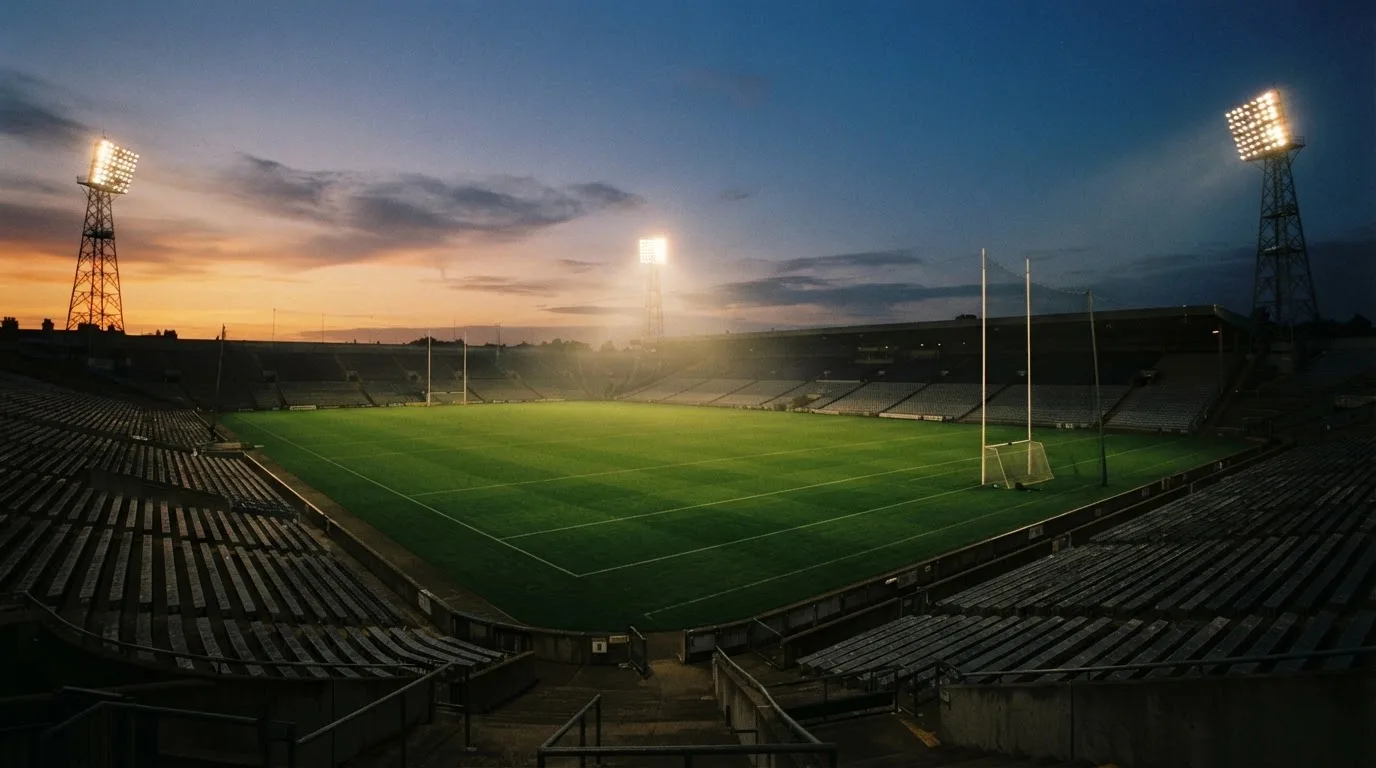
That scoring system drives what bookmakers offer. A “winning margin” market in Gaelic football is not what it is in soccer or rugby: it can be settled on a goal-and-points difference, and a single goal swings three points in a flash. Handicaps follow the same logic. A bookmaker quoting a one-point handicap on a match priced near even money has already priced in the value of a goal — a unit that means more in this sport than in almost any other. Reader, juries, marketing: the three-point goal is what forces the line on every spread, and a tipster who does not price it differently from a soccer goal is reading the wrong scoreboard.
The competition calendar is narrow. The All-Ireland Senior Football Championship final is held at Croke Park in Dublin each year, with Kerry holding the record for most titles at thirty-nine. The 2026 final was played on 26 July 2026 at Croke Park, with Mayo beating Kerry 1–20 to 1–17 for their fourth title. Outside the championship, the National League runs through the winter and spring, and club championships run alongside. That narrowness shows up in the betting offer: major bookmakers cover the championship final in depth, with markets that sometimes run into the hundreds, while early-round provincial fixtures are often restricted to match odds, total points, and a handful of player props. A reader looking at a coupon in February and one in July is looking at two different sports in bookmaker terms.
Why the calendar changes how a tip is built
Form in Gaelic football is shorter than in soccer. A county’s championship campaign runs from May to July in most years, with one or two matches per round depending on the provincial structure. A reader building a model has, in the average case, fewer matches of data to lean on than a Premier League tipster does, and the sample shrinks further when a team’s league form is split from their championship form — the same fifteen players can play a system in spring that looks nothing like what they run in summer. Reading form here is reading a story with whole chapters missing.

Statistics, on the other hand, are unusually clean. Scores are published to the point and the goal; shot locations are tracked by sport-specific data feeds; the GAA itself publishes averages on shots, possession, and turnovers for inter-county matches. The signal is there. The volume is not.
Line-ups, finally, are the variable that moves the price fastest. Gaelic football teams rotate more than a reader might assume, with managers using substitutes liberally once the six-man bench has been opened. A player rested for a qualifier can swing a goalscorer market more than a price update on the day.
The ten bookmakers: what the licence register says and what their own terms add
Each operator below carries a Gambling Commission remote licence, listed on the Commission’s public register. A place in this list is not a recommendation: the reader’s own check of the register — by brand, by domain, by account number — is the only test that confirms a licence at the moment of betting, because a register entry can change. Offers are described as each operator’s own terms state them. Several brands run under one licensee; Ladbrokes and Coral, for example, sit under Entain, and Paddy Power and Betfair sit under Flutter — neither pair is treated below as two separate names, and a reader seeing a familiar name in an ad should look one step up the chain on the register.
| Brand | Gambling Commission remote licence | What the operator’s own terms state on the subject |
|---|---|---|
| Tote | 054779-R-331321-008 (account 54779), held by TDCO Limited | UK and Irish pool-betting operator; tote.co.uk is its consumer site |
| Fafabet | 057385-R-333191-006 (account 57385), held by Taichi Tech Limited | Best Odds Guaranteed on UK and Irish horse racing win and each-way bets from 9am on race days: if the starting price is bigger than the original price, the bigger odds are paid |
| Kwiff | 044448-R-323408-017 (account 44448), held by Eaton Gate Gaming Limited | Supercharge feature can instantly boost the odds on a bet, for example from 2/1 to 20/1, and it can apply to single or multi bets on any sport |
| DAZN Bet | 048756-R-327274-019 (account 48756), held by DZBT Limited | Deposits start at £5 by debit card, Apple Pay, Paysafecard, Trustly and Skrill, and at £20 by PayPal, with no processing fees |
| Smarkets | 039173-R-319366-011 (account 39173), held by Smarkets (Malta) Limited | App offers two-factor authentication, live charts and an order book view, a quick trade-out option and 24/7 live chat support |
| Bet Ahoy | 100094-R-341742-003 (account 100094), held by Bet Ahoy Ltd | Acca Bonus of 10% up to £1,000, Sub-Cover for player substitutions, Best Odds Guaranteed on UK and Irish horse and greyhound racing up to £100, and Double Result payout on UK and Irish racing |
| BetTom | 064959-R-339314-003 (account 64959), held by Bet Tom Limited | Sports welcome offer is 50% back as a free bet of up to £50, with a matching 50% back up to £50 as free slot funds for casino play; full terms apply |
| Dabble | 065677-R-340363-005 (account 65677), held by Dabble Sports UK Ltd | Welcome offer is “Bet £10, Get £10 in Free Bets” on a first deposit for new customers, with minimum odds applying, a 7-day free bet expiry and the stake not returned |
| BetUK | 039198-R-319450-029 (account 39198), held by LeoVegas Gaming PLC | Free bets exclude virtual sports, esports and non-UK/IE horse racing, and minimum odds apply |
| Spreadex | 008835-R-104580-022 (account 8835), held by Spreadex Limited | New customer offer is £60 in free bets for a £10 fixed-odds bet, with the free bets usable across fixed odds and spread betting; the qualifying bet must be placed within 28 days of opening the account |
A note before the per-brand verdicts. Some of the headlines above describe offers that bookmakers themselves advertise to attract sign-ups. A headline price is read alongside the rest of its small print: a 10x turnover cap on the bonus applies to every licensed operator since 19 January 2026, and a free bet’s stake is usually not paid back with the winnings. The point of the table is the licence and the line of business — not the offer, which is a marketing surface, not a description of long-run value.
Tote — pool betting, settled on the dividend
Tote sits alone on this list. The pool-betting operator pools stakes on a race or match and pays a dividend rather than a fixed price, so a tip on Tote is not a tip against a price at all. For Gaelic football the offering has historically been narrower than on horse racing, and the live in-play book on a match is a fraction of what a fixed-odds bookmaker carries. Where Tote earns its place is on the markets it does carry: a small-stakes punter who backs into a big pool on a major championship match is on the same footing as everyone else in it. Worth it for the reader who wants pool-betting mechanics; not a substitute for a fixed-odds bookmaker’s coupon.
Fafabet — a horse-racing-heavy bookmaker
Fafabet’s headline feature is Best Odds Guaranteed from 9am on UK and Irish race days, on both win and each-way bets, with the bigger of the original price and the starting price paid out. The BOG guarantee does not extend to Gaelic football, which is the sport this page is about, and Fafabet’s depth of Gaelic markets in our reading of the site is thinner than the major firms. Worth it for the racing-led punter; for Gaelic football specifically, the case is thinner than the headline offer suggests.
Kwiff — surprise boosts, narrow use
Kwiff’s Supercharge feature can lift odds from 2/1 to 20/1 on a bet of any sport, on single or multi bets. The mechanism is random rather than scheduled: the punter does not choose when the boost lands. That randomness is also the limit of its utility: a Supercharge on a Gaelic football bet is welcome when it lands, but it cannot be built into a staking plan because it cannot be relied upon. Worth it as a side account for the surprise value; not a primary bookmaker for a serious Gaelic football reader.
DAZN Bet — a payments-led proposition
DAZN Bet’s clear edge is its payments range: deposits from £5 across debit card, Apple Pay, Paysafecard, Trustly and Skrill, with the PayPal minimum held at £20, all without processing fees. For a punter whose bank blocks certain e-wallets, that range matters more than any market depth claim. On Gaelic football specifically the offer sits in the middle of the pack. Worth it if the payments menu decides the account; not the first stop for a sport-specific reader.
Smarkets — exchange, not bookmaker
Spreadex Sports is a fixed-odds bookmaker, and Smarkets is a betting exchange — a different beast. Smarkets runs under a betting intermediary licence, and its app offers two-factor authentication, live charts and an order book view, a quick trade-out option and 24/7 live chat support. On a betting exchange the punter backs or lays against other punters rather than against the house, and prices are tighter because the platform does not take a margin in the same way a bookmaker does. The trade is a learning curve: a reader used to clicking “back” on a coupon has to learn to read an order book, set a lay price, and live with the depth on each side. Worth it for the experienced exchange punter; for a reader moving their first bets, the depth of a fixed-odds bookmaker is easier.
Bet Ahoy — acca-focused
Bet Ahoy’s headline features read like a coupon-designer’s wish list: a 10% Acca Bonus up to £1,000, Sub-Cover for player substitutions, Best Odds Guaranteed on UK and Irish horse and greyhound racing up to £100, and Double Result payout on UK and Irish racing. None of those is a Gaelic football mechanism, and Sub-Cover — insurance against a starting player being replaced before kick-off — is more relevant in team sports with named line-ups than in a sport where the bench is part of the contest. Worth it for the acca punter; on a single-game Gaelic football bet, the headline features are largely irrelevant.
BetTom — a small sign-up bonus, two-product split
BetTom’s sports welcome offer is 50% back as a free bet of up to £50, with a matching 50% back up to £50 as free slot funds for casino play. The split is unusual and reflects the mixed-product rule change: since 19 January 2026 mixed-product promotions — an offer that requires gambling on two or more product types, like betting and casino together — are banned at licensed operators, so the split has to be presented as two distinct offers rather than one. On Gaelic football specifically the offer is light. Worth it for the small bonus without much commitment; not a stand-out on this sport.
Dabble — a small sign-up free bet
Dabble’s welcome offer is “Bet £10, Get £10 in Free Bets” on a first deposit, with minimum odds applying, a 7-day free bet expiry, and the stake not returned. The stake-not-returned clause is the one to read: a winning free bet pays out only the profit at the stated odds, not the stake on top of it, so a £10 free bet at 5/1 returns £50 of profit rather than £60. On Gaelic football the depth sits in the middle of the pack. Worth it as a low-cost introduction; not the long-term account.
BetUK — LeoVegas Gaming, racing-led
BetUK runs under LeoVegas Gaming PLC, and its free bets exclude virtual sports, esports and non-UK/IE horse racing, with minimum odds applying. The exclusions matter on Gaelic football: the sport is not virtual, not esports, and is covered in some form on the site, so the exclusions do not in themselves block the bettor. The exclusion of non-UK and non-IE racing tells a reader the brand’s racing menu sits in a narrower lane than some competitors. Worth it as a LeoVegas-operated alternative; not a stand-out for Gaelic football.
Spreadex — fixed odds and spread betting under one roof
Spreadex is the only operator on this list licensed for both fixed-odds betting (under the Gambling Commission) and spread betting (under the Financial Conduct Authority), and its new customer offer is £60 in free bets for a £10 fixed-odds bet, with the free bets usable across fixed odds and spread betting, and the qualifying bet placed within 28 days of opening the account. Spread betting on a Gaelic football match is a different market from a fixed-odds bet: losses can exceed the deposit, which is the FCA’s standing warning on financial spread bets. The combined product is what makes Spreadex distinct; the risk on the spread side is real, and a punter who only wants fixed odds is buying a feature they will not use. Worth it for the reader who wants both products and is comfortable with spread-betting risk; for a fixed-odds-only reader, the headline understates the cost of the spread side.
The licensing frame: what a Gambling Commission licence changes
A bookmaker serving customers in Great Britain needs a Gambling Commission remote licence; the Commission’s public register is the whole test of who holds one. Since the Gambling (Licensing and Advertising) Act 2014, an operator whose remote facilities are used in Great Britain needs a Commission licence wherever it is based — a Curaçao, Maltese or Gibraltar licence is not a substitute. The Commission’s register can be searched by business name, trading name, domain or account number, and the search result shows the licence type and the categories covered. Several licence types exist: remote general betting standard (real events), the licence for fixed-odds bookmakers on real sporting events; remote general betting standard (virtual events), a separate category for virtual markets; remote general betting limited; remote pool betting, the licence for pool operators like Tote; and remote betting intermediary, the licence for exchanges like Smarkets.
Northern Ireland is outside the Gambling Act 2005 and runs under its own older law. A “GB licence” regulates Great Britain only; it does not extend to Northern Ireland. A reader in Belfast betting through a GB-licensed site is betting across a regulatory border the site itself has to manage.
A single licence register entry covers the operating company, not the consumer-facing brand. Several brands can run under one licensee — Ladbrokes and Coral under Entain, Paddy Power and Betfair under Flutter — and the reader who sees a familiar name on a billboard should look one step up the chain on the register before staking. None of the brands in the table above is “the only” licensed operator in its lane; the register lists many more than any single page can feature.
A bookmaker licensed in Great Britain verifies a customer’s name, address and date of birth before the first deposit or a first bet, including when the bet uses a free bet or bonus. Identity verification is the price of the licence: it rules out anonymous play at any site on the register, and a reader who values anonymity should know that a GB licence forecloses it.
Financial spread betting is regulated by the Financial Conduct Authority, not by the Gambling Commission, and the FCA’s standing warning is that spread-betting losses can exceed the deposit. A reader using Spreadex for both fixed odds and spread betting is operating across two regulators at once.
A note on Curaçao, Malta, and Gibraltar. None of those jurisdictions’ licences is a substitute for a Commission licence at the point of consumption in Great Britain. A brand advertising to British customers without a Commission licence is offering facilities that are unlawful under section 33 of the Gambling Act 2005 — the offence is on the operator, not on the customer who bets. The customer does, however, lose the protections a licence brings: no GAMSTOP coverage, no Commission complaints route, no approved dispute-resolution body, no British consumer redress if funds are withheld, and no binding by the 10x bonus cap or the £150 vulnerability check. “Legal to use” is the wrong framing: the truthful framing is that the protections are absent.
What a licensed site has to offer on safer gambling
A licensed remote operator has to integrate GAMSTOP, the national multi-operator online self-exclusion scheme. GAMSTOP periods are six months, one year, five years, or five years with auto-renewal; after the minimum period the exclusion stays in place for a further seven years unless the customer asks GAMSTOP to remove it. The scheme covers online sites and apps; betting shops use a separate offline self-exclusion. Every brand on the table above is a GAMSTOP member by licence condition.
A financial vulnerability check, in force since 30 August 2024 under LCCP condition 3.4.4, applies to licensed remote betting when a customer’s deposits minus withdrawals exceed £150 in a rolling 30 days — that threshold took effect on 28 February 2025. The check is a public-record one — bankruptcy and county court judgments are typical inputs — and not an income check and not a credit reference check. Financial risk assessments, sometimes called affordability checks, are announced in a staged plan published by the Commission on 7 July 2026; they have no start date and should be written about as announced, staged, with no start date, never as in force.
Deposit limits, under RTS 12, require operators to offer a gross deposit limit on a fixed time frame; the first changes have applied since 31 October 2025, a second phase was postponed to 30 September 2026, and whether it is in force at any moment is not established by any single document. There is no state-set deposit or loss ceiling for betting in Britain: limits are the customer’s choice, set on the operator’s own safer-gambling page. Unibet’s safer-gambling tools include deposit limits, a Player Profile test, product restrictions and self-exclusion, with live chat support and links to BeGambleAware, GamCare, GAMSTOP, Gambling Therapy and the BGC — a representative example of what a licensed brand offers, not the only set in the market.
Help outside the operator sits with GamCare, which runs the National Gambling Helpline, alongside GambleAware, the NHS gambling clinics and Gamblers Anonymous. The reader who needs to talk is talking to a charity or to the NHS, not to the bookmaker.
Crypto, e-wallets, and the payments the licensed reader sees
Credit cards are banned for gambling in Great Britain since 14 April 2020 under LCCP condition 6.1.2, including credit-card-funded payments through an e-wallet. Debit cards and bank-based payments are not covered by that ban. A licensed bookmaker offering a “crypto deposit” option is therefore either licensed outside Great Britain or operating in a way the Commission has not approved; the public register, not the homepage, is the test.
A British named-account rule, a state list of permitted payment methods, and any rule for or against cryptocurrency deposits at licensed operators are not established: payments should be described qualitatively and only from each operator’s own terms. DAZN Bet’s deposit menu — £5 by debit card, Apple Pay, Paysafecard, Trustly and Skrill, £20 by PayPal — is representative of the licensed range, and a reader whose only funding method is a credit card has to use a debit card or an e-wallet funded from a debit card instead.
Identity verification before the first deposit means no anonymous play at a licensed site, and source-of-funds questions at higher spend are normal under the money-laundering rules. The £150 vulnerability threshold is where these questions usually surface.
How bonuses actually price into a betting coupon
A bonus is a marketing surface, not a description of long-run value. A bookmaker offers a “Bet £10, Get £10 in Free Bets” welcome, and the headline reads as if the punter has turned £10 into £20 of betting power. What the small print does is attach a turnover requirement, a minimum price, an expiry, and a stake-not-returned clause that together change the value. Three of the brands above state those conditions in their own terms: Dabble’s free bet expires in seven days, the stake is not returned, and minimum odds apply; Bet Ahoy’s free bets sit inside a 10% Acca Bonus on multi bets only; Spreadex’s £60 of free bets has to be earned through a £10 fixed-odds bet placed within 28 days of opening the account. Each of those is a small print clause that changes what the headline number means in punting-power.
Since 19 January 2026 wagering requirements on bonuses are capped at 10x at licensed operators — a £10 bonus at 50x would need £500 of qualifying bets, and under the cap no more than £100. Mixed-product promotions — offers that require gambling on two or more product types, such as betting and casino, bingo, or lottery together — are banned at licensed operators, which is why BetTom’s split welcome into a sports free bet and a casino free-spins offer is now two distinct offers rather than one. Whether the 10x cap applies to free bets with no wagering condition, and any cap on the money value of a bonus, are not established. A £10 free bet at minimum odds of 1/1 (evens, decimal 2.00), with the stake not returned and an 85% payout share on the market in question, has an expected value to the punter of roughly £4.25 before any expiry. The price of the offer is the wagering attached, not the headline figure.
Best Odds Guaranteed — Fafabet’s from 9am on UK and Irish race days, William Hill’s from 8am on UK and Irish horse racing, Bet Ahoy’s on UK and Irish horse and greyhound racing up to £100 — is a separate mechanism. It pays the bigger of the original price and the starting price when the starting price is bigger, and it does not apply to ante-post, tote, or pari-mutuel bets. On Gaelic football the BOG guarantee is not a relevant feature: it sits on the racing side of the coupon. Enhanced odds and price boosts on Gaelic football are operator-specific, and Kwiff’s Supercharge is the most aggressive of them on our list — it can lift odds from 2/1 to 20/1 on a bet of any sport, single or multi, but it is random rather than scheduled and cannot be relied on for staking.
Live betting and cash out: how the in-play market on Gaelic football actually works
In-play betting on Gaelic football is offered at the major GB-licensed bookmakers, and the controls are the operator’s licence conditions and customer-protection duties — never an unrestricted legal status. The market during a match is narrower than before kick-off: bookmakers carry match odds, the next goal, total points over a band, and a handful of player props on big fixtures; early-round provincial matches are often restricted to match odds and one or two side markets.
Cash out is the operator’s price for closing a position before the final whistle. The price offered is the operator’s price, not the market’s: a punter who cashes out at £80 on a bet that would have paid £100 at full-time has taken the operator’s bid for that position, which is below the implied fair price because the operator takes a margin on the cash-out side as well as on the pre-match side. The bigger the live in-play margin, the worse the cash-out price tends to be, and on Gaelic football the live margin is wider than on Premier League soccer because the in-play liquidity is thinner. Two operators sitting on the same live match can offer materially different cash-out numbers.
Smarkets’ app offers a quick trade-out option in an exchange setting, which is a different mechanism from a bookmaker’s cash out: the trade-out closes the position at the prevailing back or lay price on the exchange, and the price is set by other punters rather than by the operator. A reader used to clicking “cash out” on a fixed-odds site is reading a different product on an exchange.
The acceleration of in-play prices is where the reader loses most. The first goal in a Gaelic football match swings the match-odds line by ten to fifteen points within seconds, and the bookmaker’s algorithm on the next-point market takes a similar fraction of a beat. A reader watching the stream and betting in-play is trading against a system that has already priced the goal into the live market.
What “value” means in a betting tip
A value bet is a price that exceeds the puner’s estimate of the true probability, after the bookmaker’s margin is taken out. The mechanic has three steps. The puner estimates the probability of each outcome — say, 60% for a Mayo win, 25% for a draw, 15% for a Kerry win. The bookmaker offers decimal odds of, illustratively, 1.90 / 1.90 on a two-way market for those outcomes. The fair odds on a 50% probability are 1 ÷ 0.50 = 2.00; the bookmaker is offering 1.90, which is below fair. On a 50% alternative the fair odds are 2.00 and the bookmaker is offering 1.90. Neither price exceeds the fair price, and on this hypothetical coupon the puner has no value bet at all — every price is below fair, because the bookmaker has built in a margin that lowers both.
The margin on an illustrative two-way market at decimal odds of 1.90 and 1.90 works out as follows. Payout share = 1 ÷ (1/1.90 + 1/1.90) ≈ 1 ÷ (0.5263 + 0.5263) ≈ 1 ÷ 1.0526 ≈ 0.9500, or 95.0%. Margin = 1 − 0.9500 ≈ 0.0500, or 5.0%. The bookmaker keeps roughly 5 pence of every pound bet on this market.
The wider the margin, the worse the value across the coupon. Two-way markets on the same fixture — over/under on total points, for example — can be priced closer to 5% margin; deep in-play markets on big fixtures can run to 12% or more. A punter who wants value bets has to find markets where the operator’s margin is low enough that the puner’s probability estimate can sit above it.
That is the only place a tip lives. A prediction of “Mayo to win” is a probability estimate dressed up; a value bet is the same probability estimate applied to the bookmaker’s price. If the estimate is right and the price is right, the bet has positive expected value; if either is wrong, it does not. The punter who treats a tipster’s prediction as a price rather than a probability is buying the wrong product.
How a tip is actually built: form, statistics, line-ups
A tip is built from three inputs in this order. Form is the recent results, weighted by strength of opposition: a win over the league leaders in the championship quarter-final counts more than a win over a Division Four side in a pre-season challenge. Statistics are the underlying numbers — shot counts, shot locations, expected goals if the reader’s data feed carries it, turnover rates, the share of possession that leads to a shot, the scoring rate from play versus from dead balls. Line-ups are the late information: a key player rested, an injury picked up in training, a debutante brought in for a qualifier.
For Gaelic football, form and statistics are easier to come by than for most niche sports — the GAA publishes its own averages on inter-county matches, and the BBC’s coverage includes shot charts and possession splits on the bigger fixtures. The narrow calendar is the limit. A reader building a model has, in the average case, fewer matches of data to lean on than a Premier League tipster does.
The build is a closed loop. The puner estimates a probability, compares it to the bookmaker’s price, and either bets or passes. The model improves when the puner logs the estimate, the price, the result, and the closing price — the closing line is the market’s last word on the fixture, and a tipster’s edge shows up as a systematic bias between their estimate and the closing line across many bets. Without the log, the estimate is not testable, and the tip is not a tip: it is a guess.
Staking and bankroll discipline
A punter who has decided to bet on Gaelic football should size bets as a fixed percentage of bank, not as a fixed stake. A 2% bank-per-bet rule across a £500 bank means £10 per bet; the same rule across a £200 bank means £4 per bet. The number moves with the bank, and the bank survives losing streaks. Fixed-stake betting has the punter betting £10 on a £100 bank and £10 on a £40 bank — exactly the wrong shape for someone whose edge is small and whose losing runs are long.
The 10x turnover cap on bonuses means a punter clearing a bonus cannot afford a large stake per bet either: the qualifying turnover has to fit inside the offer’s window and the minimum price, and a £100 bonus at 10x needs £1,000 of qualifying bets at minimum price over the offer period. Split across 50 bets of £20, the punter is betting the same £20 each time. Split across 10 bets of £100, the punter is exposed to a single bad run wiping out the bank.
Bankroll discipline is what turns a positive-expectancy tip into a positive-expectancy P&L over time. A punter with a 55% strike rate at average odds of 1.90 is in long-term profit; a punter with the same edge but a flat £100 stake on a £500 bank is one bad week from bankruptcy.
How the bookmaker’s margin sits inside the odds
The margin is the bookmaker’s edge on the market — the slice of every pound bet that the bookmaker keeps on average. On a three-way 1X2 market on a Gaelic football match — home win, draw, away win — the margin is the difference between the payout share implied by the prices and 100%. On the illustrative coupon above at 1.55 / 3.50 / 6.50, the margin worked out at about 7.8%. On a two-way over/under on total points the margin is closer to 5%. The margin sits inside every price on the coupon, and a punter paying 7.8% margin on every bet is giving back roughly 7.8% of turnover to the bookmaker before counting the punter’s own edge.
The margin is the reason a tip has to clear the bookmaker’s price before it has value. A 60% probability at decimal odds of 1.55 implies fair odds of 1.67; the punter has to find a price of 1.67 or higher to bet on a value basis. On a 7.8%-margin market that price is hard to come by, because the bookmaker has built the margin into every line.
The margin is not the same on every market. Two-way markets on bigger fixtures carry tighter margins; exotic markets on smaller fixtures carry wider ones. A punter who wants value bets concentrates on the markets where the margin is thinnest, which is where the bookmaker’s pricing is most efficient and where the punter’s edge has the smallest hurdle to clear.
How odds translate into a return on the bet
Odds in Great Britain are written in fractional form — 5/1, 11/4, evens — and in decimal form — 6.00, 3.75, 2.00. The conversion is a/b → a ÷ b + 1: 5/1 is 5 ÷ 1 + 1 = 6.00 in decimals; 11/4 is 11 ÷ 4 + 1 = 3.75; evens (1/1) is 1 ÷ 1 + 1 = 2.00. Decimal odds of 2.00 mean a £10 stake returns £20 — the £10 stake plus £10 of profit. Decimal odds of 6.00 mean a £10 stake returns £60 — the £10 stake plus £50 of profit. Decimal odds of 1.50 mean a £10 stake returns £15 — the £10 stake plus £5 of profit.
For a single bet at decimal odds o and stake s, return = s × o, profit = s × (o − 1). For an accumulator or combination bet, the odds of the legs multiply into one price: three legs at 2.00 / 2.50 / 3.00 give a combined price of 2.00 × 2.50 × 3.00 = 15.00; a £10 stake returns £150, with profit £140. Each-way bets double the stake into two equal bets, one on the win and one on the place; place terms vary by race and by operator.
The bookmaker’s margin sits inside every leg of the accumulator. Three legs at 7% margin each combine into a market with a margin that is wider than 7%, because the margin compounds. A punter building accumulators is paying a margin on each leg and on the combination, and the wider the combination the wider the margin. Single bets concentrate the punter’s edge in one place; accumulators dilute it across many.
The bookmaker’s marketing, and what to do with it
Best Odds Guaranteed, “risk-free” bets, free bet “welcome offers”, enhanced odds, “boosted accas”, “Supercharge” — the marketing surfaces on a coupon are part of the bookmaker’s customer-acquisition budget, and the small print attached to each is what changes what the headline means. The 10x bonus cap that took effect on 19 January 2026 has compressed the worst of the headline-versus-payout gaps at licensed operators; before the cap, a £10 bonus at 50x needed £500 of qualifying bets, and a punter clearing the bonus was giving back roughly £35 in margin to the bookmaker on the way through. Under the cap the same bonus has to be cleared with no more than £100 of qualifying bets, and the expected cost is roughly £7 on the same margin assumption. The cap has compressed the worst of the offers but not the cost of the underlying bonus.
A punter who treats the marketing as the price rather than the headline is reading the coupon right. A punter who treats the headline as the price is reading the marketing, not the coupon.
Frequently asked questions
How do I bet on Gaelic football?
Start with a Gambling Commission-licensed bookmaker that carries Gaelic football markets — the Commission’s public register is the place to confirm the licence. Pick a market the bookmaker carries in depth: match odds on the bigger fixtures, total points, handicap on the goal-points difference, or a goalscorer market where the data feed supports it. Stake a fixed percentage of bank per bet, log every bet, and treat a tipster’s prediction as a probability estimate rather than as a price.
What is a value bet, and why is no tip ever certain?
A value bet is a price that exceeds your probability estimate of the outcome, after the bookmaker’s margin has been removed. If your estimate is right and the price is right, the bet has positive expected value over many bets. No tip is certain because every estimate of probability is an estimate — a 60% probability means a 40% chance of being wrong — and a tip without a price is not a tip at all. The skill is finding prices that exceed estimates across many bets, not finding a single sure thing on a single match.
What is the bookmaker’s margin and how can it be seen in the odds?
The margin is the slice of every pound bet that the bookmaker keeps on average. On a two-way market at decimal odds 1.90 / 1.90, the implied probabilities are 52.6% / 52.6%, which sum to 105.2%; the overround above 100% is the margin, about 5.2% on this coupon. Two-way markets carry tighter margins, exotic markets carry wider ones, and the margin sits inside every price on the coupon — including the price on a tip.
How is the return on a bet worked out from the stake and the odds?
Return = stake × decimal odds; profit = stake × (decimal odds − 1). A £10 stake at decimal odds of 2.00 returns £20 — the £10 stake plus £10 profit. A £10 stake at 6.00 returns £60 — the £10 stake plus £50 profit. For an accumulator, the leg odds multiply into a single price. For an each-way bet, the stake doubles into a win bet and a place bet at the operator’s place terms.
How can I check that a bookmaker holds a Gambling Commission licence?
Use the Commission’s public register at gamblingcommission.gov.uk. Search by business name, trading name, domain, or account number. The result shows the licence type and the categories covered. A brand advertising to British customers without a register entry is offering facilities that are unlawful under section 33 of the Gambling Act 2005, and the customer loses the protections a licence confers.
Rugby, cricket & Gaelic – Darts betting
Content created by the «Darts betting» team
