
Darts Betting Online: What the Odds Actually Cost You
 Available in US
Data current as of 27 October 2026 and checked against the Gambling Commission’s public register.
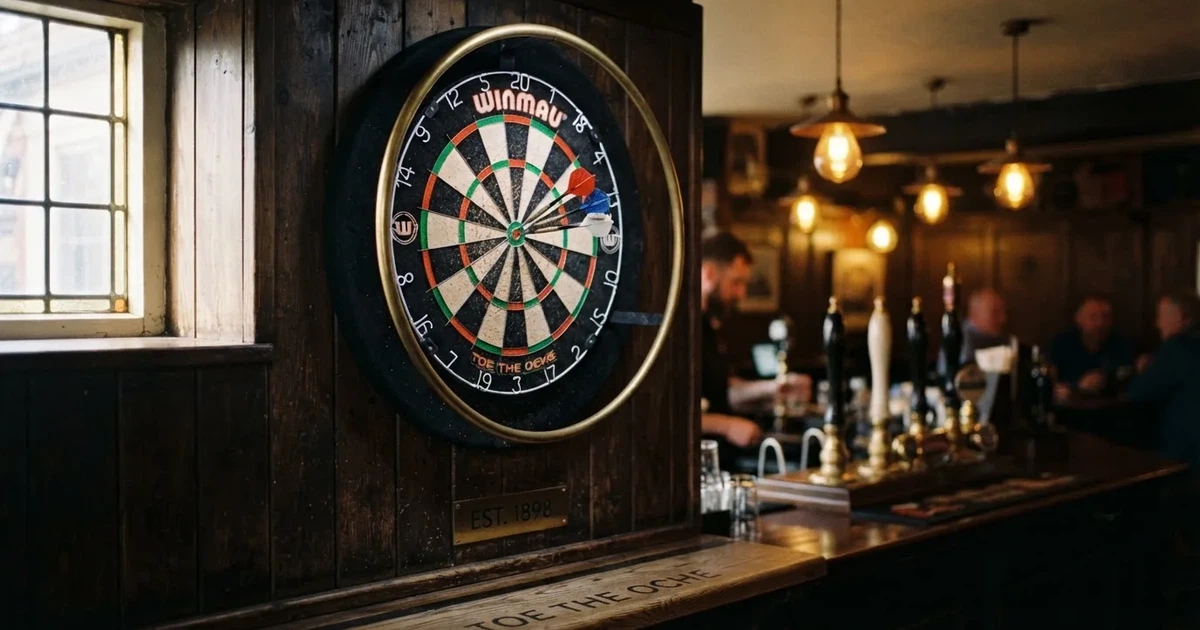
A 128-player field walked out at Alexandra Palace in December and Luke Littler closed out Gian van Veen 7–1 in the final of the 2026 PDC World Darts Championship, a £5,000,000 event with £1,000,000 to the winner. While the arrows flew, licensed bookmakers were pricing every leg, every checkout and every 180. The interesting question is not who threw what. It is what the bookmaker’s margin, the free bet’s small print and the bonus turnover did to a real bettor’s wallet while the match was on.
This page works through that question. The sport itself is short to learn. The economics of betting on it are not, and they are the part that costs the reader money if it is misread.
How darts betting sits inside British law
Darts is a permitted event under any remote general betting standard (real events) licence issued by the Gambling Commission. There is no statutory list of allowed sports or markets. A bookmaker serving customers in Great Britain needs the licence, and the Commission’s public register is the test of who holds one.
The framework is the Gambling Act 2005, amended by the Gambling (Licensing and Advertising) Act 2014 so that any operator whose remote facilities are reached in Great Britain needs a Commission licence regardless of where the company sits. A Curaçao, Maltese or Gibraltar licence does not substitute. Northern Ireland runs on its own older law; a Great Britain licence does not regulate bets placed there.
The licence categories that cover darts are remote general betting standard (real events) and remote betting intermediary, the second being the licence a betting exchange holds. A separate remote pool betting licence covers horse and dog racing pools. Since 7 May 2019, every licensed operator has to verify name, address and date of birth before the customer can deposit or gamble, including with a free bet. That is why an account opening at a British-licensed site feels slower than at an offshore one. The slowness is the licence doing its job.
A useful way to think about it: a Gambling Commission remote licence is the floor, not the ceiling. The operator adds its own rules, its own stake limits and its own market margins on top. The licence is what guarantees the consumer protections; the terms page is what determines whether the bet is a fair one.
Responsible gambling and the cost of looking the other way
Every operator in this comparison takes part in GAMSTOP, the national multi-operator self-exclusion scheme. Exclusion periods are six months, one year, five years, or five years with auto-renewal, and after the minimum period the exclusion stays in place for a further seven years unless the customer asks GAMSTOP to remove it. That is the single most useful tool a British bettor has, and it costs nothing to use.
A financial vulnerability check has applied since 30 August 2024 under LCCP condition 3.4.4, with the £150-in-30-days trigger live since 28 February 2025. It is a public-record check rather than an income or credit check. The wider financial risk assessments the press calls “affordability checks” were announced in a Commission article of 7 July 2026 as a staged plan with no start date. Deposit limits under RTS 12 have had their first phase live since 31 October 2025, with a second phase postponed to 30 September 2026; whether that second phase is now in force is not established.
The frame the page takes is cost. The cheapest bet on this market is the one a punter does not place because the bankroll was not there in the first place. Self-exclusion is free, immediate and effective across every site in this comparison. Help is at GamCare (National Gambling Helpline), GambleAware, NHS gambling clinics and Gamblers Anonymous.
Bonuses and free bets: what the marketing word hides
“Free bet”, “risk-free” and “100% bonus” are three of the most expensive phrases in British sports betting. The marketing word is what the operator hands the punter; the terms are what the punter pays. Three details decide what any offer really costs.
First, stake return. A free bet at Sky Bet, for example, expires 30 days after crediting, can be used only on single or each-way markets excluding virtuals, is non-withdrawable and does not return the stake with winnings. The stake is the price of admission. A winning £10 free bet at evens returns £10 of profit, not £20.
Second, wagering requirements. A bonus is the operator’s money tied to a turnover condition. Since 19 January 2026 the maximum is 10x: a £10 bonus at 50x needed £500 of qualifying bets; the cap closes that door. Whether the cap reaches a free bet with no wagering condition, and any cap on the bonus’s money value, are not established from public sources. Mixed-product promotions, an offer that asks the punter to bet on football to earn free spins, for instance, are banned outright under the same set of rules.
Third, minimum odds. Coral’s £40-in-free-bets welcome is a useful worked example: deposit and stake £20 at minimum odds of 2.0 (1/1), receive £40 in free bets within 7 days, expire 7 days after issue, new GB customers only. The 2.0 floor is the gate. Below it the qualifying bet does not count.
A useful rule of thumb: the bigger the headline bonus, the more important the small print. Bonuses and free bets are not free. They are turnover obligations with a marketing ribbon on top.
Live betting and cash out: the margin moves faster than the arrows
Darts is unusually well suited to in-play betting. Legs are short, the score is public and a 180 changes the price in seconds. Every operator in this comparison runs an in-play darts book, and most back it with cash out, the function that lets the punter close a bet before the final dart is thrown.
The cost of that facility sits in two places. The first is the margin, which is usually wider in-play than pre-match because the bookmaker is repricing on the fly with less liquidity behind the market. The second is cash out itself, which the bookmaker prices to its own advantage. A cash-out value that looks generous is the bookmaker buying back a bet it was happy to lay in the first place.
The honest framing is that in-play and cash out are tools, not gifts. They shorten the time a bad bet is on the screen, which has a real value, and they shorten the time a good bet is on the screen, which costs the punter any upside the leg might still have produced. Used well, both. Used by reflex, both will bleed a bankroll quietly.
A small number of the operators reviewed here, including Betfair, also stream UK and Irish racing and football inside the app, which is a useful adjourning activity while a darts price is suspended. Streaming is not the same as in-play betting, and the two should be kept separate in the punter’s head.
Predictions, tips and the things no model can see
Darts tips are easy to find and almost impossible to verify. A tip is a forecast, and a forecast is not a price. The market builds its own forecast on the second the bet is offered, and the bookmaker’s margin is the gap between the best of those prices and a fair price.
A “best darts bets today” page that names picks without naming the price the tip was placed at is selling a forecast, not an edge. The interesting question is not who will win the match. It is whether the available price is bigger than the true chance, and that question is answered with a calculator, not a tipster.
What a punter can do, and what no tip can do for them, is measure. Track the closing line. Track the price at bet placement against the price at settlement. Track the bookmaker’s margin on the darts match outright market. Over a season, the gap between the average price taken and the average closing price is the most honest measure of edge any recreational bettor will ever have.
The other thing no model sees is the hot hand. Darts is streaky in a way most sports are not: a checkout rate of 45% against 38% is two extra legs over a set, and the player who finds it first tends to keep it. That is not a tip. It is a reminder that the arrows on the screen are a human, not a number, and the price reacts to the human long before it reacts to the model.
Bet types, odds and what a price really pays
A darts book runs three families of markets. The match market is the simplest: who wins the match, sometimes with a handicap so the favourite starts a set down. The leg market is the live heartbeat: who wins the next leg, who hits the next 180, who checks out on a double. The outright market is the long shot: tournament winner, top seed, player to reach the final. Each carries a different margin and a different volatility.
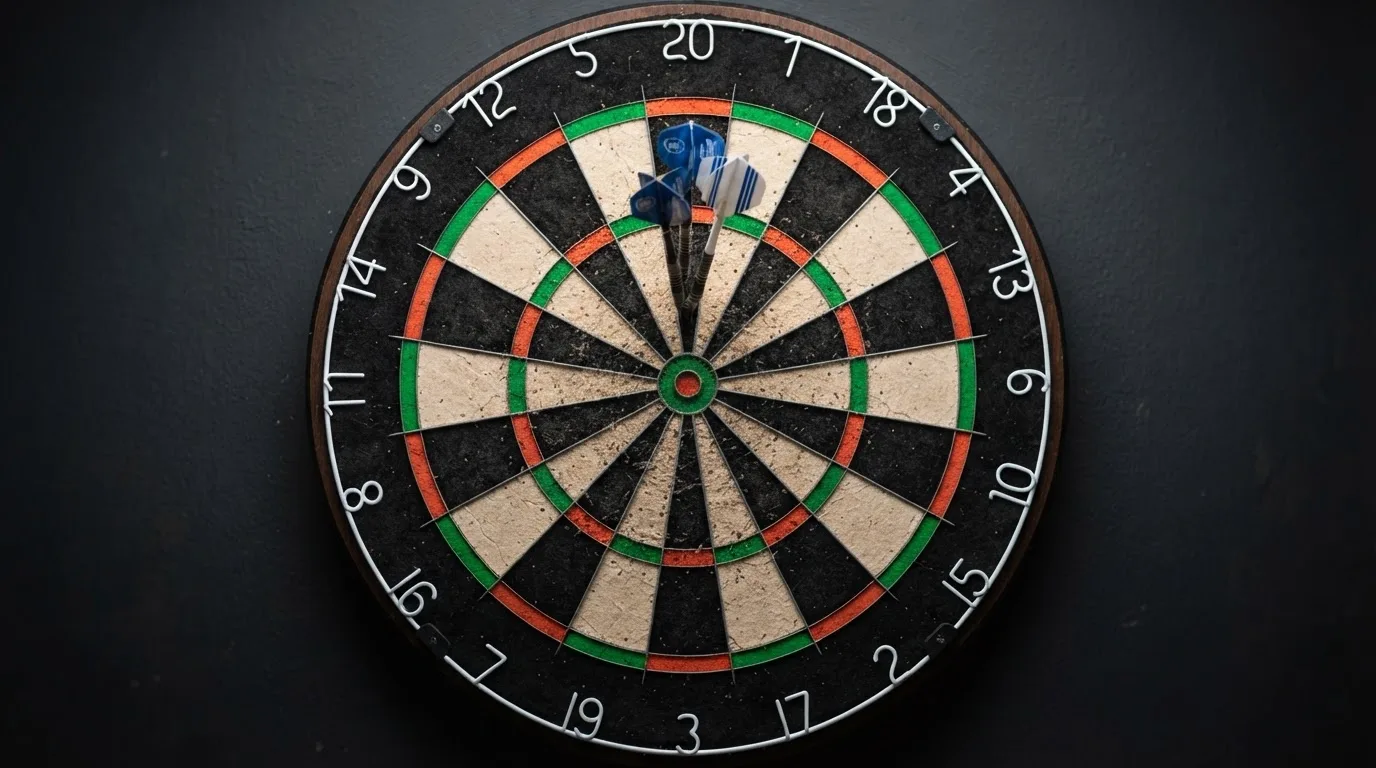
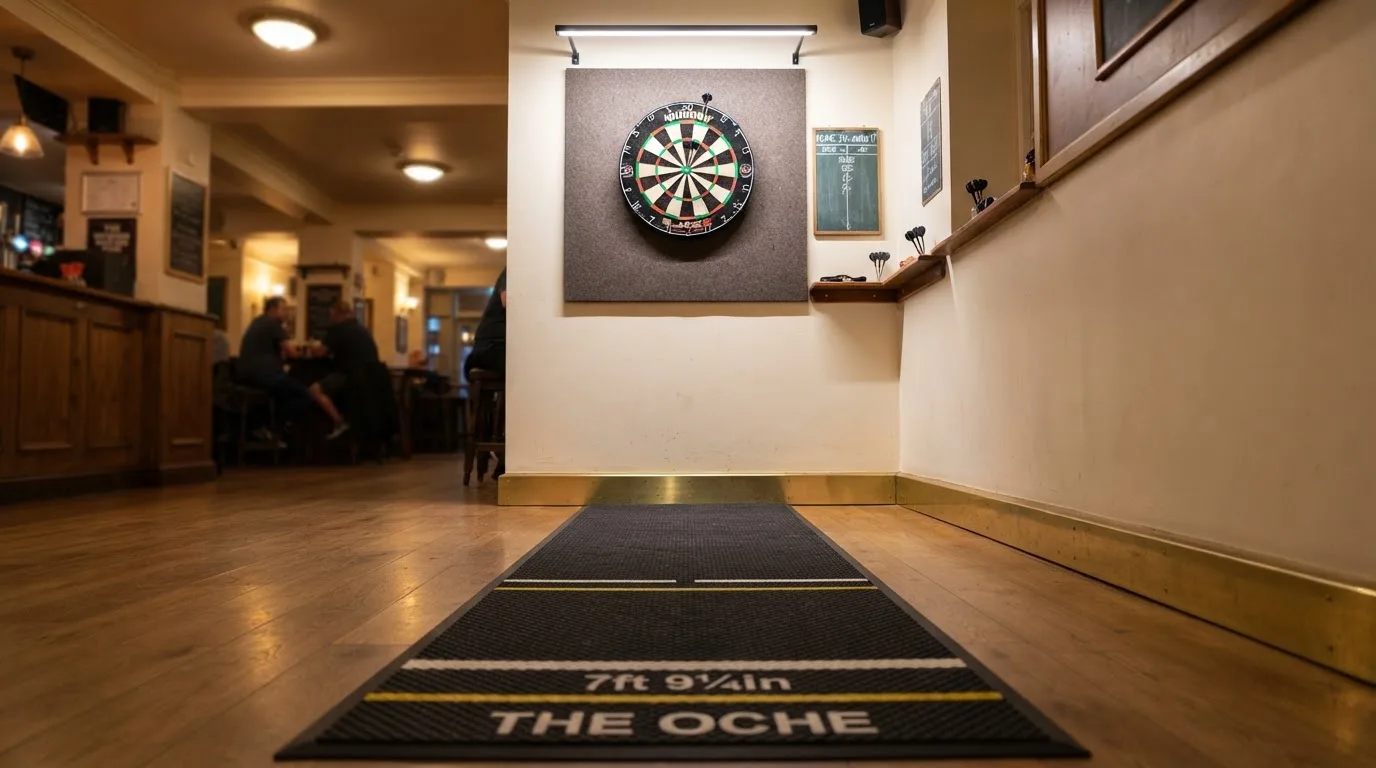
The standard fixture of odds. A standard dartboard has 20 numbered segments, each with single, double and treble areas; the bullseye is worth 50 and the outer bull 25. In 501 darts players start at 501 and must finish on a double or the bullseye. The highest possible three-dart finish is 170, and the minimum possible leg is nine darts. The standard throw distance is 2.37 m (7 ft 9 in) and the bullseye is 1.73 m above the floor. None of that changes how a price is built, but it is the geometry every darts market rests on.
Take a hypothetical two-way market priced at 1.90 / 1.90 in decimal. The two implied probabilities add to 1/1.90 + 1/1.90, or roughly 1.0526. The payout share is 1 / 1.0526, or about 95.00%. The bookmaker’s margin is 1 − 0.9500, or about 5.00% in decimal odds, with a small band depending on rounding. In fractional terms 1.90 is 9/10. The bettor receives £19.00 in return on a £10 stake at that price, £9.00 of it profit, and the bookmaker keeps roughly 50p of every £10 the market takes in. That 5% band is what the page means by margin: a quiet tax on every bet, hidden in the price.
A real-world price will rarely be 1.90 / 1.90. The favourite will be shorter, the outsider longer, and the sum of the implied probabilities will be wider than 1.000. That wider sum is the overround, and the bookmaker’s margin is one minus the reciprocal. The bigger the overround, the more the punter pays for the same bet. A 108% overround is a 7.4% margin. A 105% overround is a 4.8% margin. The difference sounds small. Over a season of darts betting it is the difference between a wallet and a hole.
Combination bets multiply one price into another. Two legs at 1.90 each become a combined 3.61, three legs 6.86, four legs 13.03, and so on. The margin compounds the same way, which is why an eight-fold accumulator looks enormous and quietly bleeds the punter dry. Each leg’s overround is a small tax; eight small taxes are a large one.
The PDC calendar and what a tournament looks like to a bettor
The PDC is one of two governing bodies at the top of the sport, alongside the World Darts Federation, and the PDC World Championship is the showpiece, held annually over the Christmas and New Year period. The 2026 edition ran from 11 December 2025 to 3 January 2026 at Alexandra Palace, with the field expanded from 96 to 128 players. Rounds 1 and 2 were first to 3 sets, rounds 3 and 4 first to 4, quarter-finals first to 5, semi-finals first to 6 and the final first to 7. That format is itself a market: handicap the favourite by a set, price the over/under on total sets, back the player to win in a specific round.
Beyond the Worlds, the PDC Premier League runs weekly through the spring, the Grand Slam follows in the autumn, and the World Matchplay, World Grand Prix and Players Championship Finals fill the rest of the year. Each has its own field, its own format and its own outright market, and the prices move differently on each. The Worlds are sharp and well-priced because the field is large and the bookmakers have years of data. The Premier League nights are tighter: eight players, weekly play, fewer data points per match, and a price that drifts as form shifts.
The honest framing for the punter is that tournament-level markets are where the bookmaker’s edge is widest. The match-level markets on the night are where it is tightest. The right place to bet on darts is the same place the right place to bet on any sport is: where the price reflects the most information, and where the punter’s own information is not just a guess.
The comparison: ten licensed bookmakers, side by side
The table below ranks the ten operators in the order this page reviews them. Each holds a Gambling Commission remote licence for real-event betting. The licence number is what a punter checks on the public register; the operator’s own terms are what determine the day-to-day experience. The third column carries what the operator’s own site or app page says on the subject of this page.
| Brand | Licence holder and Gambling Commission account | Operator’s own terms on darts and betting |
|---|---|---|
| 10bet | Blue Star Planet Limited, account 43173 | Sportsbook covers football, tennis and horse racing, with Cash out, Bet Builder and Live Streaming on the app |
| Sky Bet | SBG Sports Limited, account 67370 | Free bets expire 30 days after crediting, single or each-way only (not multiples), non-withdrawable, stake not returned with winnings |
| DragonBet | DragonBet Ltd, account 64908 | Welsh football and rugby markets, racing, American football, in-play and bet builder markets on the app |
| 888sport | 888 UK Limited, account 39028 | Pre-match and in-play betting, Cash Out, Bet Builder, racing streams, BetFinder form tools, a live bet feed and daily boosted odds |
| Fafabet | Taichi Tech Limited, account 57385 | Best Odds Guaranteed on UK and Irish horse racing win and each-way bets from 9am on race days |
| Star Sports | Star Racing Limited, account 9177 | Telephone account opening and bet placement on 08000 521 321, email support at [email protected] |
| Coral | LC International Limited, account 54743 | Sports welcome offer: bet £20 at minimum odds 2.0 (1/1), receive £40 in free bets within 7 days, expire 7 days after issue |
| Betfair | PPB Counterparty Services Limited, account 39439 | In-play betting, Bet Builder, free live streaming of UK and Irish racing and football, a 90 Minute Payout market on football |
| DAZN Bet | DZBT Limited, account 48756 | Deposits from £5 by debit card, Apple Pay, Paysafecard, Trustly and Skrill; £20 minimum by PayPal; no processing fees |
| Kalooki Sportsbook | Kalooki Sportsbook Limited, account 57730 | GAMSTOP member, account operated by Kalooki Sports Book Ltd (company number 12938274) |
A few details from outside the table, because the table cannot carry them. Betfair’s betting exchange runs under a separate betting intermediary licence at the same licensee, which is the price a punter pays for back-and-lay access and a different kind of margin. Several of the brands above run under licensees that also operate other names, Ladbrokes and Coral share LC International Limited, Paddy Power and Betfair share PPB Counterparty Services Limited, and that is the shape of the British market: a small number of large licensees, a long tail of brands on top.
10bet
10bet runs a multi-sport book rather than a darts specialist, which is a fair description of almost every operator in this comparison. The sportsbook covers football, tennis and horse racing as its headline sports, and the app carries Cash out, Bet Builder and Live Streaming across the board. Darts fits into the in-play book the same way it does at the larger names, and a punter who already has the 10bet app for football or racing will find the darts market without having to learn a new slip.
Worth it, and for whom. 10bet suits the punter who wants one app for the full British sports calendar and is happy for darts to be one sport among many rather than a headline market. The lack of a darts-specific promotion is not a weakness if the punter is not chasing a darts bonus in the first place.
Sky Bet
Sky Bet’s free bet terms are a clean illustration of what the small print actually says. Free bets expire 30 days after crediting, are limited to single or each-way markets (not multiples), excluding virtuals, are non-withdrawable and do not return the stake with winnings. That is a tighter set of restrictions than some rivals place, and it is worth knowing before a free bet is parked on a bet that does not qualify.
The wider sportsbook is a full British offering, and Sky Bet is one of the more familiar names in the high street and online. The combination of a familiar brand and a tight free bet is the trade-off a punter makes: less flexibility, more confidence in the operator.
Worth it, and for whom. Sky Bet suits the punter who will read the free bet terms before placing one and is happy to use singles rather than accumulators. The 30-day expiry is a hard deadline, and a free bet that lapses is the most expensive free bet of all.
DragonBet
DragonBet is a smaller name with a clear identity. The app is published by dragonbet ltd and the markets it headlines are Welsh football and Welsh rugby, alongside racing, American football, in-play and bet builder markets. Darts is on the book rather than at the front of it.
That is not a weakness if the punter wants a British bookmaker with a regional focus. It is a weakness if the punter expects the depth of the biggest names in the comparison. Smaller books tend to run fewer markets per event and wider margins on the markets they do run, though the published terms do not let that be confirmed here.
Worth it, and for whom. DragonBet suits the punter who wants a regional bookmaker with a real British identity and is not chasing the deepest darts book on the market. The bet builder and in-play features suggest the product has moved past a racing-only heritage.
888sport
888sport is a full-service British sportsbook. The app offers pre-match and in-play betting, Cash Out, Bet Builder, racing streams, BetFinder form tools, a live bet feed and daily boosted odds. The daily boosted odds are the headline: a 888sport-priced enhancement on a chosen selection each day, usually on a football or racing market but on occasion on a darts fixture as the calendar warrants.
BetFinder form tools are a quieter differentiator. They give the punter a form view inside the app rather than sending them to a third-party site, which is a small but real time-saver on a busy darts night.
Worth it, and for whom. 888sport suits the punter who wants a full feature set, including form tools and daily boosts, and is happy to take the 888 brand rather than a more specialist name. The breadth of the product is the point.
Fafabet
Fafabet pays Best Odds Guaranteed on UK and Irish horse racing win and each-way bets from 9am on race days. If the starting price is bigger than the original price, the bigger odds are paid. That is a racing-specific feature rather than a darts one, and it is the headline of the Fafabet offer for any punter whose calendar mixes racing and darts.
For the darts-only punter, Fafabet is a smaller name with a full sportsbook and a focus on British and Irish racing alongside the other major sports. The brand is one of the newer entrants to the licensed British market, and the racing offer is the clearest signal of who it expects its customers to be.
Worth it, and for whom. Fafabet suits the punter whose calendar includes racing and darts, and who values Best Odds Guaranteed on the racing side. The darts book is the supporting act rather than the lead.
Star Sports
Star Sports runs a counter-intuitive feature in 2026: a phone line, 08000 521 321, on which a customer can speak to a trader directly to open an account, place bets or ask customer queries, with email support at [email protected] alongside. That is a high-touch offer in a market that has moved overwhelmingly to app and web, and it is worth knowing exists for the punter who prefers a voice at the end of the line to a chat box.
The wider sportsbook covers the standard British set. The phone-first customer service is the differentiator, and it is the kind of feature that will matter most to a punter who has had a bad experience with an automated support flow elsewhere.
Worth it, and for whom. Star Sports suits the punter who wants a British bookmaker with a phone-first service and is not afraid to use it. The product is a full sportsbook, but the service is the headline.
Coral
Coral’s sports welcome offer is the cleanest in this comparison: get £40 in free bets when you bet £20. The qualifying bet is a deposit and a sports bet of £20 or more at minimum odds of 2.0 (1/1), with £40 in free bets issued within 7 days and expiring 7 days after issue, for new GB customers who opt in. The terms are spelled out on the operator’s own site rather than buried in a small-print link.
The wider sportsbook is one of the most familiar in British high-street and online betting, shared with Ladbrokes under LC International Limited. The combined group is one of the largest licensees on the Commission’s register, and that scale is part of why Coral can run a welcome offer at this level.
Worth it, and for whom. Coral suits the new GB customer who wants a familiar brand and a clean welcome offer with the terms on the front page. The 2.0 minimum odds and the 7-day expiry on both halves of the offer are the gates, and a punter who plans around them gets the full value.
Betfair
Betfair is the only name in this comparison that is also a betting exchange. The exchange runs under a betting intermediary licence at the same licensee, and the sportsbook sits alongside it. The app offers in-play betting, Bet Builder, free live streaming of UK and Irish racing and football, and a 90 Minute Payout market on football that pays out if the backed team goes two goals ahead at any point.
Darts is on the sportsbook in the usual way. The exchange is the differentiator: a punter can back a player at one price and lay the same player at another, and the spread between the two is the real cost of the trade. The exchange’s margin is structurally lower than a traditional bookmaker’s because back and lay compete against each other.
Worth it, and for whom. Betfair suits the punter who wants both a sportsbook and an exchange under one login and is willing to learn how laying works. For a darts-only punter who never opens the exchange, the sportsbook alone is a reasonable product but not the differentiator.
DAZN Bet
DAZN Bet is a newer name on the British market, with a deposit structure that is unusually well documented. Deposits start at £5 by debit card, Apple Pay, Paysafecard, Trustly and Skrill, and at £20 by PayPal, with no processing fees on any of the methods. The PayPal floor is the detail that catches the punter out, and it is worth checking before the first deposit is made.
The sportsbook is a full British offering. The deposit structure is the clearest signal of who DAZN Bet expects its customers to be: punters who fund from a debit card or an Apple Pay wallet rather than from PayPal, and who value a low minimum.
Worth it, and for whom. DAZN Bet suits the punter who funds from a debit card or an e-wallet other than PayPal and wants a low deposit minimum. The PayPal-only £20 floor is the trade-off, and a punter who pays with PayPal should know it before they try to deposit £5.
Kalooki Sportsbook
Kalooki Sportsbook is operated by Kalooki Sports Book Ltd (company number 12938274) and is licensed by the Gambling Commission under account number 57730. It is a GAMSTOP member, which is the floor every operator in this comparison meets. The product is a smaller-scale British sportsbook rather than a household name, and the licensee is a single-purpose company set up to run the brand.
For a punter, the interesting question is what the product does that the bigger names do not. The operator’s own homepage does not give a darts-specific feature, and the comparison is on breadth of market, depth of in-play and the size of the welcome offer rather than on a darts specialism.
Worth it, and for whom. Kalooki Sportsbook suits the punter who wants a smaller British bookmaker with a clear corporate structure and a GAMSTOP membership. The lack of a headline darts feature is honest, and the punter who values a smaller book over a bigger one will find it here.
The overview: what the comparison actually shows
The ten operators above are a fair slice of the licensed British market for real-event betting. They share three features. They all hold a Gambling Commission remote licence. They all take part in GAMSTOP. They all verify identity before the first deposit.
Where they differ is in product, in welcome offer and in the small print that turns a headline into a real number. Sky Bet and Coral are the cleanest welcome offers in the comparison, with the terms on the operator’s own homepage rather than in a small-print link. Betfair is the only exchange in the set. Star Sports is the only name with a phone-first service. DAZN Bet is the clearest on deposit minimums. 10bet, 888sport and DragonBet sit in the middle, with full sportsbooks and no headline differentiator.
What the table does not show is the margin. No public source gives a margin figure for darts match odds at each of the ten operators, and a margin published today is stale by tomorrow’s price move. The honest framing is that the licensed bookmakers in this comparison run darts match odds at margins in the same general range as other major sports, somewhere between 4% and 8% on the more popular fixtures, wider on the obscure ones. The punter’s job is to compare prices across two or three books before placing, not to memorise a margin figure.
The punter’s job is also to read the small print. The 10x bonus cap has been in force since 19 January 2026, and a bonus that looks generous against a 50x wagering condition is now smaller than it was a year ago. The free bet that does not return the stake is the free bet that is worth roughly its face value times (odds minus 1) divided by odds, and that is the formula a punter can run in their head on a slow leg.
The wider British market runs at General Betting Duty of 15% on the operator’s gross profits, with a new remote rate of 25% from 1 April 2027 on remote bets other than those on UK horse racing, self-service betting terminals, pool betting and in-person betting. Whether operators pass the duty on through tighter odds is not established, and the punter should never assume a published price includes a duty charge to them. The player pays no tax on betting winnings in Great Britain, and a professional gambler should ask HMRC or an adviser, not the bookmaker.
Where to check a licence, and why it matters
Every operator in this comparison holds a Gambling Commission remote licence. The Commission’s public register is searchable by business name, trading name, domain or account number, and is the whole test of whether a brand holds a licence. A punter who is unsure about a name they have seen advertised should type it into the register before opening an account, not after.
A licensed operator is a guarantee of four things: GAMSTOP coverage, a Commission complaints route, an approved dispute-resolution body, and the 10x bonus cap. It is also a guarantee of identity verification before the first deposit and the £150-in-30-days vulnerability check on a rolling basis. The trade-off is real, and the punter should know it.
An unlicensed operator is none of those things. A GB licence is compulsory at the point of consumption, and providing gambling facilities in Great Britain without the licence the Act requires is an offence under section 33 of the Gambling Act 2005, aimed at the operator. A customer who bets on an unlicensed site loses GAMSTOP coverage, the Commission complaints route, an approved dispute-resolution body and British consumer redress if funds are withheld. The punter is not committing an offence by betting on such a site. They are simply unprotected when something goes wrong. That is the honest framing, and it is the one a seasoned punter acts on.
Frequently asked questions
How do you bet on darts?
Pick a licensed British bookmaker from the comparison above, open an account, complete the identity verification, deposit by a method the operator accepts and find the darts market on the sportsbook. Choose a market, enter a stake, check the price and confirm. A winning single returns stake times the decimal odds; a winning combination bet returns stake times the multiplied odds of the legs. The whole flow takes under a minute once the account is verified.
What is darts betting?
Darts betting is wagering on the outcome of professional darts matches, legs or tournaments. The standard markets are match winner, handicap, total sets, correct score, next leg winner, player to hit the next 180, checkout markets and outright tournament winner. Darts is well suited to in-play betting because legs are short and the score updates in real time. Every darts market runs inside a bookmaker’s margin, which is the gap between the true price and the published price, and that margin is the bookmaker’s edge on every bet.
How does darts handicap betting work?
A handicap gives one player a head start in sets or legs so that the price on the favourite and the outsider is closer to even. A favourite handicapped by minus 1.5 sets has to win by two clear sets for the bet to land; a match bet at the handicap line pays out only on the adjusted score. The handicap is a way to back a strong favourite at a longer price, and a way to back an outsider with a margin of safety. The trade-off is that the handicap has to be cleared, and a close match that the favourite would have won outright is a losing handicap bet.
How can it be checked that a bookmaker holds a Gambling Commission licence?
The Commission’s public register is searchable by business name, trading name, domain or account number. The licence number for each operator in this comparison is given in the table, along with the name of the licence holder. The register entry also lists the licensed domain or domains. A licensed operator holds the licence for a category, and the categories are listed on the register entry: remote general betting standard (real events) is the one that covers darts. The register is the whole test of whether a brand holds a licence, and a punter who is unsure should check it before depositing.
How is the return on a bet worked out from the stake and the odds?
Return is stake times the decimal odds. A £10 stake at decimal odds of 3.75 returns £37.50, of which £27.50 is profit. A combination bet multiplies the legs into a single price: two legs at 1.90 and 2.50 combine to 4.75, and a £10 stake returns £47.50. The bookmaker’s margin sits inside every price, and a market priced at 1.90 / 1.90 implies a payout share of about 95% and a margin of about 5%, which is the bookmaker’s edge on every unit bet. Fractional odds convert by dividing the first number by the second and adding 1: 5/1 is 6.00 decimal, 11/4 is 3.75, evens is 2.00.
What is the bookmaker’s margin and how can it be seen in the odds?
The margin is what the bookmaker keeps of every unit bet on a market, and it sits inside the prices the bookmaker publishes. The cleanest way to see it is to convert each price to an implied probability (1 divided by the decimal odds) and add the probabilities together. A two-way market priced at 1.90 / 1.90 has implied probabilities of about 0.5263 each, which sum to about 1.0526. The reciprocal is the payout share, roughly 95%, and one minus that is the margin, about 5%. A market with an overround of 108% has a margin of about 7.4%. The bigger the overround, the more the punter pays for the same bet.
Tennis, darts & cue sports – Darts betting
Content created by the «Darts betting» team
