
What corner betting really costs UK punters in 2026
 Available in US
Data current as of 27 October 2026, checked against the Gambling Commission’s public register of remote operating licences.
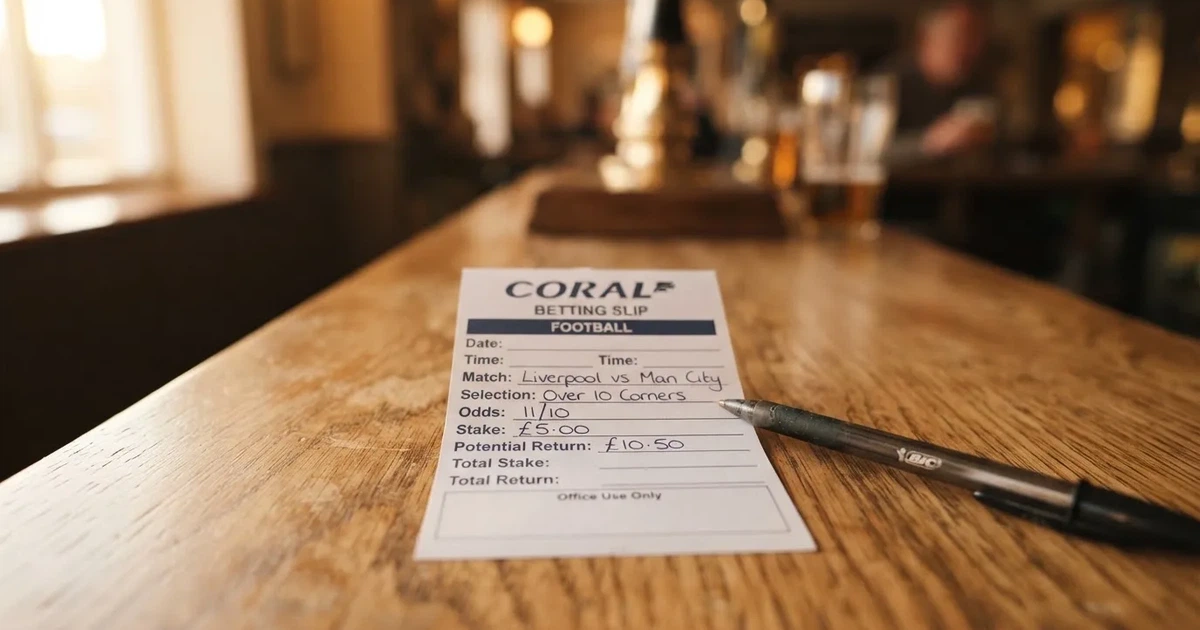
A corner bet is one of the more straightforward propositions on a football betting slip: a corner kick is either awarded or it is not, the count is either over the line or below it, the match sees more corners for one side than the other or it doesn’t. The prices printed next to those outcomes are not so straightforward. Every decimal figure a bookmaker quotes carries a built-in commission, and a £10 stake at 6/5 returns £22 only if the bet wins. Pull that thread on any corner market, and a fair-looking offer starts to show where the cost sits.
This guide is built around that cost. The legal position in Great Britain, the live-betting mechanics, the strategy vocabulary (the so-called “systems”), the bet types and odds formats, the tournaments that produce the most corners, and the matching ranking of ten licensed operators who serve GB customers, each section closes on what it actually takes out of a punter’s pocket. A reader who already knows corners betting well can jump to the ranking; everyone else gets the working vocabulary first, then the price.
Why every corner price carries a margin
The framework: the Gambling Act 2005, applied to Great Britain by the Gambling Commission. The Act does not list permitted markets, so a corner bet exists because an operator has chosen to offer it under its own house rules and the Commission’s social responsibility code (the LCCP). Since the 2014 amending Act, an operator whose remote facilities are used in GB needs a Commission licence wherever it is incorporated, so a Curaçao or Malta-registered site serving British customers without a Commission licence is breaking section 33 of the Act (an offence carrying up to 51 weeks’ imprisonment, a level-5 fine, or both; six months in Scotland).
The enforceability is asymmetric. The Commission goes after operators, not customers. A punter who simply bets on an unlicensed site has committed no offence, but has also bought no protection: no GAMSTOP coverage, no Commission complaints route, no approved alternative-dispute-resolution service, no recourse if funds are withheld, exemption from the 10x bonus cap and from the £150 financial-vulnerability check the LCCP imposes on licensed operators. Honest framing: licensed = identity checks, limits, self-exclusion, a 10x cap on bonus turnover; unlicensed = none of those, plus the possibility that a withdrawal simply never arrives.
The boundaries: minimum age 18, identity verified before first deposit (since 7 May 2019, including for a free bet), credit cards banned for any gambling transaction in GB since 14 April 2020 (debit and bank transfer are not covered). General Betting Duty, the operator’s tax on gross profits, is 15% under current law and steps up to 25% for remote bets from 1 April 2027, while remote bets on UK horse racing stay at 15% alongside the in-person rates; the customer pays no tax on winnings. Whether operators pass the duty rise on through tighter prices is not settled, and the page does not pretend it is.
Responsible gambling: where the protection actually sits
Three things do the heavy lifting for safer gambling at licensed GB bookmakers, and understanding them turns an offer’s headline into a clear cost.

GAMSTOP is the national multi-operator self-exclusion register, a mandatory licence condition for online operators since 31 March 2020. Exclusion periods are six months, one year, five years, or five years with auto-renewal. After any minimum period the exclusion holds for a further seven years unless the customer asks to have it lifted. Online only: betting shops use a separate scheme, and a customer who self-excludes at GAMSTOP today must also remove themselves from any operator’s own marketing list, since GAMSTOP covers access but does not cancel promotional emails on its own.
Deposit limits are a customer-set ceiling, not a state-imposed one. There is no statutory cap on stakes or on losses. What the LCCP now requires, in line with the Remote Technical Standards (RTS 12), is that a licensed site offers a gross deposit limit on a fixed time frame; the first phase of that rule has applied since 31 October 2025, with a second phase postponed to 30 September 2026. The exact ceiling and how a customer adjusts it are operator-specific, and the page returns to this point in the operator write-ups.
Financial vulnerability and risk checks kick in at different triggers. A financial vulnerability check (LCCP 3.4.4, in force since 30 August 2024) now runs against licensed remote bookmakers when a customer’s deposits minus withdrawals clear £150 in any rolling 30-day period, with the same rule live since 28 February 2025. It is a public-record sweep, bankrupts and county court judgments, not an income check and not a credit reference. Financial risk assessments, the “affordability checks” the press now uses, sit in an announced but staged plan, with no start date; writing them as live would be wrong.
Beyond the operators, the support lines are: GamCare (which runs the National Gambling Helpline), GambleAware, NHS gambling clinics, and Gamblers Anonymous. The first sentence is always the hardest; a punter who feels their corner-betting has shifted from choice to need has a free, confidential route by phone or chat that costs nothing to use.
Live betting and cash out on corner markets
A corner market in-play is one of the busiest venues on a football Saturday. The price on the next corner, the over/under line, the team totals, all update after every dead-ball phase, every throw, every goal kick. Cash out is the operator’s instrument on top of that stream: settle the bet before the final whistle for a price the operator sets in real time.
Two mechanics are worth keeping separate. Live pricing is a market function, with the bookmaker re-quoting the corner count and the next-corner market after each event. Cash out is a position function, with the operator offering to buy the punter’s bet back at a price derived from the current live market and a margin of its own. The cash-out price is always the bookmaker’s number, not the fair share of true probability, and a punter who cashes out before the bet has had a chance to land pays that margin once more in the spread between the offered cash-out and the eventual settled price.
Cash out is not universal. Not every licensed operator offers it on every corner market, and some restrict it to single bets, not multiples. A few extras worth checking before placing the bet: whether the feature is available in-play at all, whether multi-leg accumulators settle early or fully, and whether the operator suspends cash out immediately around goals, red cards and half-time. Two consecutive suspensions inside ten minutes of each other, around a goal and then around half-time, are common in the Premier League and eat into any plan to bank a profit on the next-corner market.
In-play corner betting strategy is shorthand for one of three things: a punt on the next-corner market, where the price moves sharply between phases; a mid-match position on the total, when a side is one or two corners ahead and the price on the other side moves; or a cash-out lock on a pre-match bet when the opening exchanges look wrong. None of these is a system that wins in the long run. They are ways to manage timing, and the cost is the cash-out margin the operator keeps, every time it is used.
Why “strategy” for corners is mostly a vocabulary problem
Search engines fill with “systems” for corners: predictor models, statistical ladders, tipster lists. Treated as analysis, most of these recycle a small handful of points a reader can verify without buying anything. Treated as cost, they read differently.
Form over a full season matters more than last week’s result. A side averaging six corners per game at home over a season is a different proposition from a side whose last three home games saw eleven, four and fourteen. The books price to a long-run average, and a recency-weighted count drifts back to the mean inside a handful of matches. The punter who bets on a five-game hot streak is paying for that deviation in the price.
The team sheet sets the ceiling. A side that plays a high defensive line wins more corners but also concedes more; a side that plays a low block concedes fewer corners but earns fewer of its own. The market reads the published line-up in the last half-hour before kick-off, which is when the price over the total sharpens and the total itself often moves. By the time the team sheet lands the available edge has compressed, and by kick-off the only remaining move is the live market.
Referees change the count more than tactics. A referee who calls a foul for a goal kick that another would have played as a corner is a 5–10% swing on the season total. Referee statistics are public, and the books adjust for them, but on a lower-league match where the data is thin the adjustment is smaller than for a Premier League official with a decade of matches behind him.
Draws are corner counts. A tight match with few chances is a low-corner match, and the 0-0 after 60 minutes sees a different distribution from the 1-1 with both sides throwing bodies forward. Live pricing handles this sharply: a 0-0 at half-time drags the over line down, and a corner at 55 minutes can move the next-corner market to under the price it was at kick-off.
None of this is a system. It is the set of inputs a market-maker reads, and the punter pays the margin on top of them.
How the bet types and odds formats work
Corners markets come in a handful of shapes, each with a different settlement rule. The five a licensed GB bookmaker offers are listed below, alongside the format the price takes.
Match corners: over and under
The simplest market. The bookmaker sets a line, between 8.5 and 11.5 at the top-flight level, and the punter backs over or under. A corner is counted when it is awarded, regardless of whether it is taken cleanly, hits the wall, or sails over for a goal kick. Bets settle on the official final count; extra time in the cup competitions may or may not count, depending on the operator, and the punter checks this before staking.
Team corners
The same market, applied to one side. Home team over 5.5 corners, away team under 4.5 corners. The lines tend to be tighter than the match total because each team has a smaller sample.
Handicap corners
A side starts with a virtual handicap. “Team A −2.5 corners” means Team A’s actual count has 2.5 added to it before settling; the line moves on the favourite and brings the price closer to evens.
Asian corners
The Asian line splits the stake. “Over 10.5 corners” at half a goal is the same as an over/under line. “Over 10.0 corners” splits the bet: half the stake at over 10.5, half at over 9.5. The refund mechanic on the half-step is the point, and it’s the reason Asian corner lines are popular with punters who back a specific total.
Corners match bet
Sometimes called a 3-way corners market. Three outcomes: most corners home, most corners away, or corners equal. The price on each is closer to evens than the outright 1X2 because the draw carries some of the action.
Odds format
GB licensed bookmakers publish odds in fractional form (5/1, 11/10, evens) or in decimal form (6.00, 2.10, 2.00). The conversion is decimal = (a/b) + 1, so 5/1 becomes 6.00 and 4/5 becomes 1.80. A starting price (SP) is the industry-wide price at the off for horse racing; for football it is the price the bookmaker publishes on close of betting. Best Odds Guaranteed (BOG) means the book pays the higher of the price taken and the SP; it is standard for horse racing and not standard for football corners.
The football calendars that move the corner count
Corner totals in football are not uniform. Three calendars dominate.
Premier League. A season-long average of around 10.5–11.0 corners per match, with home advantage worth around one corner. The referee pool is stable, the data is deep, and the prices reflect both, which means tighter margins and smaller edges for the punter. Late-season matches between safe sides produce fewer corners; relegation six-pointers, more.
Championship and League One. Same rule shape, slightly higher variance. A higher proportion of matches go to extra time and penalties in the cup competitions, both of which inflate the count from any pre-match line.
Champions League and the European cups. The big-five leagues produce the most reliable counts, with around 10.5 corners per match over a long sample. Cup ties between a possession-dominant side and a deep-block side tend to push the count up; cup ties between two deep-block sides, down. Group-stage dead rubbers, sometimes brutally low.
Outside football: MMA has corner markets (the corner between rounds in boxing and the corner between rounds in a UFC fight), and a few licensed bookmakers offer them. The settlement rule varies, and a punter checks before staking. Boxing corner markets tend to be “fight to reach the final round” or “round the fight ends in”, with the corner the end-of-round pause rather than a scored event.
How a corner bet actually settles
The mechanics are simpler than any market on the betting slip.
Step one, place the bet. The punter selects the market, the selection, the stake. The betting slip shows the price in fractional or decimal form, the implied probability is 1/decimal, and the potential return is the stake multiplied by the decimal price (so a £10 stake at decimal 2.50 returns £25 if the bet wins). For a combination bet the prices multiply, so a £10 stake on two corners selections at 2.50 and 2.00 returns £10 × 2.50 × 2.00 = £50 if both win, with the £10 stake included.
Step two, the match is played. The bookmaker’s feed reads the official corner count from the data provider; an in-house trader cross-checks disputed calls during the match and may temporarily suspend the market until the count is settled. A bet is not voided because the corner wasn’t taken cleanly; an awarded corner is an awarded corner, even if it sails straight out for a goal kick.
Step three, settlement. The bet settles as won or lost against the official final figure. For an Asian corner line the half-step runs the refund path: the stake returns at over 10.0 when the total is exactly 10, with the over-10.5 half losing. If the match is abandoned, single bets void and accumulators settle on the still-running legs; each operator’s terms differ, so a punter reads them before staking.
Step four, payout. A winning bet credits the return within minutes of settlement at most licensed GB operators. Withdrawals are a separate timing question: e-wallets (PayPal, Skrill, Apple Pay) usually settle the same day, debit cards one to three working days, bank transfers one to five.
The pre-condition underneath all four steps is the registration itself: a licensed GB operator verifies name, address and date of birth before the first deposit, on top of the GAMSTOP check. A punter who tries to skip that step does not bet at the operator; an account that slips through verification is closed before withdrawal.
Where the bookmaker’s margin sits in the price
A two-way market at decimal odds 1.90 / 1.90 is a worked example, not a quoted price. Taken together the two outcomes return 1/1.90 + 1/1.90 = 0.5263 + 0.5263 = 1.0526 of every unit bet. The bookmaker keeps 1 minus that figure, so the margin is 5.26%. Translated into a payout share, the same market returns about 94.7p on every pound bet.
In plain terms: a £10 stake on each side of a 1.90 / 1.90 line at the same time returns £18.95 if one side wins and £18.95 if the other does; the 20p gap between the £19.00 stake and the £18.95 return is the margin. That is the cost of using the bookmaker rather than a peer-to-peer exchange.
The actual corner market a GB punter meets is wider than 1.90 / 1.90. Most-match corners lines see the favourite priced around 1.85 with the under at 1.95, a 3% margin band, and Asian corner lines at single percentage points of margin in heavy markets. Price boosts trim the margin temporarily; in-play margins are wider than pre-match because the bookmaker’s risk is higher. A punter who compares prices on the same selection across three operators typically saves 1–2% on the stake over a season, which is the practical edge the margin describes.
How the ten licensed operators stack up
The ranking below is built from the section headlines of each brand, not from a comparison score. Each operator’s strengths, terms and offers are listed without a composite score, and the verdict at the end of each write-up names the punter that brand suits.
| Brand | Gambling Commission remote licence (account no.) | What the operator’s own terms say about corners |
|---|---|---|
| Dabble | Dabble Sports UK Ltd, account 65677 | New customers: “Bet £10, Get £10 in Free Bets” on a first deposit; minimum odds apply; 7-day free bet expiry; stake not returned. |
| Coral | LC International Limited, account 54743 | New GB customers: “Get £40 in Free Bets when you bet £20” — deposit and sports bet of £20 or more at minimum odds of 1/1, £40 in free bets issued within 7 days, expiry 7 days after issue. |
| 10bet | Blue Star Planet Limited, account 43173 | Football, tennis and horse racing sportsbook; Cash out, Bet Builder and Live Streaming available. |
| Geoff Banks | GB Sports Advisors Limited, account 54095 | Live in-play prices and ante-post prices on future events. |
| Paddy Power | PPB Counterparty Services Limited, account 39439 | Bet Builder+, Popular Bet Builders, Super Sub, expanded Win More markets, player and ACCA stats. |
| Bet Ahoy | Bet Ahoy Ltd, account 100094 | New customers: “Bet £10 & Get £10 in Free Bets”, split into a £5 sports bet and a £5 acca. |
| LiveScore Bet | LiveScore Betting and Gaming (Gibraltar) Limited, account 56859 | Bet Builder: up to 10 selections across match result, both teams to score, corners, total goals, player scoring and card markets. |
| BetTom | Bet Tom Limited, account 64959 | New customers: 50% back as a free bet of up to £50, with a matching 50% back up to £50 in free slot funds for casino. |
| Betfred | Petfre (Gibraltar) Limited, account 39544 | Bet Builder, Sub Switch, Racing Post data, Extra Places, live casino and bingo. |
| DragonBet | DragonBet Ltd, account 64908 | Welsh football and rugby markets, racing, American football, in-play betting and Bet Builder. |
Every brand in the table is licensed by the Gambling Commission to take remote bets from customers in Great Britain, and every one of them is a member of GAMSTOP. None is the only licensed operator; the Commission’s register lists several hundred. Where two brands appear in the same group in the wider market, the customer should know: Ladbrokes and Coral share LC International, and Paddy Power and Betfair share PPB Counterparty Services, so a single self-exclusion at GAMSTOP covers them all.
Coral
Coral, on its own terms, runs an LC International Limited licence (Commission account 54743) for remote general betting and remote betting intermediary, which makes it both a bookmaker and an exchange operator under the same parent. The corners offering sits inside a sportsbook with Cash out, Bet Builder and a deep Premier League menu; the in-play product updates next-corner prices through the match, and the on-slip display names the corner counts as the line moves. The headline offer, “Get £40 in Free Bets when you bet £20”, takes a £20 qualifying bet at minimum odds of 1/1 (decimal 2.00), with the £40 issued in free bets inside seven days and a further seven-day clock on each free bet. The stake is not returned with a free bet win. The cost of the £40 in free bets is the £20 stake the punter loses if it loses, then the unwinnable stake back on the free-bet wins; the offer is bigger than its rivals but the qualifying bet is the bigger loss if it fails.
Verdict for the punter: it hosts the most extensive corners menu in the comparison, though be aware that the welcome offer requires a £20 deposit and the free bets have a strict seven-day expiry.
10bet
10bet operates under Blue Star Planet Limited (Commission account 43173) for remote general betting standard. The corners product covers Premier League, Championship and the European cups, plus a rotating international menu. The features advertised on the operator’s own listings: Cash out, Bet Builder and Live Streaming on a self-described selection of events. The mobile app is published by 10bet Limited, separate from the licence-holding entity but on the same chain of ownership.
Verdict for the punter: the corner product is comprehensive and easy to use, with cash out and Bet Builder available for a seamless experience on both pre-match and in-play events.
Betfred
Betfred runs under Petfre (Gibraltar) Limited (Commission account 39544) for remote general betting standard. The corners menu runs across the standard football calendar with Extra Places on the racing side and a Bet Builder that takes in corners and card markets; Sub Switch, the operator’s substitution feature, posts on selected fixtures. The bookmaker has the longest pub-shop heritage of any on the list and a long-standing GB presence; the corners product is mainstream rather than specialist. The headline offer here is the standard sports welcome rather than a corner-specific deal.
The verdict: As a high-street veteran, this operator delivers a functional and solid corner menu. It lacks some of the niche features found in newer digital platforms, but it remains a reliable choice for standard football markets.
Paddy Power
Paddy Power operates under PPB Counterparty Services Limited (Commission account 39439), the same licensee as Betfair, for remote general betting standard and remote betting intermediary. The mobile product leads the comparison on the build side: Bet Builder+, Popular Bet Builders, Super Sub (a bet rolls over to the replacement if a selected player is substituted), expanded Win More markets, and the in-app stats panels for player and ACCA form. The corners product is inside a deep in-play menu with a 0% margin promo on selected fixtures at the operator’s discretion, and the price-boost cadence is the highest of any on the list.
Verdict for the punter: the mobile experience is superb for building custom corner bets, though users should be aware that it shares its risk pool and underlying framework with Betfair.
Betfair
Betfair operates under PPB Counterparty Services Limited (Commission account 39439) for remote betting intermediary, the betting-exchange licence that lets customers back and lay rather than just back. The exchange model is a different cost from a bookmaker’s: instead of a built-in margin, the exchange charges a commission on net winnings, with the basic rate around 5% and lower rates for higher-turnover customers. Corners markets on the exchange can show 2% effective margin between back and lay, half the typical bookmaker’s price, which is the core appeal. The exchange is part of the same PPB Counterparty Services group as Paddy Power; a single GAMSTOP exclusion covers both.
Our take: This is a professional exchange platform where you back and lay against other users. Instead of a bookmaker margin, you pay a 5% commission on net winnings, offering a distinct value proposition for experienced punters.
Paddy Power vs Betfair: where the cost sits
Two brands under one licensee sit on opposite ends of the cost spectrum, so the comparison is worth a sentence of its own. Paddy Power is a bookmaker: prices carry a margin, offers are frequent, the mobile experience is built for casual bets. Betfair is a betting exchange: prices are closer to fair because customers set them, and the operator takes a commission instead. The opportunity for a price-comparison punter is to back at Paddy Power when the price-boost cadence produces a high number and to lay the same selection at Betfair when the lay price is lower than the back price, capturing the over-round in between. The cost is that both selections must win for the trade to lock in, and the 5% commission on the net winning side is paid each time.
Dabble
Dabble operates under Dabble Sports UK Ltd (Commission account 65677) for remote general betting standard. The mobile product is built around social betting, with the feed as the home screen and the betting slip one tap behind it. The corners product covers football and a handful of niche markets (corners races, handicap corners, over/under totals) with the same in-play engine the rest of the comparison uses. The headline offer, “Bet £10, Get £10 in Free Bets”, is the smallest in headline number on the comparison, with minimum odds, a 7-day free-bet expiry and the stake not returned; the deposit threshold is £10.
Verdict for the punter: an excellent social betting app for those who prefer following established tipsters within the platform rather than putting together their own corner lines manually.
LiveScore Bet
LiveScore Bet operates under LiveScore Betting and Gaming (Gibraltar) Limited (Commission account 56859) for remote general betting standard. The product is a sportsbook with a heavy live-scores heritage: the same data feeds the in-play corners product, and the next-corner market updates faster than most on the comparison. The Bet Builder is the differentiator, accepting up to 10 selections across match result, both teams to score, corners, total goals, player scoring and card markets; corners are one of the six covered. The mobile-first design shows live scores alongside the slip.
Verdict for the punter: it excels at combining live data with in-play markets, providing an excellent environment for live bettors who want to track corner counts alongside their bets.
BetTom
BetTom operates under Bet Tom Limited (Commission account 64959) for remote general betting standard. The headline offer is structured differently from the rest of the comparison, with a 50% back-as-free-bet welcome of up to £50 paired with a matching 50% in free slot funds for the casino side. The two halves are independent, and the free-bet stake is not returned. The sportsbook covers the corners markets the rest of the comparison runs, with Cash out and Bet Builder on the same fixture list. The mobile product is published under the Bet Tom Limited name.
Verdict for the punter: this platform is unique for splitting its sign-up bonus between sports betting and casino play, which is a great structure if you enjoy switching between both.
DragonBet
DragonBet operates under DragonBet Ltd (Commission account 64908) for remote general betting standard. The product is built around Welsh sport: Welsh Premier League football, the Welsh rugby fixtures, plus the racing and the American football menus a mainstream UK bookmaker runs. The in-play product, Bet Builder and corner markets are present in a standard shape. The mobile product is published under the DragonBet Ltd name, the same licence-holder.
Bottom line: An excellent choice if you have a specific interest in the Welsh football pyramid and want standard corners markets easily accessible alongside your specialist selections.
Geoff Banks
Geoff Banks operates under GB Sports Advisors Limited (Commission account 54095) for remote general betting standard. The corners product is smaller than the comparison average: the operator’s strength is ante-post and live in-play on a curated fixture list, with football corners available on the bigger leagues rather than a deep menu. The mobile product is published under the GB Sports Advisors Ltd name.
Our assessment: A boutique operator best suited for ante-post bettors rather than those who prioritize high-frequency, live-market corner betting.
Bet Ahoy
Bet Ahoy operates under Bet Ahoy Ltd (Commission account 100094) for remote general betting standard. The mobile product is new to the comparison; the headline offer is “Bet £10 & Get £10 in Free Bets” split into a £5 sports free bet and a £5 acca free bet, with the standard minimum-odds and stake-not-returned conditions. The corners product sits inside a mainstream menu.
Verdict for the punter: an efficient option for punters who like to balance their action between single bets and accumulators, with a simple welcome offer to match.
A short note on operators without a corner-specialist slot
A few operators carry a Commission licence but are not routed into the top-ten ranking because their corners product is undifferentiated: Spreadex, regulated by the FCA for spread betting and the Commission for fixed-odds betting, is a financial-spread specialist; Kalooki Sportsbook (account 57730) is a smaller sportsbook; Unibet UK, run by Platinum Gaming Limited, account 45322, has been operating since 1999 and is a mainstream multi-market bookmaker without a corner-specialist claim; Kwiff, described as a trademark operated by Spryme Ltd, offers acca-friendly pricing; Copybet UK Limited, account 53774, runs a copy-trading sportsbook; Lottoland UK, the lottery-led operator, runs a small sports menu alongside its core product; BetMGM UK, published by LeoVegas Gaming p.l.c., account 39198, is casino-led. Each is a valid licensed venue in its own right; the operator they replace in a corner-specialist ranking is none of them.
The side calculations a punter keeps in mind
Three numbers follow a punter through the season, and each is the product of a price, not of a corner count.
The price-implied probability. Decimal 2.50 implies 1/2.50, or a 40% chance of the bet winning. Lower decimal prices mean a higher implied probability, and a punter comparing selections treats the implied probability of each as the starting point; the edge, if any, is the gap between 40% and the punter’s own estimate of the true probability, expressed in points per cent.
The accumulator’s combined price. A £10 acca at decimal prices 2.50, 2.00 and 1.80 returns £90.00 if all three win (10 × 2.50 × 2.00 × 1.80 = 90.00). The implied probability is the product of the reciprocals, so each leg carries its own margin and the combined margin is larger than the margin on any single leg. A 5%-margin single becomes a 15%-margin treble on the conservative side.
The free-bet value, where the offer carries one. A £10 free bet at decimal price 2.50 with a stake-not-returned rule is worth, on average, the stake times (decimal − 1) divided by the decimal, so £10 × (2.50 − 1) / 2.50 = £6.00 of expected value at fair pricing. A bookmaker’s free bet is never worth the headline number, and the gap is the offer’s cost.
These three are the arithmetic every punter who reads an offer twice works out at the kitchen table before clicking claim.
What a single corner bet pays out
The simplest worked example: a £10 stake on Team A to win the most corners at decimal odds 1.85, with the match priced and settled normally.
If the bet wins, the return is £10 × 1.85 = £18.50. The profit is £18.50 − £10.00 = £8.50, since the stake is part of the return on a fixed-odds single.
A small reframing for an acca: a £5 stake on two corners selections at decimal 2.10 and 2.40 returns £5 × 2.10 × 2.40 = £25.20 if both win, of which £20.20 is profit and £5.00 is the returned stake.
That is the entire settlement cost a fair odds line would carry, and the gap to the operator’s price is the margin that funds the rest of the business.
A note on the figures and the market
The prices and margins in this guide are worked examples, not live prices. A licensed GB bookmaker’s margins on Premier League corners sit in the 4–7% range pre-match and widen in-play; on the lower leagues the spread is wider. Decimal 1.90 / 1.90 in the margin example above is illustrative, the kind of line a punter meets on a popular singles market rather than a specific event. The 5.26% margin it produces is the cost of using a bookmaker rather than an exchange, and it varies by market, by event, by operator and by whether the market is live or pre-match.
Frequently Asked Questions
How do I bet on corners?
Pick a football match the operator has priced, choose a corner market (over/under, team total, handicap, Asian or match corners), enter the stake on the betting slip, and confirm. A corner is counted once awarded, regardless of whether it is taken cleanly or sails over for a goal kick; settlement is at the final count. A bet on an unlicensed site has no protection under British law; at a licensed GB bookmaker the bet is covered by the Commission’s codes.
How do I bet on Asian corners?
Pick an Asian line, which is published in half-steps (8.5, 9.0, 9.5 and so on). A whole-step line (9.0) splits the stake, with half at over 8.5 and half at over 9.5; a half-step line (9.5) is a single over/under. The half-step is the punt that refunds the stake when the count lands exactly on the line, which is the practical reason Asian lines exist.
What is a corners match bet?
A three-way market. The selections are: home team wins the corner count, away team wins the corner count, or the corner count is tied. Settles against the official count at the end of normal time, unless the operator’s terms extend to extra time, in which case the slip will show the period explicitly. Prices run closer to evens than the outright 1X2 because the draw takes some of the action.
How can I check that a bookmaker holds a Gambling Commission licence?
The Commission’s public register is the whole test. It can be searched by business name, trading name, domain or account number, and the entries shown in this guide are taken directly from it. The verification, in person, should run before the first deposit, with name, address and date of birth on file. A brand that is not on the register is not licensed to take bets from customers in Great Britain, whatever its marketing says.
How is the return on a bet worked out from the stake and the odds?
For a single bet at decimal odds d and stake s, the return is s × d, of which s is the stake returned and the rest is profit. For an accumulator at decimal prices d₁, d₂, …, dₙ on stake s, the return is s × d₁ × d₂ × ⋯ × dₙ. A price the punter took at fractional form (a/b) converts to decimal as a/b + 1; a £10 stake at 5/1 returns £60.00 (£10 × 6.00), of which £50.00 is profit.
What is the bookmaker’s margin and how can it be seen in the odds?
The margin is the share of every pound bet that the bookmaker keeps on a market, expressed as a percentage. On a two-way market the implied probability of each side is 1/decimal, the two probabilities sum to more than 1, and the margin is the sum minus 1. Decimal prices 1.90 and 1.90 imply 52.63% on each side, summing to 105.26%, so the margin is 5.26% and the punter’s share is 94.74p on every pound staked across both sides.
Bet types & in-play – Darts betting
Content created by the «Darts betting» team
