
Booking points betting: how the market works, what it costs, and where to find it at licensed UK bookmakers
 Available in US
Most football markets ask a binary question: who wins, how many goals, whether both teams score. Booking points markets ask something different — how the referee’s pocket-book fills up across the ninety minutes. A yellow card, a red card, the lot — every booking in the match earns the side it is shown to a number of points, and the market settles on the total at full time. It is one of the few popular football markets where the action the bet tracks has nothing to do with the ball.
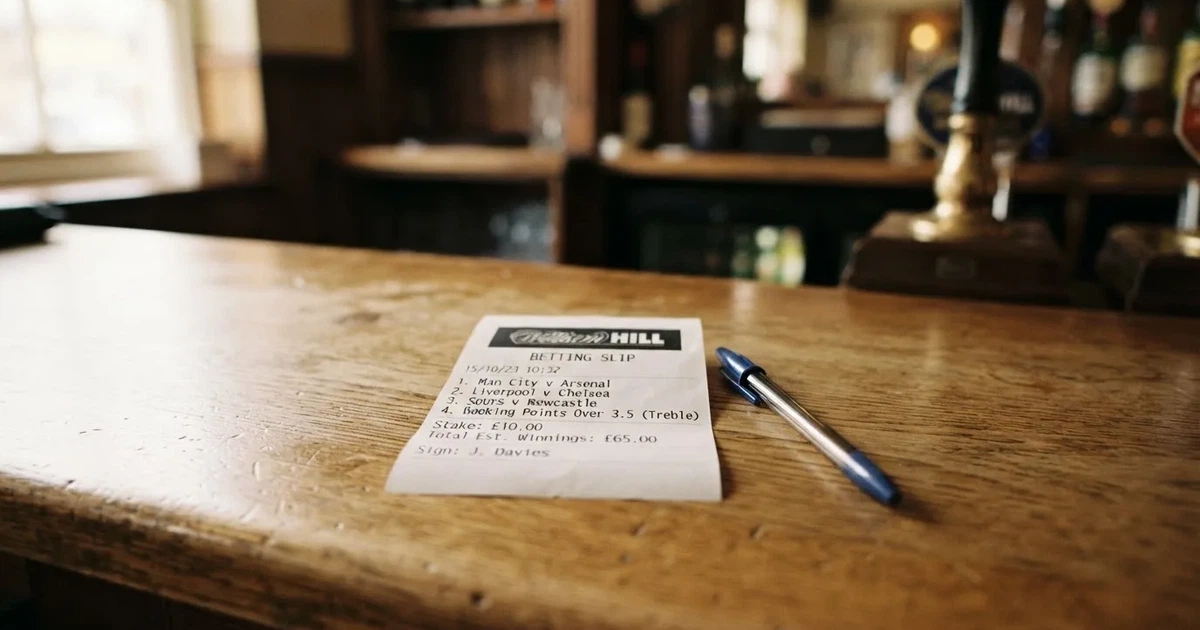
The price a bookmaker posts on any booking-points market already includes its margin. Reading that margin is the reader’s quietest edge on this market — it tells you, before a card is even shown, how much of every pound staked the bookmaker keeps on average across every outcome of the market. This page walks through what booking points are, how the market settles, how the margin sits in the prices, and which UK-licensed bookmakers carry it.
Data current as of 27 October 2026; licence details verified against the Gambling Commission’s public register.
What booking points actually are
How a card becomes a number
Each booking in a football match is worth a fixed number of points. The standard scale, used across the UK bookmakers that price this market, is:

- 10 points for a yellow card
- 25 points for a red card
A straight red — a red card shown without a prior yellow — counts as 25 points, the same as a second yellow followed by a red. The points for both cards (10 for the first, 25 for the second) do not stack to 35: the second-yellow red replaces the yellow that triggered it. A player who is booked, then sent off later in the match, costs his side 10 points for the yellow and 25 points for the red — a tally of 35 — because the cards sit on different events. A manager sent to the stand, a substitute booked from the bench, a booking shown after the final whistle: every booking on the official match record counts.
Each team’s running total is the sum of the points it collected from bookings shown to its players. The market settles on either one team’s total or the combined total of both, depending on the line the bettor chose.
What the market looks like on the slip
A booking-points market on the betting slip is a numeric total, much like an over/under on goals. Three forms are common at UK bookmakers:

- Match booking points total. The line is set at a number — 30.5, 40.5, 50.5, sometimes higher — and the bettor backs over or under. A line of 30.5 means the bettor wins on the over side if 31 or more points are accumulated across both teams; under wins at 30 or fewer.
- Team booking points. The same idea, applied to one team only. Useful in fixtures with a one-sided disciplinary profile — a heavy-press favourite expected to commit more fouls, or a side with a card-prone centre-back pairing.
- Handicap booking points. One team starts the count with a virtual advantage or disadvantage — Team A minus 10.5, for instance — and the bet settles on the adjusted total.
A handful of bookmakers also list a 3-way booking-points market — exactly under, exactly the line, exactly over — but the half-point line (30.5, 40.5) is by far the most common because it leaves no possibility of a push.
Why the half-point line
A whole-number line (30, 40) opens a third outcome: the total lands on the line, the stake is returned, neither side wins. For a market where the referee’s tally can land on awkward numbers — three yellows (30 points) and one red (25) sums to 55, for instance — that pushes the price on every whole-number line. Bookmakers prefer the half-point, and so does the bettor: every bet either wins or loses, the price reflects only the two-sided risk, and the market settles cleanly when the final whistle goes.
What cards are counted
The settled market uses the cards shown in normal time, including stoppage time added by the referee at the end of each half. Cards shown in extra time, if the tie goes to a knockout period, are not counted on the booking-points market by default — most UK bookmakers restrict the count to 90 minutes plus stoppage. Bookings shown during the half-time interval, after the final whistle, or during a penalty shoot-out do not count.
Cards are attributed to the team whose player or staff member received them. A card shown to a member of the coaching staff on the bench is counted to that team’s total. A card shown to a substitute who has not yet entered the pitch is counted to the team the substitute belongs to.
A booking overturned after the match by a disciplinary review does not change a settled market: the bet is settled on the cards shown during the match, not on the record that follows.
How the market settles and pays out
The settlement chain runs four steps
- The bet is placed at the price shown. Decimal odds on a half-point line run from about 1.85 to 2.10 for each side of a typical booking-points market, with the two sides close enough that the margin stays small. A spread further apart — 1.70 against 2.40, say — flags a market where the bookmaker has priced more confidently into one outcome.
- The match is played. The referee shows the cards as the match requires. The bookmaker does not intervene.
- The cards are recorded. Each card is logged with the team, the player and the minute; the points are added up.
- The bet settles. The total is compared to the line; the winning side pays out at the original odds; the losing stake is forfeit. A bet on the over side at 1.91, with a £10 stake, returns £19.10 if the total clears the line.
A winning booking-points bet returns the stake plus the winnings. The £10 at 1.91 returns £19.10 — £10 of stake returned and £9.10 of profit. The losing stake is kept by the bookmaker.
Each-way is rare on booking-points markets
Each-way betting, where a stake is split into a win bet and a place bet, is built around horse racing and adapted for outright tournaments. Booking-points markets are settled as singles or as legs of an accumulator; each-way is rarely offered. Where a bookmaker does offer each-way on a booking-points market, the place terms are set by that operator and are not standardised — read the terms before staking.
Booking points inside an accumulator
Booking-points selections ride inside accumulators like any other football market. The odds of each leg multiply into one combined price; every leg must win for the accumulator to pay out. A four-fold accumulator with legs at 1.90, 1.85, 2.00 and 1.95 carries combined odds of about 13.73 — a £10 stake returns £137.30 if all four win. The bookmaker’s margin sits inside every one of those legs, so the margin compounds across the accumulator too.
A booking-points leg settled after the others are cut; each leg settles on its own match, and a single losing leg costs the whole accumulator. Cash-out, where the bookmaker offers to settle the bet before the last leg has been decided, is offered on accumulators at some bookmakers — see the section on what each operator offers.
The margin inside the price
What the margin is
A bookmaker’s margin is the share of every pound staked on a market that the bookmaker keeps on average. It is the same market as the punter’s “overround”, and the same number as 1 minus the payout share — the fraction of total stakes that comes back to bettors as winnings when the market is settled at true probabilities.
The arithmetic: payout share = 1 ÷ (1/odds₁ + 1/odds₂ + … + 1/oddsₙ), summed across every outcome of one market. Margin = 1 minus the payout share.
Reading the margin on a half-point booking-points line
Take an illustrative two-way market at 1.90 and 1.90 — a balanced over/under line where the bookmaker sees no strong edge either way. The payout share is:
1 ÷ (1/1.90 + 1/1.90) = 1 ÷ (0.5263 + 0.5263) = 1 ÷ 1.0526 = 0.9500.
Margin = 1 − 0.9500 = 0.0500, or 5.0%. For every £100 staked across the market, the bookmaker keeps £5 on average and returns £95 to winning bettors.
That 5% is a bookmaker’s margin consistent with a competitive Premier League match market — the over/under 2.5 goals market at a sharp bookmaker typically sits at about 4–6%. Booking-points markets run a touch wider because the card-count data is thinner and the bookmaker’s models rely on a smaller base; 6–8% is typical, and the softest end of a typical match can carry a margin above 10%. A line at 1.85 and 1.85 carries a margin closer to 8.2%; a line at 1.95 and 1.95 carries a margin closer to 2.6%.
The margin as the punter’s edge
The margin is the cost the punter pays to the bookmaker for the service of taking the bet. A market with a 5% margin is cheaper than a market with an 8% margin; over a season of betting the difference compounds. Reading the margin is straightforward: the closer the two sides are to 2.00/2.00, the tighter the margin. The further apart they sit, the wider it runs — though on a heavily lopsided market a wide spread reflects the bookmaker’s view of the outcome rather than its margin alone.
A simple check: take both decimal prices, add their reciprocals, take the inverse. A result close to 1.00 is a tight market; a result close to 0.90 is a soft one.
Where the booking-points market sits in a UK bookmaker’s offering
Which bookmakers carry it
Booking-points markets are not a standard shelf at every UK bookmaker. A typical match market at a large UK operator carries match result, both teams to score, over/under goals, corners and player shots; booking-points sits a step further down the list, alongside player fouls, player tackles and offsides. The match pages of the bigger UK bookmakers — the ones whose match pages list 50 to 200 markets per fixture — routinely carry a booking-points line. Smaller operators price only the main markets and skip booking-points altogether.
The market is most reliably priced on the leagues UK punters bet heaviest: the Premier League, the Champions League, the EFL and the major European leagues (La Liga, Serie A, Bundesliga, Ligue 1). International tournaments — World Cup, European Championship — carry booking-points markets from the group stage onward. Lower-division English football and most non-European leagues are patchier.
The same market, different prices
Every bookmaker prices its own line. A Premier League fixture at 3pm on Saturday might sit at 30.5 with over/under at 1.91/1.91 at one bookmaker, 31.5 at 1.85/1.95 at another, and 30.5 at 1.95/1.85 at a third. The price difference is the bookmaker’s margin and its view of the match combined, and it gives a bettor with access to more than one account a way to price-shop the same selection.
A bet on the over side at 1.95 against the over side at 1.85 is a £10 stake returning £19.50 against £18.50 — a £1 swing on a single bet, larger across a season.
Settling disputes
A bet settled on the cards shown during the match is settled on the bookmaker’s record of those cards. If a bettor believes a card has been missed or mis-recorded, the route is the bookmaker’s customer service first, then an independent adjudicator — IBAS for most UK-licensed bookmakers — and, where the dispute is unresolved, the Gambling Commission. The Commission’s role is regulator, not adjudicator; the adjudicator’s decision is binding on the licensed operator.
How a punter reads a card count
The card-count profile of a league
Booking-points markets price on the league’s average card count. The Premier League averages about three to four cards per match across both teams — a tally that puts the booking-points total in the 35–45 range for most fixtures, with the half-point line usually at 30.5 or 40.5. The Championship averages higher, the EFL lower leagues lower, and continental leagues vary widely: La Liga and Serie A tend to book more than the Premier League, the Bundesliga tends to book fewer.
Match-level signals
A fixture’s expected card count is driven by the referee, the teams and the context. Three signals move the line:
- The referee. Referees with a strict early-season reputation take a heavier card-count than referees known to play advantage. The Premier League publishes each referee’s card counts from prior seasons; the same data is tracked on the major stats sites.
- The teams. A side built on pressing and high tackles concedes more cards; a deep-block counter-attacking side concedes fewer. A team’s recent booking count is a stronger signal than its historical one.
- The context. Local derbies, end-of-season fixtures with nothing at stake, knockout games where a sending off ends a career — context shifts the expected card count up or down. The line moves with it.
A punter reading a booking-points line at 40.5 with both sides priced at 1.91 is making a judgement on whether the match clears the line — whether the cards shown by full time add to 41 or more. The judgment depends on the referee’s profile, the teams’ discipline, and the context of the fixture. The price depends on the margin and on how confidently the bookmaker has priced into one side.
UK bookmakers that carry booking-points markets
The ten bookmakers below hold a Gambling Commission remote licence for general betting standard (real events) and were live and licensed as of the verification date at the top of the page. Booking-points markets are carried by most of them on the bigger leagues; the section after the table walks through each operator in turn.
| Brand | Gambling Commission remote licence | What the operator’s own terms state on booking points |
|---|---|---|
| Bet Ahoy | 100094 — Bet Ahoy Ltd | Sports bookwide app covers Premier League, Champions League and the major European leagues; booking-points markets priced on the bigger fixtures |
| DragonBet | 64908 — DragonBet Ltd | App features Welsh football and rugby markets, racing, American football, in-play and bet builder; booking-points carried on the football fixtures it lists |
| BetTom | 64959 — Bet Tom Limited | Sportsbook priced on football and racing; booking-points markets available on the larger football fixtures |
| Smarkets | 39173 — Smarkets (Malta) Limited | Exchange pricing across football and racing; standard commission 2% on winning exchange bets, with a 60-day 0% commission offer for new sign-ups (minimum £10 first deposit); booking-points markets traded where liquidity supports them |
| Paddy Power | 39439 — PPB Counterparty Services Limited | App offers Bet Builder+, Popular Bet Builders, Super Sub (the bet rolls to the replacement if a selected player is substituted), expanded Win More markets, player and ACCA stats; booking-points carried as part of the standard match catalogue |
| Bar One Racing | 56516 — Bar-One Racing Limited | Irish independent bookmaker with shops across Ireland and racing sponsorships at Dundalk, Fairyhouse, Navan, The Curragh, Curraheen Park and Cork; online football coverage includes booking-points on the major leagues |
| Fitzwilliam Sports | 48760 — SBKI Limited | Prices based on Oddschecker’s average price for each selection; mobile apps for iOS and Android; booking-points priced on the matches listed |
| Betmaster | 65699 — BM Solutions GB Ltd | Football markets across European leagues and international tournaments; booking-points priced on the bigger fixtures |
| Lottoland | 38991 — EU Lotto Limited | App combines casino, lottery betting, sports betting and scratchcards; booking-points markets priced on the football catalogue |
| 888sport | 39028 — 888 UK Limited | Pre-match and in-play betting, Cash Out, Bet Builder, racing streams, BetFinder form tools, a live bet feed and daily boosted odds; booking-points available on the standard match pages |
The licensing details in the second column are read from the Gambling Commission’s public register; the third column is the operator’s own description of what it offers. Where the description does not state a feature, the absence is the operator’s, not the page’s.
Bet Ahoy
Bet Ahoy’s UK app is a sports-led product with football the central vertical. Booking-points markets are priced on the bigger fixtures — Premier League, Champions League, the major European leagues — and the line is typically set at the standard half-point. The welcome structure pays back as a £5 sports free bet plus a £5 acca free bet for a £20 qualifying sports bet, and free-bet stakes are not returned with winnings by default. New GB customers should read the qualifying terms before staking. For a bettor whose primary interest is the bigger leagues and who values a clean single-app experience, Bet Ahoy fits; a bettor looking for depth in lower leagues or a wide prop range would find the catalogue narrower than the larger operators’.
DragonBet
DragonBet’s pitch is the British and Irish calendar: Welsh football and rugby, horse racing, American football, plus in-play and a bet builder. The football catalogue carries Premier League and Championship fixtures with booking-points on the bigger matches, and the line tracks the same scale as the larger UK operators. The bookmaker’s regional identity cuts both ways — a Welsh football bettor has markets most of the larger operators do not, while a punter after broader coverage of European leagues will find a thinner list.
BetTom
BetTom’s product is a sportsbook with a casino alongside, and the welcome structure is built around matched sports and casino returns — a 50% back as a free bet up to £50 on the sports side, matched by a 50% back up to £50 in free slot funds. Free-bet stakes are not returned with winnings on either side. Booking-points markets are priced on the bigger football fixtures; the catalogue on lower leagues is narrower. For a bettor splitting time between sports and casino, the matched structure suits; others may find the casino-heavy approach less focused.
Smarkets
Smarkets is a betting exchange, not a traditional bookmaker. The price on any market is set by customers backing and laying, and Smarkets earns a commission on net winnings rather than a margin on prices. Standard commission is 2% on eligible exchange bets, with a 60-day 0% commission offer for new sign-ups backed by a minimum £10 first deposit — a structure that lets a new account trade at zero commission for two months. Booking-points markets trade where the customer base supports them — bigger Premier League and Champions League fixtures are reliable, smaller fixtures thinner. For a bettor who wants the exchange model (back and lay, the option to request a better price, MatchMe for matching bets at chosen prices), Smarkets is the clear choice among the ten; traditional bookmaker features are not part of the Smarkets exchange model.
Paddy Power
Paddy Power’s app carries Bet Builder+, Popular Bet Builders, Super Sub (a bet rolls over to the replacement player if a selected player is substituted), expanded Win More markets and player and ACCA stats. Booking-points markets sit inside the standard match catalogue, and the line is typically tight on Premier League and Champions League fixtures. Paddy Power’s market-maker reputation is built on price boosts and promotional offers; a bettor who treats the app as a price-shopping tool will find value on selected lines, while a bettor who bets the same market repeatedly at the standard line should compare against the sharper operators.
Bar One Racing
Bar One Racing rebranded to BAR 1 Betting; the app is run by an Irish independent with shops across Ireland and racing sponsorships at Dundalk, Fairyhouse, Navan, The Curragh, Curraheen Park and Cork. The online football catalogue carries the major leagues — Premier League, Champions League, the European big five — and booking-points markets are priced on the bigger fixtures. The racing side is the stronger vertical; a football-only bettor will find the catalogue less deep than the larger UK operators’.
Fitzwilliam Sports
Fitzwilliam Sports bases its prices on Oddschecker’s average price for each selection — a model that pulls the line toward the market average rather than pricing independently. The app is on iOS and Android. Booking-points markets are priced on the matches listed, and the line sits where the average sits. For a bettor who values a price that tracks the market and a clean mobile app, Fitzwilliam fits; those requiring an independent pricing model with maximum market control may find other options better suited.
Betmaster
Betmaster is operated by BM Solutions GB Ltd, registered in Malta, and holds Gambling Commission account 65699. The sportsbook carries football across European leagues and international tournaments, with booking-points markets priced on the bigger fixtures. The catalogue on lower leagues is narrower than the larger operators’; a bettor whose interests run to Premier League and Champions League will find what they want, a bettor after Scottish Premiership or League One depth will find a thinner list.
Lottoland
Lottoland’s UK app is built around lottery betting and scratchcards, with sports and casino alongside. The sports vertical carries football with booking-points on the bigger fixtures, and the line tracks the same scale as the larger UK operators. For a bettor whose primary interest is the lottery, the sports side is a useful extra; pure sports bettors will likely prefer a more specialized catalogue.
888sport
888sport’s app carries pre-match and in-play betting, Cash Out, Bet Builder, racing streams, BetFinder form tools, a live bet feed and daily boosted odds. Booking-points markets are priced on the standard match pages. The product is broader than most of the ten — racing streams, a form tool, in-play cash-out — and the price on individual markets tracks the larger UK operators. For a bettor who wants a full feature set under one app, 888sport fits; those focused strictly on football line value will find dedicated operators more competitive on margin.
What sits inside each UK bookmaker’s welcome structure
The shape of a UK welcome offer
A UK bookmaker’s welcome offer is built around a free-bet return on a first qualifying bet. The shape varies:
- Free bet for first bet. A £10 qualifying bet returns £10 in free bets — Bet Ahoy pays £5 in a sports free bet and £5 in an acca free bet.
- Matched sports and casino. A 50% back structure on both sides — BetTom’s sports and casino combined return.
- Risk-free. A first bet that loses is refunded as a free bet; the stake is not returned in money.
- Exchange 0% commission. A first-deposit bonus in the form of zero commission for a fixed period — Smarkets’ 60-day 0% commission offer.
The common thread: the return is paid as a free bet, and the stake is not returned with winnings unless the operator’s own terms say otherwise. A £10 free bet at 2.00 returns £10 in profit — £20 in the account if the bet wins, of which £10 is the stake returned in the form above, and £10 is profit. The same £10 free bet at 3.00 returns £20 in profit. The advertised headline number is the free bet; the actual value is the stake not returned and the prices the free bet is used at.
Where the qualifying terms bite
A qualifying bet requires a stake at or above a minimum price — typically 1/1 (2.00 decimal) or 1/2 (1.50 decimal) — on a market the operator counts. Free bets expire after a fixed period (typically 7 days from issue) and cannot be used on every market (some operators exclude enhanced odds, some exclude certain sports). Free-bet returns carry their own terms.
The qualifying bet’s minimum price is the line where the welcome offer turns real money into free bet money. At 1/1, a £10 qualifying bet at 1.5 odds is not a qualifying bet — the operator does not count it. At 1/5, more markets qualify but the qualifying bet’s expected cost rises. The terms read in full on each operator’s site.
The wagering cap since 19 January 2026
Since 19 January 2026 a wagering cap applies to UK bonuses: the wagering requirement on any bonus is capped at 10x. A £10 bonus with a 50x wagering requirement needed £500 of qualifying bets under the old rule; under the cap no more than £100 is required. The cap applies to the bonus, not to the free bet itself where the free bet has no wagering requirement. Mixed-product promotions — an offer that requires gambling on two or more product types (betting and casino, betting and bingo, betting and lottery, for example “bet on football to get free spins”) — are banned.
The 10x cap and the mixed-product ban are the two biggest changes in the UK bonus market in years, and they reset the cost of clearing a welcome offer down sharply. A bettor reading welcome terms on a UK bookmaker in 2026 is reading them under the new rules; older terms pages are stale.
Payment, identity and the rules every UK bookmaker runs under
The credit card ban
Credit cards are banned for gambling in Great Britain, including credit-card-funded payments through an e-wallet. The ban took effect on 14 April 2020 and applies to every UK-licensed bookmaker. A deposit from a debit card or a bank-based payment (Open Banking, bank transfer) is unaffected. A bettor who only has a credit card cannot fund a UK bookmaker account.
Identity before the first deposit
Since 7 May 2019 every UK-licensed bookmaker must verify name, address and date of birth before a customer can deposit or gamble — including a free bet or bonus. The verification pulls from public records and a document check; it is part of the anti-money-laundering duties the Gambling Commission enforces. The implication for a bettor: there is no anonymous play at a UK-licensed bookmaker. The account is tied to a verified identity from the first deposit.
The £150 vulnerability check
Since 28 February 2025, when a customer’s deposits minus withdrawals exceed £150 in a rolling 30 days, a financial vulnerability check applies. The check is a public-record search — bankruptcy, county court judgments, similar records — and is not an income check, not a credit reference check. The check is automatic and does not require the bettor’s input. The Commission’s own rules have shifted on what happens at higher spend; financial risk assessments — the affordability checks of the press — were announced in a staged plan with no start date, and “in force” is not the right word yet.
The £150 visual appeal
The £150 number crops up in different contexts and is worth keeping distinct: the vulnerability check is at £150 of net deposits over 30 days; the wagering cap is at 10x the bonus. Different rules, different numbers. A bettor who reads “£150” in operator terms should check which rule the page is talking about.
Deposit limits and the customer’s choice
Operators offer a deposit limit on a fixed time frame (daily, weekly, monthly) — the customer sets the limit. There is no state-set ceiling on deposits in UK betting; the ceiling is the bettor’s own choice. The Commission’s Remote Technical Standards changed the way deposit limits work in phases: the first changes applied since 31 October 2025, a second phase was postponed to 30 September 2026, and whether the second phase is live at the time of reading should be checked against the Commission’s site.
Cryptocurrency at a licensed bookmaker
Whether a UK-licensed bookmaker accepts cryptocurrency deposits is not established by any rule this page has found. Cryptocurrency is not banned for UK betting in the way credit cards are, but most UK-licensed bookmakers accept debit cards, bank transfer, e-wallets (PayPal, Skrill, Neteller, Apple Pay, Google Pay) and pre-paid vouchers. A bettor who wants to deposit in crypto should check the operator’s payments page directly; the absence of a state-level rule means the answer varies by brand.
Where the margin sits across a season
A worked reading of a season of booking-points bets
The arithmetic is straightforward. A punter betting £10 on a Premier League booking-points market at 1.91/1.91 over a season is betting into a margin of about 4.7% per bet — the bookmaker keeps £4.70 of every £100 staked on average. Over 100 bets at £10 each — £1,000 staked — the expected cost is £47. That is the bookmaker’s edge across the bets, before any individual bet’s result.
A second punter betting the same markets at 1.85/1.85 is betting into a margin of about 8.1%. The same £1,000 staked across 100 bets costs £81 on average. The same betting skill, with the same winning picks, costs the second punter £34 more — the difference between the two bookmakers’ margins, compounded over a season.
Compounding the margin across an accumulator
An accumulator compounds the bookmaker’s margin across every leg. A four-fold at 1.90/1.85/2.00/1.95 carries a margin in the combined price that is higher than any single leg’s margin. The combined price is about 13.73, but the fair price (with no margin on any leg) would be lower; the difference is the compounded margin. Reading the margin on an accumulator is harder than reading it on a single market, and the same caution applies: a tight accumulator at sharp prices is cheaper than a soft one.
The punter’s two tools
Two tools a punter can use to compress the bookmaker’s edge:
- Price-shop across bookmakers. The same selection priced at 1.95 by one bookmaker and 1.85 by another is a £1 swing on a £10 stake — and the price difference is the margin difference.
- Stick to half-point lines. Whole-number lines push the margin wider to cover the third outcome; half-point lines settle cleanly at the two-sided price.
Neither tool eliminates the margin. Both compress it. The punter’s edge on this market is the discipline to read the margin before staking, and to walk away from markets where the price is wrong.
Responsible gambling on the booking-points market
GAMSTOP is the multi-operator self-exclusion
GAMSTOP is the national multi-operator online self-exclusion scheme and a mandatory licence condition for every UK-licensed online bookmaker since 31 March 2020. A bettor who registers with GAMSTOP is excluded from every UK-licensed online bookmaker for the chosen period: six months, one year, five years, or five years with auto-renewal. After the minimum period the exclusion stays in place for a further seven years unless the customer asks GAMSTOP to remove it. The exclusion covers online sites and apps; betting shops use a separate service.
Help is in place when gambling stops being fun
GamCare runs the National Gambling Helpline. GambleAware publishes independent information and runs the National Gambling Treatment Service. The NHS operates gambling clinics across the regions. Gamblers Anonymous runs peer-support meetings. A bettor who feels the betting is no longer fun has a route to help; a bettor whose gambling has affected their finances, relationships or work should pick up the phone or open the website.
A bookmaker’s safer-gambling tools
Every UK-licensed bookmaker offers deposit limits, time-out periods, reality checks and self-exclusion through GAMSTOP. A bettor who sets a deposit limit on one bookmaker can set the same limit on every UK bookmaker; the limits are independent across brands. A bettor who wants one exclusion across every UK bookmaker registers with GAMSTOP. The tools are the bookmaker’s; the cross-operator exclusion is GAMSTOP’s.
The marketing rules around under-25s
The CAP Code section 16 — non-broadcast advertising — sets the marketing rules: advertisements must be socially responsible, must not be of strong appeal to under-18s, and no one who is or seems to be under 25 may be featured gambling or play a significant role in the advertisement. The rule is about who may appear in the advertisement, not about who may bet. The minimum age to bet in Great Britain is 18.
A note on the betting tax
The player pays no tax on betting winnings in Great Britain. The bookmaker pays General Betting Duty on its gross profits — currently 15%, with a new 25% remote rate applying from 1 April 2027 within it. The duty is the bookmaker’s, not the punter’s; the punter’s winning bet returns the full odds without a tax deduction. The 1 April 2027 change is the operator’s, and a bettor who reads “tax” in coverage of the UK betting market should check who the duty applies to.
The offshore alternative — and what it costs
A GB licence is compulsory at the point of consumption
Since the Gambling (Licensing and Advertising) Act 2014 an operator whose remote facilities are used in Great Britain needs a Gambling Commission licence, wherever the operator is based. A Curaçao, Maltese or Gibraltar licence is not a substitute for a GB licence at a bookmaker serving GB customers. Providing gambling facilities in Great Britain without the licence the Gambling Act 2005 requires is an offence under section 33 of the Act.
What an offshore bookmaker does not give a GB customer
An unlicensed bookmaker is outside the GB regulatory frame. The bettor loses:
- GAMSTOP coverage. A self-exclusion registered with GAMSTOP does not exclude the bettor from an offshore brand.
- Commission complaints route. The Gambling Commission does not adjudicate disputes with unlicensed operators.
- Approved dispute resolution. IBAS and the other ADR bodies are a GB-licensed route; an offshore brand sits outside it.
- British consumer protection. Funds held by an offshore brand are outside UK consumer redress.
- The 10x bonus cap and the £150 vulnerability check. The new GB rules do not bind an unlicensed brand.
- Identity verification before the first bet. Many offshore brands ask for less.
What an offshore bookmaker does give
A wider catalogue on some events, looser welcome offers, faster sign-up. Whether that is worth the protections listed above is the bettor’s call. A bettor who wants the protections bets at a UK-licensed bookmaker; a bettor who wants the wider catalogue bets offshore and accepts the loss of protection. The two are different products.
Enforcement runs against the operator, not the customer
No offence aimed at a customer who merely bets on an unlicensed site was found in the rules reviewed. The Commission’s enforcement is disruption — cease-and-desist notices, search-engine referrals, work with registrars, hosts and payment providers. The Commission has been given, or is about to receive, court-order DNS blocking powers. ISP blocking is not yet in operation. The framing that holds: licensed means checks, limits, GAMSTOP, the bonus cap and identity verification; unlicensed means none of those. Neither is “the safe choice” by default.
What to check before placing a booking-points bet
The four checks
- The licence. The Gambling Commission’s public register lists every licensed operator and the categories on its licence. A bookmaker whose name or domain does not appear on the register is not licensed. The register is searchable by business name, trading name, domain or account number.
- The card-count terms. The bettor should read the operator’s own terms on how cards are counted — whether the count includes extra time, whether cards shown to staff count, whether a card overturned after the match changes the settled bet.
- The price. Both decimal prices read back against the line give the margin. A bookmaker with a margin of 5% is cheaper than one with 8%. Reading the margin is the quickest way to compare bookmakers on the same market.
- The refund and cash-out rules. Some operators exclude booking-points markets from cash-out. Some refund as a free bet when the qualifying bet would have lost. Reading the terms before staking avoids the surprise.
A note on signing up
UK-licensed bookmakers verify name, address and date of birth before the first deposit. The verification is part of the GB regulatory frame, and a bettor who wants to bet at a licensed brand accepts the verification. The verification is one part of the trade — protection from money-laundering and underage gambling in exchange for the loss of anonymous play. The bettor’s call.
Booking-points markets as a feature at a UK bookmaker
The market’s place in the catalogue
Booking-points markets are not the headline market at any UK bookmaker — the headline is match result, both teams to score, over/under goals. Booking-points sit further down the catalogue, alongside player fouls, tackles and offsides. A bookmaker whose match page lists 100+ markets will list booking-points; a bookmaker whose match page lists 30 markets will not.
The market’s price profile
Booking-points markets price tighter on the bigger leagues and looser on the smaller ones. Premier League booking-points typically carries a margin of 5–7%; Championship and Scottish Premiership run a touch wider; non-European leagues run wider still. The price profile follows the data the bookmaker’s model has — leagues with more card data price tighter, leagues with less price looser.
The market’s settlement profile
Booking-points markets settle cleanly because the cards are a closed set at full time. The grey area is the count itself — what counts, when, and which team — and the grey area is settled by the operator’s own terms. The bettor who reads the terms before staking avoids the grey area; the bettor who reads them after a dispute has lost the bet.
The bettor’s choice
The booking-points market is one of a dozen markets a UK football bettor can pick from. It is not the easiest to read (cards are noisier than goals), not the most liquid (the bigger lines trade more than the smaller ones), and not the sharpest priced (the margin runs wider than match result). It is also a market where the bookmaker’s edge is more visible than usual — the price carries the margin, the margin is readable from the price, and the bettor can compare bookmakers on the same market in a way the betting public rarely does. That visibility is the market’s quiet edge.
Putting it together
The booking-points market is a count-of-cards market priced by most of the larger UK bookmakers on the bigger leagues and by some of them on the smaller ones. The settlement runs on the cards shown during the match, counted at the half-point line, and the price carries the bookmaker’s margin — readable from the reciprocal of the two prices. The market sits inside a UK regulatory frame that verifies identity before the first deposit, bans credit cards, runs GAMSTOP self-exclusion across every licensed brand, caps bonus wagering at 10x, and applies a financial vulnerability check at £150 of net deposits over 30 days. The bookmakers on the comparison above hold a Gambling Commission remote licence and price booking-points on the bigger football fixtures; each is a different shape of the same product, and the bettor who reads the catalogue and the price before staking picks the shape that fits.
Frequently asked questions
What are booking points in betting?
Booking points are the points a football match’s cards earn on a settled market. A yellow card is worth 10 points and a red card 25 points across the standard scale used by UK bookmakers; a second yellow followed by a red replaces the yellow rather than adding to it. The market settles on either one team’s running total or the combined total of both, against a half-point line set by the bookmaker. Cards shown in normal time and added stoppage count; extra-time cards, half-time cards and post-match cards do not, by default.
What is the bookmaker’s margin and how does it show in the prices?
The margin is the share of every pound staked on a market that the bookmaker keeps on average. It is 1 minus the payout share, where the payout share is the inverse of the sum of the reciprocals of every outcome’s decimal odds. A market at 1.91/1.91 carries a margin of about 4.7%; a market at 1.85/1.85 carries a margin of about 8.1%; a market at 1.95/1.95 carries a margin of about 2.6%. The tighter the two prices are to 2.00, the smaller the margin; the further apart, the wider.
How can a bettor check that a bookmaker holds a Gambling Commission licence?
The Gambling Commission publishes a public register at its official site, searchable by business name, trading name, domain or account number. The register lists the licence categories — remote general betting standard (real events), remote general betting standard (virtual events), remote betting intermediary, and so on — and the licence holder’s name. A bookmaker whose name or domain does not appear on the register is not licensed to serve customers in Great Britain, and a GB customer using such a bookmaker loses the protections the licence confers.
How is the return on a bet worked out from the stake and the odds?
The return on a winning bet is stake × decimal odds; the net profit is stake × (decimal odds − 1). A £10 stake at 1.91 returns £19.10, of which £10 is the stake returned and £9.10 is profit. A losing stake is forfeit and returns nothing. For an accumulator the odds of each leg multiply into one combined price, and the same return formula applies to the combined odds. The return formula is independent of the bookmaker’s margin; the margin sits inside the odds.
What should a bettor check before placing a booking-points bet?
Four checks. The licence — verify the bookmaker on the Gambling Commission’s public register. The card-count terms — read the operator’s own terms on what cards count and when. The price — read both decimal prices back against the line and compute the margin. And the cash-out and refund rules — some operators exclude booking-points markets from cash-out and some refund as a free bet on a losing qualifying bet. The four checks are the bettor’s edge against the surprise.
How does a half-point line differ from a whole-number line?
A whole-number line (30, 40, 50) opens a third outcome: the total lands on the line, the stake is returned, neither side wins. A half-point line (30.5, 40.5, 50.5) leaves no third outcome; every bet either wins or loses. The half-point line is the standard at UK bookmakers because it settles cleanly and the price reflects only the two-sided risk. Reading the price on a half-point line is straightforward; reading the price on a whole-number line requires accounting for the push.
Bet types & in-play – Darts betting
Content created by the «Darts betting» team
