
Cricket Betting Odds 2026
 Available in US
27 October 2026 · Checked against the Gambling Commission’s public register.

A cricket price looks like nothing else on a bookmaker’s site. It has to absorb fifty overs of run-making, three formats with different lengths, a forecast that can wipe out a session, and a method called Duckworth-Lewis-Stern that turns a rain delay into a maths problem. Most punters see the number on the screen and move on. The number is doing a lot of work before they get there.
This page is about that work. It walks through the formats a UK bookmaker prices, the markets that hang off each one, and the margin baked into every price on the slip. It then runs through ten Gambling Commission-licensed brands that carry cricket in their sportsbook, sets out what each one actually offers, and closes on the arithmetic a punter needs to judge any offer they meet. Throughout, the audience is a British bettor looking at a British site in pounds sterling, with the Commission register as the only test of who is licensed to take their money.
How the Game Shapes the Market
Cricket is unusual among the sports a UK bookmaker prices. A Test can run five days and finish with no result at all. An ODI hands each side a fixed fifty overs and settles in a day. A T20 fits inside about three hours. A bookmaker’s cricket section is three markets stacked in one tab: Tests are patient and odds move slowly, ODIs sit somewhere in the middle, and T20 is short enough that live betting can rewrite a price every over.
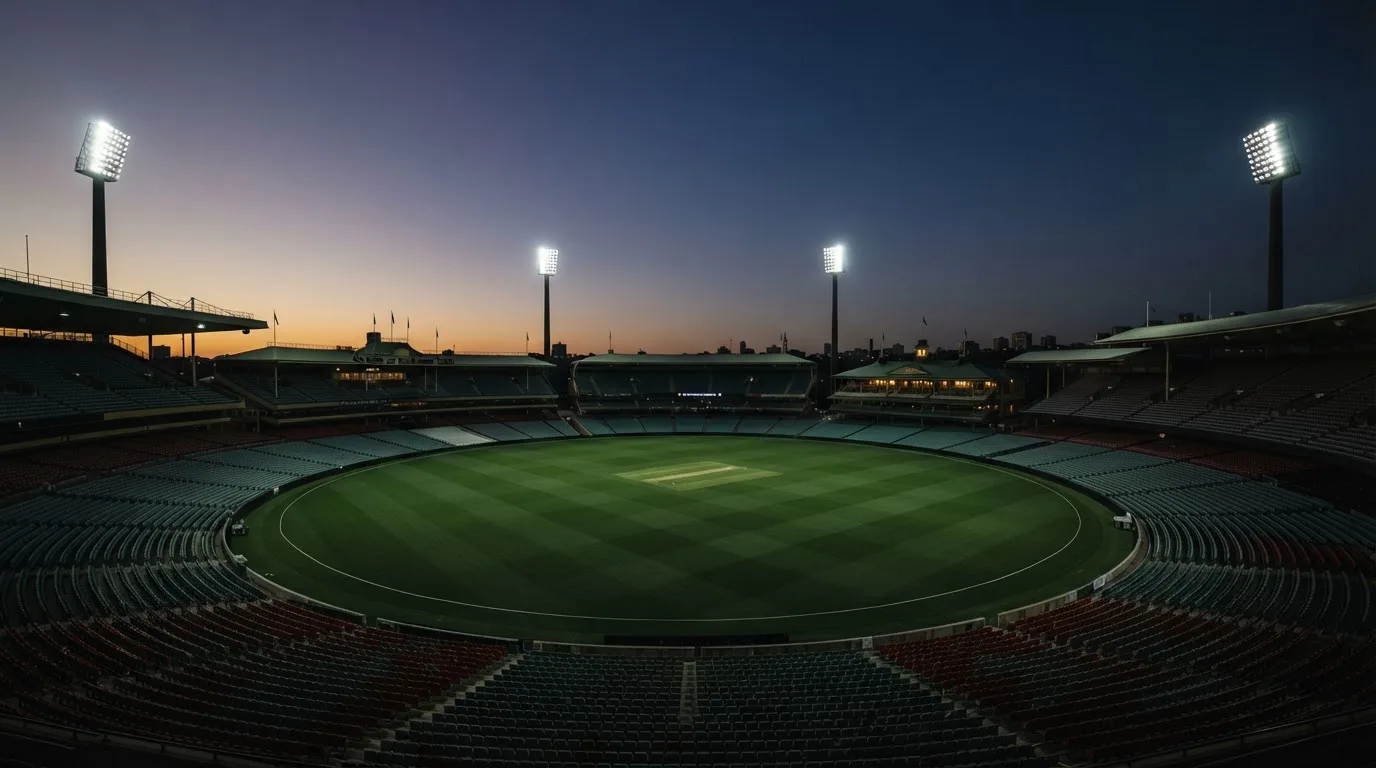
A cricket side has eleven players. Every market on a cricket coupon is built on that fact in one way or another.
Tests: the long form
A Test match lasts up to five days with up to four innings in total, a maximum of two per team. A minimum of ninety overs is scheduled per day, and a match neither side wins is a draw. Three things flow from that structure for a punter.

First, the draw is not a freak result. In a Test it is one of three outcomes on the match-winner market, alongside the home side and the away side. A bookmaker’s 1X2 equivalent on a Test is a three-way line: home, draw, away. A market with three runners takes more margin than a two-runner market, because each outcome shortens the book more. Second, a Test is long enough that in-play betting covers several sessions and weather can swing a price across a day. Third, session markets, over markets and player performance markets sit on top of the match line; a bookmaker’s depth in cricket is partly a measure of how many of those side markets it quotes on a single Test.
ODIs: fifty overs, one innings each
In an ODI each side bats a fixed fifty overs; if the scores are level when the chasing side is all out or out of overs the match is a tie. The result is therefore simpler than a Test: win, lose, or tie. The draw goes.
What an ODI adds is the Duckworth-Lewis-Stern method. In rain-affected ODIs the Duckworth-Lewis-Stern method usually sets the target or the result. If too few overs are played (usually twenty), the match is a no result. A bookmaker’s settlement rules around DLS are a place where two operators can settle the same match differently. The punter checks the operator’s own terms.
T20: the short form
In Twenty20 each team bats a maximum of twenty overs, that is 120 legal deliveries. A bowler may bowl at most four overs. A tied match is decided by a super over. The format suits live betting because an over takes roughly five minutes and a price can move meaningfully across five or six deliveries. T20 is also the format most heavily covered on the coupon outside of international cricket, through franchise leagues and bilateral series.
Who governs the game
The International Cricket Council governs cricket; twelve full members hold Test status, and the World Test Championship began its inaugural season in 2019. India won the 2026 ICC Men’s T20 World Cup, held from 7 February to 8 March 2026 and co-hosted by India and Sri Lanka, beating New Zealand by 96 runs in the final. The T20 World Cup is the tournament the UK punter sees priced for months ahead. For the punter, the meaning is that fixtures cluster around the ICC calendar and the franchise windows, and bookmakers extend their cricket section when those windows open.
How UK Bookmakers Show Cricket Prices
UK bookmakers show cricket odds in two formats: fractional by convention and decimal on the same slip. Fractional odds of 5/1 mean a pound returns six (five profit plus the pound stake back). Decimal odds of 6.00 carry the same information in one number (stake × 6.00). Conversion is a ÷ b + 1, so 5/1 is 6.00 and 11/4 is 3.75.
A first thing to know about either format is that the bookmaker’s margin sits inside every quoted number. The market margin is the share of every pound staked that the bookmaker keeps across all outcomes of a market. On a cricket match-winner market, a margin in the region of 5–8% is ordinary; on a tightly priced market with many runners it can be lower; on a niche player market it can be considerably higher. The margin is paid out of every winning bet, regardless of the outcome.
The arithmetic belongs to one fixed form. For a two-way market priced at decimal odds 1.90 / 1.90, the payout share is 1 ÷ (1/1.90 + 1/1.90), which works out to roughly 0.95. The margin is therefore roughly 5% in that example. Real prices differ: a Test match-winner with home, draw and away at, say, 2.10 / 3.30 / 4.00 yields a payout share around 0.917, a margin around 8.3%. A T20 match-winner with two runners close to evens is closer to the 5% band. A market’s margin is a property of the market, not a property of the bookmaker, and it moves with format, fixture, time to start and operator.
A punter reading a coupon is comparing two things at once. They want the best price on the outcome they want, and they want to know what the bookmaker’s margin on the market looks like. Two prices with the same outcome can sit on different margins on different sites. The price on the slip is the answer to whether the bookmaker left money on the table for that market.
What the odds cover
Every cricket market on a UK bookmaker falls into a few families. Match result, with draw on Tests and tie on ODIs. Innings runs, totals, and the over/under at a target total. Top batsman and top bowler across both sides. Player performance, partnerships, fall of next wicket. Method of dismissal. And on a longer game, session markets, runs at the fall of the first wicket, and the like. The depth of side markets is one of the practical differences between a bookmaker that takes cricket seriously and one that does not. A book with a Test line and a T20 line but no player markets tends to quote the headline markets only.
Live betting sits inside the same families, settled from a stream of data. The bookmaker’s in-play cricket product moves quickly and the price offered a few balls earlier may not be there a few balls later. Cash out, where the bookmaker offers to settle the bet mid-match at a price of its own, sits on top. A bookmaker offering cash out on cricket is offering to take the bet back at its own number; the punter decides whether that number is fair at the time it is offered.
Best Odds Guaranteed and similar concessions
Best Odds Guaranteed is a horse-racing concession rather than a cricket one: if the starting price is bigger than the early or show price taken, the bet is settled at the SP. Bet600 pays Best Odds Guaranteed on horse racing on that basis. QuinnBet’s Best Odds Guaranteed applies to Irish and UK horse racing bets from 10:00am daily on singles, multiples and system bets, with a maximum benefit of £150 per customer per race. On cricket the equivalent concession, where it exists, is named in the operator’s own terms.
The Ten Licensed Brands Reviewed
| Brand | Gambling Commission Licence | What the Brand Offers |
|---|---|---|
| Bet600 | 44731 (Tyche Tech Limited) | Horse racing and best odds guaranteed |
| bet365 | 55148 (Hillside (UK Sports) ENC) | Wide sportsbook, Bet Builder+, and live streaming |
| BetMGM | 39198 (LeoVegas Gaming PLC) | Sports welcome offer with free bets for accumulators |
| BoyleSports | 39469 (Boylesports Enterprise) | £20 free bets for UK players on a £10 stake |
| Octobet | 62545 (Octopus Game Limited) | 50% back as free bet up to £50 |
| Dabble | 65677 (Dabble Sports UK Ltd) | “Bet £10, Get £10 in Free Bets” |
| Sky Bet | 67370 (SBG Sports Limited) | Large UK sportsbook, free bets exclude virtuals/multiples |
| Fitzwilliam Sports | 48760 (SBKI Limited) | Dublin bookmaker with capped membership |
| Kwiff | 44448 (Eaton Gate Gaming Limited) | Randomised “supercharged” odds boost |
| QuinnBet | 61011 (QuinnBet (Gibraltar) Limited) | BOG on UK/Irish horse racing |
The brand set below is drawn from the Gambling Commission’s public register of remote betting licence holders. Every brand named here holds a Commission licence for remote general betting standard (real events). The set is the comparison the page can defend, not a ranking: no single brand is the only licensed one, and a place in a comparison is not a licence.
The write-up under each brand carries the same fields. What does the brand carry in cricket? How is the welcome offer structured? What is on the app? Where the data is missing, the brand is presented on the other fields. Each write-up closes on the brand’s profile as it stands.
Bet600
Bet600 is operated by Tyche Tech Limited under Gambling Commission account 44731 and holds a remote general betting licence. Cricket is part of the sportsbook alongside horse racing, which is where the brand’s Best Odds Guaranteed concession sits. The welcome offer has not been quoted in the licence-level material carried here and is not asserted from inference.
Punters who care most about horse-racing terms and secondarily about cricket will recognise the shape. The brand suits that mix and is thin on what a cricket-only punter would look for.
bet365
bet365 is operated by Hillside (UK Sports) ENC under Gambling Commission account 55148, with a remote general betting licence active for its UK operations. Its app is described in its own marketing as the most downloaded sports betting app in the UK, and the brand is the official global betting partner of the UEFA Champions League. Cricket sits inside a wide sportsbook with Bet Builder+, Super Boosts, Winnings Boosts on Bet Builders and selected singles, and daily Bet Boosts.
Bet Builder+ combines markets from one event into a single bet, available pre-match and in-play. The cricket equivalent of a same-game multi is built there. With a deep in-play product and a long list of side markets, the brand suits a punter who bets on a Test session and on a T20 over the course of a weekend.
BetMGM
BetMGM is operated by LeoVegas Gaming PLC under Gambling Commission account 39198, which covers its remote general betting operations in the UK. The brand’s sports welcome offer for new UK customers who deposit £10 or more and place a sports bet within 7 days is four £10 free bets, two tagged for football accumulators of four or more selections and two for sports multiples of two or more, valid for 7 days with minimum odds and an opt-in required. The free bets are credited after a qualifying bet settles.
The welcome is split across four free bets rather than paid as one block. Punters who bet football and cricket will use all four; cricket-only punters will only use the multiples bucket cleanly.
BoyleSports
BoyleSports is operated by Boylesports Enterprise under Gambling Commission account 39469, which includes a remote general betting licence. The sports welcome offer for UK players is £20 in free bets when a £10 bet is placed, with a parallel €30 in free bets for a €10 bet for Irish players. The stake is not part of the return on a free-bet win.
The BoyleSports welcome is a free-bet-for-stake structure rather than a bonus-with-wagering one. Cricket punters who back a short-priced favourite and want a free bet rather than a bonus-and-turnover will recognise the shape.
Octobet
Octobet is operated by Octopus Game Limited under Gambling Commission account 62545, with a remote general betting licence registered in the UK. The sportsbook welcome offer is 50% back as a free bet up to £50, plus a £10 casino bonus for new customers. The free bet is set at half the qualifying stake to a cap, and the casino bonus is on a separate licence.
A 50%-back free-bet structure refunds the qualifying stake in the form of a free bet rather than cashing out. Punters who stake close to the cap realise close to the headline. Punters who stake well below the cap take a smaller free bet.
Dabble
Dabble is operated by Dabble Sports UK Ltd under Gambling Commission account 65677, and it holds a remote general betting licence for the UK market. The welcome offer is “Bet £10, Get £10 in Free Bets” on a first deposit for new customers, with minimum odds applying, a 7-day free bet expiry and the stake not returned.
One-to-one free-bet match on a £10 stake is a thin welcome. The relevant number is the minimum odds on the qualifying bet, which is the term that decides whether the offer clears cleanly.
Sky Bet
Sky Bet is operated by SBG Sports Limited under Gambling Commission account 67370, authorised to offer remote general betting in Great Britain. The brand is one of the larger UK sportsbooks and is part of a group that shares certain products and policies with adjacent brands; it is presented here on its own terms.
Free bets at Sky Bet expire 30 days after crediting, can be used only on single or each-way markets (not multiples) excluding virtuals, are non-withdrawable and do not return the stake with winnings. The single/each-way only rule is a meaningful constraint: a punter who would naturally put the free bet on an accumulator cannot do so here.
Fitzwilliam Sports
Fitzwilliam Sports is operated by SBKI Limited under Gambling Commission account 48760, with remote general betting standard (real events) on the register. The brand describes itself as a Dublin bookmaker with capped membership, and its welcome is a “High Stakes Welcome” subject to compliance criteria. Capped membership means the bookmaker does not accept every signup.
The brand’s profile is unusual on a UK-licensed list. Punters who can join will find the welcome tailored to a larger stake pattern. Punters who apply and do not hear back have hit the cap.
Kwiff
Kwiff is operated by Eaton Gate Gaming Limited under Gambling Commission account 44448, with remote general betting standard (real events) on the register. The brand describes itself as a trademark operated by Spryme Ltd, and the app carries a 17+ App Store age rating. Kwiff’s distinguishing product is a randomised “supercharged” odds boost on selected bets, which can lift a price well above the market.
A punter who treats Kwiff as a secondary book to take boosted prices has the right shape. A punter who expects every cricket price to carry a boost does not.
QuinnBet
QuinnBet is operated by QuinnBet (Gibraltar) Limited under Gambling Commission account 61011, with remote general betting standard (real events) on the register. The Best Odds Guaranteed concession applies to Irish and UK horse racing bets from 10:00am daily on singles, multiples and system bets, with a maximum benefit of £150 per customer per race. The cricket sportsbook is structured around the same product.
QuinnBet suits a punter whose betting is spread across racing and cricket. The BOG cap of £150 per customer per race is a ceiling rather than the headline, and a punter staking more than that on a single race has hit the cap.
How a UK Bookmaker Is Regulated
In Great Britain there is no statutory list of permitted sports or markets. A bookmaker serving customers in Great Britain needs a Gambling Commission licence wherever it is based; the Commission’s public register is the whole test of who holds one. The Gambling Act 2005 covers Great Britain (England, Scotland and Wales). Northern Ireland is outside the Act and has its own older law; the test on this page is whether the operator holds a Commission licence for the activity of taking bets remotely from customers in Great Britain.
The Gambling Commission is a non-departmental public body sponsored by the Department for Culture, Media and Sport. Since the Gambling (Licensing and Advertising) Act 2014 an operator whose remote facilities are used in Great Britain needs a Commission licence wherever it is based; a Curaçao, Maltese or Gibraltar licence is not a substitute. Betting licences fall into several categories: remote general betting standard (real events), remote general betting standard (virtual events), remote general betting limited, remote pool betting and remote betting intermediary (the licence for betting exchanges). Every brand in the comparison above holds a remote general betting standard (real events) licence.
There is no state monopoly and no cap on the number of licences. Licences are issued to operating companies, not to trading names; several brands can run under one licensee, and it is wrong to present a brand as independent of its licence holder. The register can be searched by business name, trading name, domain or account number, and is the source to check a licence against. Domain proves nothing: licensed operators use .com as well as .co.uk. Financial spread betting is regulated by the Financial Conduct Authority and not the Commission; Spreadex, for example, is regulated by the FCA for spread betting and by the Gambling Commission for fixed-odds betting.
The minimum age is 18. Name, address and date of birth are verified before a customer can deposit or gamble (since 7 May 2019), including with a free bet or bonus. A punt on credit is impossible at a GB-licensed site because credit cards are banned for gambling in Great Britain (since 14 April 2020), including credit-card-funded payments through an e-wallet; debit cards and bank-based payments are not covered by that ban.
In-play, virtual events and exchanges
GB bookmakers offer in-play betting on cricket. The controls are the operator’s licence conditions and customer-protection duties; the page does not characterise in-play as legally unrestricted, because that would overstate the position. Esports are treated like any other event; virtual events are a separate licence category; bets on politics, TV shows and novelty markets are offered by GB bookmakers without a statutory prohibition. Betting exchanges run under a betting intermediary licence, and the rates and rules specific to exchanges are stated only from each exchange’s terms. Spread betting that is not a financial product sits inside General Betting Duty.
Responsible Gambling at a UK-Licensed Operator
The UK framework places the responsible-gambling regime on the operator’s licence. The two pieces a punter meets first are GAMSTOP and affordability checks.
GAMSTOP
GAMSTOP is the national multi-operator online self-exclusion scheme and a mandatory licence condition for online operators since 31 March 2020. Exclusion periods are six months, one year, five years, or five years with auto-renewal, and after the minimum period the exclusion stays in place for a further seven years unless the customer asks GAMSTOP to remove it. GAMSTOP covers online sites and apps; betting shops use a separate service. A self-excluded customer cannot deposit or place bets on any participating operator for the period chosen.
Affordability checks
A financial vulnerability check (LCCP condition 3.4.4, in force since 30 August 2024) applies to licensed remote betting when a customer’s deposits minus withdrawals exceed £150 in a rolling 30 days (since 28 February 2025). It is a public-record check (for example bankruptcy or county court judgments), not an income check and not a credit reference check. Financial risk assessments (often described as affordability checks in the press) were announced in a staged plan published by the Commission in July 2026, with no start date set. The punter’s experience is that the first deposit at any licensed site triggers identity verification and that source-of-funds questions at higher spend are normal under the money-laundering rules.
Deposit and stake limits
Deposit limits (RTS 12) require operators to offer a gross deposit limit on a fixed time frame; the first changes have applied since 31 October 2025, a second phase was postponed to 30 September 2026, and whether it is live is not established. There is no state-set deposit or loss ceiling for betting, and limits are the customer’s choice. Stake limits are the operator’s: no statutory cap on stakes was found, and operators set their own maximum stakes and may restrict customers.
Where to get help
The independent services signposted at every licensed operator include GamCare (which runs the National Gambling Helpline), GambleAware, the NHS gambling clinics network and Gamblers Anonymous. Fitzwilliam Sports, for instance, links to GambleAware, GamStop and Gamblers Anonymous from its own homepage. A punt at stake should never carry a worry that should sit elsewhere.
Bonuses and Free Bets on Cricket
A cricket welcome offer at a UK bookmaker is usually a free-bet structure rather than a bonus-with-wagering one, though the structure varies across brands. The wagering rules in force since 19 January 2026 cap wagering requirements on bonuses at 10x, and mixed-product promotions that require gambling on two or more product types (such as an offer that asks for a football bet to unlock casino free spins) are banned. Whether the 10x cap applies to a free bet with no wagering condition is not established.
Reading a free-bet offer
A free bet with a stake that is not paid back with a win is a smaller offer than its headline number suggests. On a free bet of £10 at decimal odds of 4.00, the punter keeps the £30 profit, not the £40 return, because the £10 stake is not returned. The bookmaker’s margin on the market the free bet is placed on reduces what that £30 represents on average. The deal is worth more on longer-priced selections and less on short-priced favourites.
A casino bonus attached to a cricket welcome is on the casino licence rather than the betting licence. Where research shows a casino bonus, such as Octobet’s £10 casino bonus alongside the 50% back free bet on the sportsbook, the welcome is mixed-product and the rules across products are different.
Where the term bites
Three terms decide whether the offer is worth taking. First, the minimum odds on the qualifying bet: a £10 bet at minimum odds of 1.50 is a different bet from a £10 bet at minimum odds of 2.00. Second, the expiry on the free bet itself: Sky Bet’s 30 days is generous against BetMGM’s 7 days and Dabble’s 7 days. Third, whether the free bet can be used on multiples: Sky Bet excludes multiples and virtuals, which limits a punter who would naturally put a free bet on an accumulator. A free bet that is restricted to single or each-way markets is a different offer from a free bet that can ride an accumulator.
The one promotion rule to remember
A promotion that requires gambling on two or more product types is banned under the rules in force since 19 January 2026. Mixed-product promotions are out. A clean cricket-only offer is in. A combined offer that asks for a cricket bet to unlock a casino reward sits in the banned set.
Mobile and Apps for Cricket Betting
The bookmakers in the comparison all run an iOS and Android app. The depth of the cricket section on a mobile app is roughly the depth of the desktop section, with the live markets reordered for in-play use. A punt on a T20 from a phone shows the current over, the latest price and a cash-out figure all on one page.
bet365’s app is described in its own marketing as the most downloaded sports betting app in the UK, which is a market position rather than an editorial verdict on cricket depth. Lottoland UK’s app combines casino, lottery betting, sports betting and scratchcards, and it is licensed by the Gambling Commission for customers in Great Britain; a punter choosing between a single-sportsbook app and a multi-product app is choosing two different product shapes.
An app that supports partial cash-out, bet-building across markets in one event and live streaming of cricket gives a punter more to do between the prices. The features are named on the operator’s terms page. A 17+ App Store age rating, like Kwiff’s, reflects the gamble-real-money age.
Live Betting and Cash Out on Cricket
Cricket suits live betting because the format produces frequent enough events that a price can move within an over. T20 is the format where live betting is most active; Tests are the format where the price moves slowly enough that each move is a meaningful one. The bookmaker’s in-play product is fed by a data stream and the price offered a few balls earlier is not the price on offer now.
Cash out is a separate product on top of live betting: the bookmaker offers to settle the bet at a price of its own choosing. The punter’s decision is whether that number, at that moment, is fair. A bookmaker offering cash out on cricket sets the number; the punter decides whether to take it or let the bet run.
In-play markets and cash out are pointed at by QuinnBet’s daily-price update and Best Odds Guaranteed on racing and by bet365’s Bet Builder+ available pre-match and in-play. A bookmaker whose in-play product is thin is one where the live experience is a few markets and a slow refresh. A bookmaker with a deep in-play product has the full side markets re-priced ball by ball.
Predictions, Tips and What a Punter Can Actually Know
The punter is right to ask how a cricket price is set. The honest answer is that no model can name a winner on a Test match or a T20 game, and any outlet that sells a “sure bet” is selling something that cannot be delivered. A betting market is a market: prices move with information, with team news, with weather and with the shape of the order book. A tip is one opinion among many; an accumulation of tips is several opinions, still not a prediction.
What a punter can do is work the conditions around the price. A bookmaker’s offer of Best Odds Guaranteed on racing sits on racing, not cricket, and applies to specific conditions. A bookmaker’s offer of a price boost on a cricket match is a marketing concession, not a guarantee; the boost is one-off, sometimes capped at stake, sometimes subject to minimum odds, sometimes withdrawn if the market moves. Reading the terms is the part of the bet that happens before the bet.
A stake plan, a budget and a willingness to leave the bet unplaced are the working tools. A bankroll separate from household money, a stake per bet set as a small share of the bankroll, and a record of settled bets are what a long-run punter ends up doing, because the run is where the variance plays out.
The Bet Types a Cricket Punter Meets
A UK bookmaker’s cricket section is a stack of single-event markets that can also be assembled into multiples and bet builders.
Match result and series result
The headline market. On a Test the line is home, draw, away; on an ODI it is home, away, tie; on a T20 it is home, away, with tie resolved by super over and a tie bet settled accordingly. A bookmaker’s margin on this market varies with format and fixture.
Totals and overs
Innings totals, team totals, and over/under on the match at a target total number of runs. An ODI innings total set at 280.5 is a market on whether the side batting first passes 280 runs. The line moves with team news and weather.
Top batsman and top bowler
Top batsman and top bowler for each side across an innings or a match. These markets are wide on a Test and tighter on a T20. A bookmaker with a deep cricket section prices player markets on the full squad list; a thin section prices three or four.
Player performance
A composite market: runs scored, wickets taken, catches taken. The lines vary by operator. Bet builders often assemble a player-performance line for a single named player.
Method of dismissal
A popular market on Test and county cricket. Bowled, caught, lbw, run out, stumped, hit wicket. The market on the first innings first wicket method carries different prices to the rest of the match.
Live markets on the over
Over/under on the runs scored in the next over, on the next method of dismissal, on the next boundary. These markets live in the in-play section and the prices move ball by ball. The over markets are where a T20 in-play product earns its keep.
Multiples and bet builders
A multiple leg-to-leg is a bet where the winnings of one leg are added to the stake for the next. An accumulator is the common form: four-fold, five-fold, six-fold. A bet builder assembles markets from one event into a single price. Bet Builder+ on bet365 takes markets from one event and prices them as a single bet, available pre-match and in-play. A multiple leg is a multiplication of odds, and the more legs the more the margin compounds.
Working Out Return, Margin and What a Win Actually Pays
Three figures sit behind every bet a UK punter places. The return on a win, the profit on a win, and the margin the bookmaker keeps across a market. Each is a calculation that can be done on the slip and checked against the result the operator settles.
Return and profit on a single bet
For a single bet at decimal odds of 3.00 and a stake of £10, the return on a win is £10 × 3.00 = £30 and the net profit is £30 − £10 = £20. For a bet at 1.50 and £10, the return is £15 and the profit is £5. On a free bet of £10 at 4.00, the return is the £30 profit only because the £10 stake is not paid back; the punter’s net is £30, not £40.
The conversion from fractional odds to decimal is a ÷ b + 1, so 5/1 is 6.00, 11/4 is 3.75, and 1/2 (the price on a short favourite) is 1.50. Conversion is mechanical; decimal odds make the return calculation one multiplication.
Margin across a market
For a market with every runner priced, the payout share is the share of every pound staked that is returned to winning punters across all outcomes. The margin is 1 minus the payout share. On a two-way market at 1.90 / 1.90, the payout share is roughly 0.95 (a punter staking £1 on each outcome gets back roughly £0.95 of every pound) and the margin is roughly 5%. On a three-way Test market at 2.10 / 3.30 / 4.00, the payout share is roughly 0.917 and the margin is roughly 8.3%. A higher margin means a worse deal for the punter in expectation, because more of every pound is taken by the bookmaker.
The margin is a property of the market, not the punter or the bet. It is paid out of every winning bet regardless of which outcome wins. A punter who bets across many markets is paying the margin on each one. The arithmetic provides the only honest summary of what a coupon costs.
What the margin looks like in a price
A price is the answer to two questions. What does the punter get back on a win, and what does the bookmaker keep on average? The first is read off the slip; the second is read off the margin. On a 1.90 / 1.90 line the punter gets £1.90 back on every £1 staked. The bookmaker keeps roughly 5p of every £1 staked across both outcomes. On a 1.85 / 1.85 line the punter gets £1.85 back on every £1 staked and the bookmaker keeps roughly 8p. The lower the price on a favoured runner, the higher the margin on the market tends to be when the opposite runner’s price is also lower.
The Calculation That Does the Work
A worked example on a two-way market makes the point without quoting a real price. Take decimal odds 1.90 on each runner. The payout share on the market is 1 ÷ (1 ÷ 1.90 + 1 ÷ 1.90), which works out to 0.95 once the arithmetic is done. The margin on the market is 1 − 0.95, which is 0.05, or 5%. Stated as a band with its condition, the margin on a typical even-money two-way market at a UK bookmaker sits in the region of 5–8%. Tight odds reduce the margin to a number below 5%, and a market with a mispriced runner pushes the margin above 10%.
The margin is an estimate, not a prediction of any single outcome. A winning bet still pays the price the punter took; the margin tells the punter what the bookmaker is keeping on average across every pound staked. The 5% margin on the 1.90 / 1.90 example is a working number, not a guarantee.
Licensing in Practice
A punter who wants to check a brand against the Commission’s register does it in three steps. Open the register on the Commission’s site. Search by business name, trading name, domain or licence number. Confirm that the operator holds a remote general betting standard (real events) licence that includes the trading name they signed up with.
A licensed brand carries the LCCP conditions: GAMSTOP membership, age verification before the first bet, the financial-vulnerability check on deposit-withdrawal net over £150 in a rolling 30 days, the marketing rules, the 10x bonus wagering cap and the ban on mixed-product promotions. A licensed brand is not, by default, the safer choice in a single comparison; it is the only one with the protection framework behind it. An unlicensed offshore brand offers none of those protections and adds the risk that funds can be withheld without a British redress route.
The Commission’s enforcement is not ISP blocking. It works through cease-and-desist notices, search-engine referrals and work with registrars, hosts and payment providers, and the Commission has been given or is about to receive court-order DNS blocking powers. The frame is disruption, not blanket blocking. Punters should not assume that a search engine or a payment provider decision replicates the Commission’s enforcement or that its absence means a brand is licensed. The register is the source.
Frequently Asked Questions
How do you bet in cricket?
Cricket betting at a UK bookmaker starts with selecting a market on the page: match result, totals, top batsman, top bowler, method of dismissal, or one of the live markets on the next over. The punter enters a stake in pounds, confirms the bet on the slip, and the bet is logged against the customer’s account. Settlement happens when the event is settled by the operator’s settlement rules, and the payout follows the settlement.
How do you bet on cricket?
A bet on cricket at a licensed UK bookmaker requires a verified account, an age of 18 or over, and a deposit from a debit card or bank-based payment (credit cards are banned for gambling in Great Britain). The punter picks a cricket fixture from the sportsbook, selects a market on the match, sets a stake and confirms the bet on the slip. Settlement is from the operator’s own rules, including Duckworth-Lewis-Stern where rain affects an ODI.
How can you win at cricket betting?
A punter wins on cricket when a bet settles in their favour at the price they took, and the payout is stake multiplied by decimal odds. The punter does not, on average, beat the bookmaker’s margin over many bets because the margin is taken out of every winning bet. The arithmetic a winning punter does over time is record-keeping, a stake plan, and an honest read of the terms on each offer.
How can a bookmaker’s Gambling Commission licence be checked?
The Commission’s public register lists every licensed operator in Great Britain and can be searched by business name, trading name, domain or account number. The punter enters the brand name or the domain and confirms a remote general betting standard (real events) licence in the result. No printed number, no marketing line and no link from the brand’s homepage is a substitute for the register entry.
How is the return on a bet worked out from the stake and the odds?
The return on a win is stake multiplied by decimal odds, and the profit is return minus stake. A £10 bet at decimal odds of 3.00 returns £30, of which £20 is profit. A free bet at £10 and decimal odds of 4.00 returns £30 profit, not £40, because the free-bet stake is not paid back. The conversion from fractional odds to decimal is the numerator divided by the denominator, plus one.
What is the bookmaker’s margin and how can it be seen in the odds?
The bookmaker’s margin is the share of every pound staked that the bookmaker keeps across every outcome of a market. On a two-way market at 1.90 / 1.90 the payout share is roughly 95% and the margin is roughly 5%; on a Test match-winner at 2.10 / 3.30 / 4.00 the margin is in the 8% band. The margin is paid out of every winning bet regardless of which outcome wins, and it is the only honest summary of what a coupon costs the punter in expectation.
Rugby, cricket & Gaelic – Darts betting
Content created by the «Darts betting» team
