
Curling Betting Odds 2026: Reading the Prices, the Markets and the Margin
 Available in US
Curling is a niche sport for British bookmakers, and the niche starts at the odds board. The contest between two teams of four — eight stones per end, ten ends at international level — looks orderly on a frozen sheet, yet the prices a bookmaker publishes have a shape of their own. A margin sits inside every decimal quote, that margin decides what an edge costs a bettor, and the size of the margin is what separates a usable price from a poor one. What follows is a working reading of curling betting odds as they sit on a licensed British site in 2026 — how the sport is priced, how a price pays back, how the market is built, and where the offer attached to it actually loses value. Licence status is current as of 27 October 2026 against the Gambling Commission’s public register.

What Curling Looks Like as a Betting Market
Curling has been an Olympic medal sport since 1998 (mixed doubles since PyeongChang 2018) and is contested on the World Curling Tour, the men’s and women’s World Championships, the European Curling Championships, the Continental Cup, the Grand Slam of Curling on Canadian television, and the Canadian mixed doubles championship. Domestically in Great Britain the visible product is the World Championships and the European Championships, with the Winter Olympics a once-every-four-years peak. The British Curling calendar also runs the Scottish men’s and women’s championships and the English Curling Association events at rinks like Greenacres and Murraylands, but those fixtures rarely reach a sportsbook.
The reason is structural. Curling stones weigh 17.24 to 19.96 kg under World Curling Federation rules, and a 10-end game runs roughly two and a half hours of play plus an interval. Markets only form when several bookmakers expect enough turnover to recover the trader’s cost of writing the line, and curling reaches that threshold at World Championships, the Olympics and the major Canadian mixed doubles events. Outside those fixtures the sport sits off the main board; you may find an outright winner market on a tournament a week out, then little else. This is the first thing a punter comparing bookmakers should look for: which operators carry curling as part of their main sportsbook versus a thin line on an event page, and whether the in-play product extends to live ends.
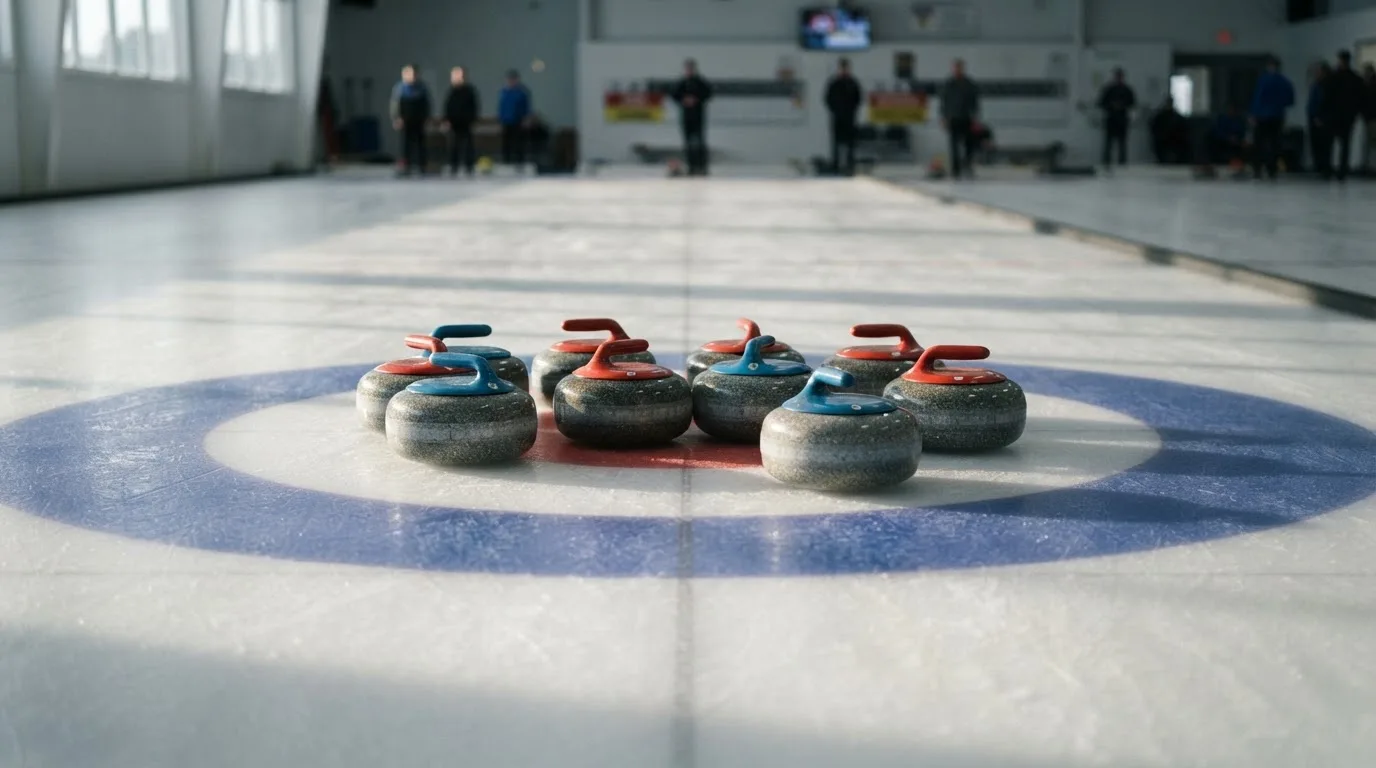
The Fixture Map a Punter Reads First
The fixture map is sparse but cyclical. The men’s World Championship runs each spring, the women’s follows it, the European Championships sit in late autumn, the Olympic qualifier and the Olympic Winter Games are quadrennial, and the mixed doubles Worlds sit midwinter. A bookmaker that takes curling seriously usually prices the World Championships and the Olympics as standalone events, then runs a smaller outright market for the European Championships. If a brand shows curling anywhere — fixtures, antepost, in-play — at all, that is the shelf to read.
Bookmakers in Great Britain treat curling as a niche winter sport in the same category as biathlon, ski jumping and short-track speed skating: present, but never the headline. The “best odds” page of a British sportsbook will not be led by curling. What matters is whether the brand carries it at all, and at what depth. A match outright, an over/under on ends scored, a handicap on stones and an in-play next-stone market are the realistic ceiling. Anything beyond that — totals by country, props on individual curlers — is rare and uneven.
Curling Fundamentals That Decide a Price
A model that prices curling has to know the sport, because the price of a 1X2 — win, draw (extra end), loss — depends on rules that no other sport shares. Three fundamentals move every line.

A team has four players, and each player throws two of the team’s eight stones. That is the squad. Mixed doubles uses two players, each throwing five stones, with pre-positioned stones as well; this rule change at the Olympics in 2018 makes mixed doubles its own market, not a sub-market of the team game. The hammer (last stone of an end) goes to the team that did not score in the previous end; if an end is blanked (no score), the hammer stays with the same team. Hammer is the single biggest variable in curling, and an odds compiler who cannot model it cannot price a game. Tied curling games go to extra ends. After all 16 stones of an end are thrown, the team with the stone closest to the button scores one point for each of its stones closer than the opponent’s nearest stone; only stones in the house count. Curling games usually last 8 or 10 ends; international competitive games are generally 10 ends.
The consequence for a price: bookmakers that price curling seriously will run a match-up model that accounts for hammer, blank probability and extra-end frequency. A bookmaker that does not — and most do not, because curling is a niche — will quote a “softer” 1X2 that the model-influenced sites then price around. The difference shows up in the margin, not the headline. That is why two operators can quote the same favourite at 1.85 and 1.91 and one of them is the better bet.
Licenced British Bookmakers That Carry Curling
The comparison that follows ranks ten operators licensed by the Gambling Commission for remote betting in Great Britain. None of them is “the only” licensed brand — the Commission’s public register lists many more — and a place in this ranking is not a licence or a recommendation. The ten are the brands that research verified as offering a sports betting product accessible to a British customer; their relative position reflects how their curling, in-play, builder and odds shape up against each other. The legal test of whether a brand holds a licence is the Commission’s public register, searchable by name, trading name, domain or account number.
| Brand | Licence & Holder | Terms Summary |
|---|---|---|
| BetMGM | 39198 (LeoVegas Gaming PLC) | Match outright, ends O/U |
| Star Sports | 9177 (Star Racing Limited) | Direct trader contact |
| BetTom | 64959 (Bet Tom Limited) | Mixed-promo offer |
| Betboro | 44181 (Webmedia Development N.V.) | Small curling shelf |
| Lottoland | 38991 (EU Lotto Limited) | Lottery-led sportsbook |
| BetGoodwin | 2927 (Goodwin Racing Limited) | Acca/Sub-Cover focus |
| Betfair | 39439 (PPB Counterparty Services Limited) | Exchange liquidity |
| Fitzdares | 400 (Fitzdares Limited) | Antepost, specials |
| QuinnBet | 61011 (QuinnBet (Gibraltar) Limited) | BOG on horse racing |
| Bet Ahoy | 100094 (Bet Ahoy Ltd) | Broad listings |
BetMGM runs under a Gambling Commission remote general betting standard (real events) licence held by LeoVegas Gaming PLC, account 39198. Its sports welcome offer for new UK customers who deposit £10 or more and place a sports bet within 7 days is four £10 free bets — two £10 football accumulators of four or more selections, two £10 sports multiples of two or more. The free bets are valid for 7 days and require a minimum price and opt-in. The brand inherits LeoVegas’s technology stack and the live odds feed that the parent uses in European markets, which means in-play coverage on mainstream winter sports. Curling markets on BetMGM tend to appear around the World Championships and the Olympics as a match outright plus an over/under on ends.
Star Sports
Star Sports runs under a Gambling Commission remote licence held by Star Racing Limited, account 9177. The brand’s distinctive offer is direct contact: customers can call 08000 521 321 to open an account, place bets or ask customer queries, and reach the same traders by email. That phone-led model is a sharp departure from the click-and-go app stack, and it suits a punter who wants a price negotiated rather than taken from a screen. Star Sports tends to price horse racing, football and boxing more deeply than curling, and the curling shelf is usually limited to outright winner on a major championship.
BetTom
BetTom runs under a Gambling Commission remote licence held by Bet Tom Limited, account 64959. The sports welcome offer is 50% back as a free bet of up to £50, with a matching 50% back up to £50 as free slot funds for casino play. The matched free bet and the casino pairing place the offer in the mixed-promotion zone that the Gambling Commission addressed in its 19 January 2026 rules — see the legality section for what that means in practice. BetTom is positioned as a multi-product brand rather than a deep-niche bookmaker, and its curling coverage tends to sit alongside other winter sports as a single outright market on each major championship.
Betboro
Betboro runs under a Gambling Commission remote licence held by Webmedia Development N.V., account 44181. The sports welcome offer is a 100% matched free bet of up to £25 on the first qualifying wager, requiring a debit card deposit of at least £10 and a first bet of £5 to £25 with at least three selections each at 3/5 (1.60) or higher. The minimum price of 1.60 is the figure to watch: any free-bet return only realises when a leg beats that line, and a curling outright rarely clears it for an underdog. Betboro’s product is broad rather than deep, and the curling shelf is small.
Lottoland
Lottoland holds a Gambling Commission remote licence (account 38991) via EU Lotto Limited. The Lottoland UK app combines casino, lottery betting, sports betting and scratchcards; the brand’s identity is the lottery side, and the sportsbook is an add-on rather than the lead product. The curling shelf on Lottoland is typically absent outside the biggest events. A punter looking for the niche here should not expect it, and the brand is on this ranking as a licensed sportsbook that can in principle carry the sport, not as a deep curling bookmaker.
BetGoodwin
BetGoodwin operates with Gambling Commission remote licence 2927 (Goodwin Racing Limited). The sports welcome offer is “Bet £10 & Get £15 in Free Bets”, made up of a £5 sports bet, a £5 acca and a £5 Sub-Cover bet. The Sub-Cover format is brand-specific: a single £5 stake returns a free bet if one leg of an accumulator voids. BetGoodwin’s product leans horse racing, and curling appears mainly as an outright on major championships rather than a match-by-match feed.
Betfair
Betfair Sportsbook runs under a Gambling Commission remote betting intermediary licence held by PPB Counterparty Services Limited, account 39439. The Sportsbook — the fixed-odds product, distinct from the Exchange — offers in-play betting, a Bet Builder, free live streaming of UK and Irish horse racing and football within the app, and a 90 Minute Payout market on football. Betfair Sportsbook prices curling in major championships and offers in-play during the bigger events, and the Exchange layer lets a sophisticated punter lay a price rather than back it. The Exchange carries separate liquidity and a separate commission structure, and a curling price on the Exchange is set by backers and layers, not by the Betfair Sportsbook trader.
Fitzdares
Fitzdares is licensed by the Gambling Commission under account 400 (Fitzdares Limited), one of the older accounts on the register. The Fitzdares app offers cash out, accumulators, Lucky 15s, specials and antepost markets on horse racing, football, tennis, rugby, cricket, golf and American football, with in-play live odds. The sport list does not include curling as a headline market, and the brand’s depth is in horse racing and the major team sports. A punter who likes a phone-led bookmaker with antepost specials will find Fitzdares has a particular character; a punter looking for curling depth will not.
QuinnBet
QuinnBet holds Gambling Commission remote licence 61011, issued to QuinnBet (Gibraltar) Limited. Its Best Odds Guaranteed applies to Irish and UK horse racing bets from 10:00am daily on singles, multiples and system bets, with a maximum benefit of £150 per customer per race. The Best Odds Guaranteed concession is horse-racing specific and does not extend to curling. QuinnBet’s curling coverage is modest, and the brand is on this ranking because it carries a remote licence and offers a sportsbook product rather than because it prices curling deeply.
Bet Ahoy
Bet Ahoy is licensed by the Gambling Commission for remote betting (account 100094, Bet Ahoy Ltd). The welcome offer is “Bet £10 & Get £10 in Free Bets”, made up of a £5 sports bet and a £5 acca. Bet Ahoy’s product is broad and the curling shelf is small. Research lists Bet Ahoy’s curling coverage as listings-only against en.wikipedia.org — what the listings report rather than what the operator’s own terms confirm — so this write-up presents the brand on its other features rather than as a verified curling outlet.
The Landscape: What Curling Looks Like Across the Ten Brands
The ten brands are not equivalent on the curling shelf. At one end sit the operators with a deep mainstream sportsbook that prices curling around the World Championships and the Olympics — BetMGM and Betfair at the front of the pack, with Betfair’s Exchange layer as a separate liquidity pool. At the other end sit the lottery-led, horse-racing-led and phone-led brands where curling is an afterthought or a single outright market at best. Lottoland, Star Sports, BetGoodwin, Fitzdares and QuinnBet fall into that group. BetTom and Betboro occupy the middle, with a free-bet welcome package attached and a modest curling shelf. Bet Ahoy is on this ranking because it holds a remote licence and runs a sportsbook; its curling presence is listings-only. The verdict on each block above closes on the gap, not on a rephrased suitability clause.
How to Read a Curling Price
A price in decimal form is what a £1 stake returns if the bet wins, stake included. Stake £10 at 1.85 returns £18.50; the punter keeps the stake and takes £8.50 of profit. Stake £10 at 6.00 returns £60; the punter keeps the stake and takes £50 of profit. The return is stake × odds, and the profit is stake × (odds − 1). That arithmetic is universal on a British licensed sportsbook, because decimal odds are a regulatory norm in Great Britain. Fractional odds — the British native form, written 5/1 or 11/4 — express profit over stake, with the conversion decimal = numerator ÷ denominator + 1, so 5/1 becomes 6.00 and 11/4 becomes 3.75. Evens is 1/1, decimal 2.00.
The punter reading a price knows three things at once: the implied probability the bookmaker is building into the quote, the rival bookmaker’s quote on the same outcome, and the margin the bookmaker is taking from the market. The third is the one the headline price hides.
The Margin Is What the Price Hides
A two-way market is the cleanest way to see a margin. Take an illustrative match outright with both teams quoted at decimal odds 1.90 — fractional 9/10, an example rather than a quoted price. Implied probability from one decimal price is 1 ÷ odds, so each side reads as roughly 52.6%. Two sides at 52.6% each sum to 105.3%, and that 5.3% over 100% is the bookmaker’s margin, sometimes called the overround. It is the slice of every pound bet that the bookmaker expects to keep on average across many bets on this market. The same arithmetic on a three-way market — win, draw (extra end), loss — runs to three implied probabilities summing to roughly 108% on a deep market and worse on a thin one.
What follows from that: a bookmaker quoting 1.85 / 1.85 is asking for a higher margin than one quoting 1.91 / 1.91, and a bookmaker quoting 1.95 / 1.95 is closer to a “true” line. The punter who reads two prices on the same selection from two different accounts has already done the work the headline hides. A margin of 5% to 6% on a curling match outright at a deep bookmaker and 8% to 12% at a brand that does not price the sport seriously are both realistic bands; the wider the band, the more the headline favourite is being over-quoted against the underdog.
The conclusion is plain. Margin is not a feature; it is the price of using the bookmaker. The punter who prices curling across two or three books has already done the comparison the headline cannot.
Accumulator Odds Multiply Into One Price
For a combination bet the odds of the legs multiply into one price. Three legs at 1.85, 1.91 and 1.95 multiply to roughly 6.89; a £10 stake returns £68.90 if all three win, profit £58.90. The combined margin of an accumulator is higher than any single leg’s margin, because each leg carries its own slice and the slices compound. A 6.89 accumulator on three curling matches is a worse price than 6.89 laid as a single price, because the bookmaker has taken the margin three times. That is why an accumulator on curling in a thin market is a particularly expensive way to bet.
What a Licensed British Bookmaker Has to Do
The bookmakers on this ranking hold a Gambling Commission remote general betting standard (real events) licence for Great Britain — a category that covers betting on real sporting events from a remote platform. Several are run by licensees outside Great Britain (Gibraltar, Curaçao, Malta) under Gambling (Licensing and Advertising) Act 2014, the rule that brought all operators serving British customers into the Commission’s reach. None of them is licensed in Northern Ireland, which sits outside the Gambling Act 2005; a GB licence regulates the operator’s third-party transactions involving Great Britain, not Northern Ireland.
The legal test of whether a brand holds a licence is the Commission’s public register at gamblingcommission.gov.uk, searchable by business name, trading name, domain or account number. A punter who runs the brand name, the trading name or the account number into the register sees the licence status, the categories and the trading names the licence covers. Ladbrokes and Coral sit under one licence; Paddy Power and Betfair sit under another. Two brands under one licence are not two independent operators.
The Bonus Cap That Changes the Picture
Two Commission rules shape what a “free bet” or “matched bonus” is worth. From 19 January 2026 a bonus offered to a customer may not carry a wagering requirement above 10x — a £10 bonus at 50x needed £500 of qualifying bets, and under the cap no more than £100 of qualifying bets can be required. From the same date, mixed-product promotions — an offer that requires gambling on two or more product types such as betting, casino, bingo and lottery, for example “bet on football to get free spins” — are banned.
What follows for the brands on this ranking: BetTom’s “50% back as a free bet” with a “matching 50% back as free slot funds” sits exactly in the cross-product promotion the rule addresses; whether it remains in that shape after the rule’s enforcement depends on how the brand has rebuilt it, and the punter should read the current terms before claiming. The wagering cap is the rule that decides what a bonus costs. A £25 free bet with no wagering condition is one thing; a £25 free bet with a 10x turnover is another, and the cap is what stops it becoming a third.
Verification Before the First Bet
Since 7 May 2019 a licensed British bookmaker must verify the customer’s name, address and date of birth before the customer can deposit or gamble, including with a free bet or bonus. There is no anonymous play at a licensed site. Since 28 February 2025 a financial vulnerability check (LCCP condition 3.4.4, in force since 30 August 2024) applies when a customer’s deposits minus withdrawals exceed £150 in a rolling 30 days: it is a public-record check (for example bankruptcy or county court judgments), not an income check and not a credit reference check. A financial risk assessment — the deeper affordability check that has appeared in press coverage — was announced as a staged plan in a Commission article of 7 July 2026, with no start date.
What the Off-Shore Alternative Costs
A bookmaker without a GB licence has no obligation under the Commission’s rules: no GAMSTOP coverage, no Commission complaints route, no approved dispute-resolution body, no British consumer redress if funds are withheld, no 10x bonus cap and no £150 vulnerability check. The customer’s deposit sits behind a Curaçao, Maltese or other non-British regime. The Commission treats providing gambling facilities in Great Britain without the licence the Act requires as an offence under section 33 of the Gambling Act 2005 — aimed at the operator, not at the customer. The customer using an unlicensed site loses the protections the British licence brings, and the Commission enforces by cease-and-desist, search-engine referrals, registrar and host work, and announced court-order DNS blocking powers. ISP blocking is not in operation. The honest framing is that licensed means checks, limits, GAMSTOP and the bonus cap; unlicensed means none of those and the risk of loss of funds.
What May Be Bet On
There is no statutory list of permitted sports or markets in Great Britain. An operator holds a licence for a category and offers markets under its own rules and the Licence Conditions and Codes of Practice (LCCP). Curling is treated like any other event and may be bet on under a remote general betting standard (real events) licence. In-play betting is offered by GB bookmakers and the controls are the operator’s licence conditions and customer-protection duties; there is no statutory “restriction” on in-play, and there is no statutory freedom from restriction either. Bet Builder markets combine markets from one event into a single bet; how deep that builder runs into curling props varies by bookmaker.
Tax and What It Means for a Punter
The punter pays no tax on betting winnings in Great Britain. General Betting Duty is the operator’s tax on gross profits and is currently 15%; from 1 April 2027 a new remote betting rate of 25% applies within it, while remote bets on UK horse racing, bets on self-service betting terminals, pool betting and in-person betting stay at 15% (HM Government policy paper of 26 November 2025). Until 1 April 2027 the remote rate stays at 15%, and whether operators pass duty on through odds is not established. The punter’s take is the return the betting slip prints, in full, no tax line and no withholding.
Safeguards and Limits a Punter Should Know
Three rules sit in front of every British bookmaker, and a punter who knows them has already cut the offer down to size. GAMSTOP is the national multi-operator online self-exclusion scheme and a mandatory licence condition since 31 March 2020. Periods are six months, one year, five years, or five years with auto-renewal; after the minimum period the exclusion stays in place for a further seven years unless the customer asks GAMSTOP to remove it. GAMSTOP covers online sites and apps; betting shops use a separate service. Every GB-licensed online operator takes part in GAMSTOP, so a punter who has registered with GAMSTOP is excluded from every brand on this ranking at once.
Deposit limits sit at the operator level: an operator must offer a gross deposit limit on a fixed time frame (Remote Technical Standards 12). The first changes applied from 31 October 2025, a second phase was postponed to 30 September 2026, and whether it is live in 2026 is not established. There is no state-set deposit or loss ceiling for betting: limits are the customer’s choice and a customer can lower a limit at any time and raise it only after a cooling-off period. A punter setting a £100 weekly limit and then trying to raise it to £300 at one trade-off does not find the operator offering the raise on demand.
Help is real and British. GamCare runs the National Gambling Helpline. GambleAware funds treatment and education. The NHS runs gambling clinics. Gamblers Anonymous runs group meetings. A punter who finds the offers and the limits still rendering visible on a screen has the option to talk to a professional; a punter who is reluctant to do that can self-exclude through GAMSTOP and the operator’s own self-exclusion facility, and a friend or family member can refer the customer to GAMSTOP through its referral pathway.
How to Choose Among the Ten Bookmakers
The ranking is not a recommendation. It is a licensed set, and the comparison the punter does is the one a margin and an offer turn into a price. A punter picking a curling bookmaker on a single criterion should pick on three: the depth of the curling shelf, the size of the margin on the match outright, and the shape of the welcome package if one is being claimed.
Depth of shelf is the first cut. Betfair and BetMGM carry the deepest curling shelves on this ranking, with in-play on major championships. QuinnBet fits Lottoland fits Fitzdares carry curling as a single outright market or not at all. A punter who wants to bet on the men’s World Championship match-by-match needs a deep shelf; a punter who wants a single outright wager does not.
Margin on the match outright is the second cut. The punter who runs two bookmakers side-by-side on the same match and finds a 1.85 / 1.91 gap on the favourite is looking at a margin difference that compounds across a season. The wider margin is the one that hurts an edge.
Shape of the welcome package is the third cut, and the shape that matters in 2026 is the wagering multiple and whether the offer is mixed-product. A free bet with no wagering condition is a free bet. A matched bonus with a 10x turnover costs £100 of qualifying bets for every £10 of bonus — and that turnover is not free to the punter, because the qualifying bets carry their own margin. The mixed-product promotion is the one the Commission has banned from 19 January 2026; the punter who sees “bet on football to get free spins” should not see it.
What a Punter Can Realistically Win
The numbers, plain. A £10 stake at decimal odds 6.00 (fractional 5/1) returns £60 if the bet wins — stake returned, profit £50. A £10 stake at 1.85 returns £18.50, profit £8.50. A £10 accumulator of three legs at 1.85, 1.91 and 1.95 returns roughly £68.90 if all three win, profit £58.90. The arithmetic is the same on every licensed British sportsbook; the price is what changes. The punter who bets a single £10 stake on a curling match outright and wins takes the return the slip prints. The punter who bets a £10 accumulator takes the multiplied price and the multiplied margin.
Picking the Right Market
Three market types carry curling. The match outright (1X2, with the draw an extra end) is the headline and is the cleanest market for reading a margin, because the two-way version reduces the variables. The over/under on ends scored — usually 9.5 — turns the game into a pace market and rewards a punter who can read a blank-end strategy. The handicap on stones — a +1.5 stones line — turns the game into a margin market and rewards a punter who can read a steal. In-play during a major championship adds the next-stone market, which is fast and is for a punter who is watching the sheet. Anything beyond these is rare and uneven across bookmakers.
Frequently Asked Questions
How does a punter bet on curling?
A punter bets on curling at a bookmaker licensed by the Gambling Commission, opens an account, verifies name, address and date of birth, deposits £10 or more by debit card or bank transfer (credit cards are banned for gambling in Great Britain), then selects a curling market — typically a match outright, an over/under on ends, a handicap on stones, or an outright winner on a tournament — and places a stake at the price shown. The bookmaker settles the bet at the result returned by the data provider.
Can a punter bet on curling in Great Britain?
Yes. Curling is a permitted betting market under a remote general betting standard (real events) licence, and bookmakers licensed by the Gambling Commission for Great Britain can offer it under their own market rules. The sport is treated like any other event; no statutory prohibition was found. Markets are deeper during the World Championships and the Olympic Winter Games than at other points in the calendar, and the bookmakers that carry curling year-round on a thin shelf are the majority of those listed above.
How does a punter check that a bookmaker holds a Gambling Commission licence?
A punter uses the Commission’s public register at gamblingcommission.gov.uk, searchable by business name, trading name, domain or account number. A match against the register shows the licence status, the categories, the trading names and the company. A brand not on the register is not licensed for Great Britain. Several brands can run under one licence — Ladbrokes and Coral under one, Paddy Power and Betfair under another — and two brands under one licence are not two independent operators.
How is the return on a bet worked out from the stake and the odds?
The return is stake × odds in decimal form. A £10 stake at decimal odds 1.85 returns £18.50 if the bet wins, of which the profit is £8.50; the formula for profit is stake × (odds − 1). For a combination bet the odds of the legs multiply into one price. The arithmetic is the same on every licensed British sportsbook; the price is what changes.
What is the bookmaker’s margin and how can it be seen in the odds?
The margin is the slice of every pound bet that the bookmaker expects to keep on average across many bets on the market, and it sits inside the price. On a two-way market where both outcomes are priced at decimal odds 1.90, each outcome implies roughly 52.6% probability (1 ÷ 1.90), and 52.6% + 52.6% sums to 105.3% rather than 100% — the 5.3% over 100% is the margin. On a curling match outright at a deep bookmaker a margin of 5% to 6% is realistic; on a thin shelf a margin of 8% to 12% is realistic. The wider the margin, the more the favourite is being over-quoted against the underdog.
How do fractional odds such as 5/1 convert to decimal odds such as 6.00?
The conversion is decimal = numerator ÷ denominator + 1. Fractional 5/1 becomes 5 ÷ 1 + 1 = 6.00. Fractional 11/4 becomes 11 ÷ 4 + 1 = 3.75. Evens (1/1) becomes 2.00. The numerator is the profit the punter makes per unit stake, the decimal form is the total return per unit stake including the stake, and the two are the same price expressed differently.
Tennis, darts & cue sports – Darts betting
Content created by the «Darts betting» team
