
How to bet on cycling in 2026 without mistaking the race
 Available in US
Cycling rewards patience. A three-week Grand Tour hands you twenty-one stages and a result bookmakers already had months to price, so the market that lets you think is the one before the off, not the one at the line. The job of a cycling punter is to read a price, not to predict a winner — those are different trades and what follows is built around that gap.
Cycling betting tips in 2026 sit inside a market that is wider than it looks. Bookmakers cover the Tour de France, the Giro d’Italia and the Vuelta a Espana stage by stage; they price one-day Classics from Milan-San Remo to Il Lombardia; they hold outright markets on the WorldTour ranking months before a rider has touched a handlebar. The substance of a tip on any of those is the same: the form, the route, the team around the leader, and a price that reflects more than guesswork. None of it removes the margin. The bookmaker keeps a slice of every pound wagered, and that slice is the first number a tip should clear before it earns its stake.
Currency and data are current as of 27 October 2026 and have been checked against the Gambling Commission’s public register and the bookmakers’ own published terms.
The Grand Tours and the road calendar that frames every price
Three races sit above everything else in road cycling, and any bookmaker offering outright markets on cycling has them priced before the season begins.
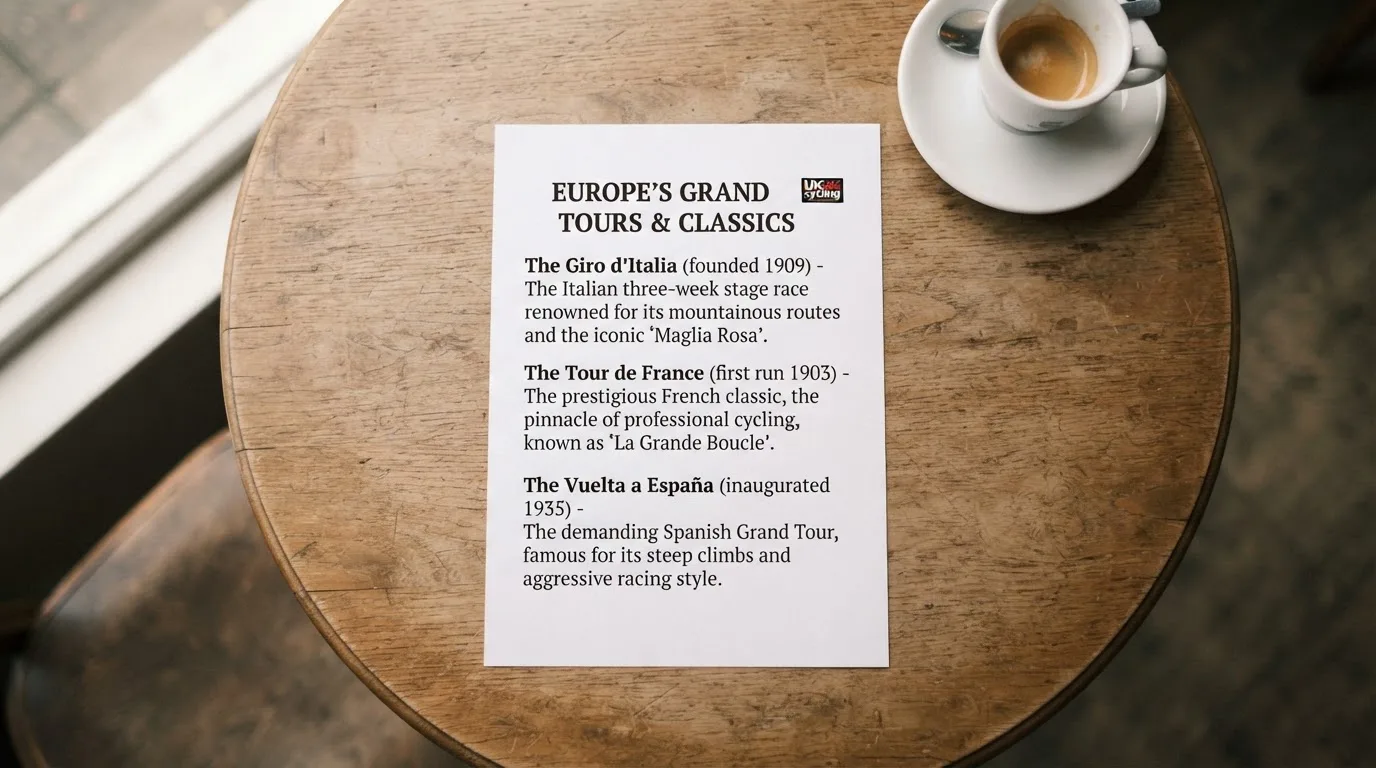
The Giro d’Italia has run since 1909 and tours three weeks of Italy in May. The Tour de France, the longest-running of the three at well over a century, crowns July and finishes on the Champs-Elysees. The Vuelta a Espana, first held in 1935, closes the season in August and September. UCI rules allow a Grand Tour to run between fifteen and twenty-three days, and most editions sit in the low twenties. The leader’s jersey changes by race: pink in Italy, yellow in France, red in Spain. Two rest days inside three weeks is the norm rather than the exception, and bookmakers mark them as light trading days in stage markets.
The 2026 Tour de France ran from 4 July to 26 July 2026, starting with a team time trial in Barcelona and finishing in Paris over 21 stages and 3,245 kilometres, with 23 teams on the start list. Tadej Pogacar (UAE Team Emirates, Slovenia) took his fifth Tour win in that edition. The Tour sets the tone for the rest of the calendar: a Grand Tour winner in July tends to shorten the outright price on the Vuelta six weeks later, and bookmakers adjust before the start lists are confirmed.
Beneath the Grand Tours sits the UCI WorldTour, which the UCI created in 2005 as the ProTour and renamed the WorldTour in 2011. It bundles the Grand Tours, the week-long stage races (Paris-Nice, Tirreno-Adriatico, the Critérium du Dauphiné, the Tour de Suisse), and the one-day Monuments. The WorldTour ranking determines which teams hold automatic entry to those races the following season. Outright markets on the WorldTour are thin — most bookmakers price stages, GC standings, jersey classifications and head-to-heads inside each race rather than the season-long ranking — but the points table explains why a team rides one rider for GC and another for stage wins: both halves of that bet need a different customer.
Stage markets and GC outrights
A Grand Tour offers four core markets on the men’s side, and most offer the same four on the women’s side through the Tour de France Femmes and the Giro d’Italia Women.
The general classification (GC) outright is the race winner. Bookmakers open a market the day entries are confirmed and keep it live until the final stage, with the field priced from a favourite at roughly 2/1 (3.00) through to 500/1 (501.00) and beyond. The favourite is rarely the winner — twenty-one stages and three weeks invite attrition — which is what makes GC a market for reading form rather than picking a name.
Stage markets open once the route of the next day is published and close shortly before the start. They are priced from the day’s profile: flat stages favour sprinters and breakaway specialists, hilly stages favour puncheurs, mountain stages favour the climbers, and the individual time trial favours the rider against the clock. The favourite’s price depends on the field; a sprint stage in a flat Tour week can see the favourite at 4/1 (5.00) with the next ten riders inside 33/1 (34.00), while a mountain stage can see a clear favourite at 2/1 (3.00) if only two or three riders in the field can climb at the front.
Jersey classifications are three separate outrights inside one race: points (green in the Tour, ciclamino in the Giro, red points jersey equivalent in the Vuelta), mountains (polka dot, blue, blue-dot depending on race), and young rider (white in the Tour, white in the Giro, white in the Vuelta). Each is a season-long bet compressed into three weeks of points scored at intermediate sprints, on classified climbs, and on stage finishes. The points jersey goes to a sprinter who can survive the mountains; the mountains jersey often goes to a breakaway specialist or a GC rider picking up points opportunistically; the young rider jersey goes to the highest-placed rider under 26 on GC.
Head-to-head markets pair two named riders and ask which finishes higher on the stage or on GC. They are the easiest market to read because two riders in one number is simpler than a field of 150, and the margin inside them is tighter than in stage outrights. Bookmakers price them down to the tenth of a point.
One-day Classics follow a different shape: a one-off race, no GC, no jerseys, a smaller field, and a market that opens a few days before and closes an hour before the start. Milan-San Remo, the Tour of Flanders, Paris-Roubaix, Liège-Bastogne-Liège and Il Lombardia are the five Monuments and headline the spring and autumn Classics calendars.
In-play on a moving race
In-play on cycling is a different market than in-play on football. The price does not move because the game state moves — there is no score — but because the bookmaker reprices after each meaningful event: a crash at the front of the peloton, an attack on a classified climb, a time gap at the top of a mountain, a split in the crosswinds. UK bookmakers offer in-play on Grand Tour stages and the major Classics, and the controls on it sit in the operator’s licence conditions rather than in statute. A market that can move fifteen points inside two kilometres of racing is one to respect rather than chase.
Live streaming of cycling is patchier than for football. The ASO and RCS own the broadcast rights to the Tour and the Giro and licence a feed to bookmakers in some markets but not others; British customers more often watch the race on a public broadcast and the price on the betting app in parallel. A few operators carry selected race feeds; most carry none, and the punter’s job is to watch the race and read the price rather than rely on a stream that may not exist.
Reading a price: form, route and what the bookmaker already knows
The form book is where a tip starts. A punter reading a stage market looks at the last ten race days of each rider in the field, the type of stage that day, and the team the rider turns up with. A sprinter who has not podiumed in three flat stages is not a tip at 6/4 (2.50) on the fourth. A climber who finished tenth on the previous mountain top is not a tip at 3/1 (4.00) on the next. Form is the part of the price a punter can replicate; the bookmaker’s model already has it.
The route is the part of the price a punter can sometimes out-read. Bookmakers publish the stage profile the day before the stage and the riders confirm their targets overnight; a punter who reads the profile, the weather forecast and the start list together has an edge a model fed only on results will not catch on the day. A mountain stage into a headwind favours a defensive ride; a flat stage into a crosswind invites a nervous bunch sprint and a higher probability of a split.
The team is the part of the price the bookmaker already has. UAE Team Emirates, Visma-Lease a Bike, Soudal Quick-Step, INEOS Grenadiers, Lidl-Trek, Bahrain Victorious and the other WorldTour squads ride a stage with a leader and a domestique roster built around that leader. The domestique part is rarely priced into stage markets; a punter who watches the race and reads the team car has a sense of who is working for whom that the closing line rarely captures.
The value bet sits on top of all three. A value bet is a price higher than the true probability of the outcome, once the bookmaker’s margin has been taken out. If a sprinter has a 25% chance of winning a flat stage and the bookmaker is offering 4/1 (5.00) — implying 20% — there is no value. If the same sprinter has a 25% chance and the bookmaker is offering 6/1 (7.00) — implying 14.3% — there is value. The punter’s job is to estimate the probability honestly and then take the price only when it is above it. The bookmaker keeps the margin; the punter keeps whatever sits above it.
The same logic applies to GC outrights, where a punter who thinks the favourite is 35% to win and the bookmaker has him at 5/2 (3.50) — implying 28.6% — has a different decision to make than a punter who thinks the favourite is 35% and the bookmaker has him at 6/4 (2.50) — implying 40%. The first is value; the second is overpaying the favourite because the field is short. The bookmaker keeps more than the difference on most outrights because the field is long and the margin is built in.
A tip that ignores the margin is a tip that loses before the race starts. A 25% chance at a price implying 20% is value; the same 25% chance at a price implying 30% is a gift the bookmaker is not offering. Margin is the first number to clear, not the last.
Staking, bankroll and the discipline that survives a three-week race
Cycling punting breaks bankrolls because the calendar is heavy and the markets are tempting. A punter who bets on every stage of a Grand Tour at £10 a stage over 21 stages has staked £210 before the race is a third through; the same punter who bets £10 on a single GC outright at the start of the Tour is in the market for one race for the same money. The difference is how exposed the bankroll is to bad days.
Bankroll discipline is the part of cycling punting that turns form reading into a return. A punter with a £500 bankroll for the season might stake 1% — £5 — on a head-to-head and 2% — £10 — on a stage outright, and 0.5% on the longshot breakaway bets that are most of the fun. The stake is sized before the price is taken, not after; a £5 bet at 6/1 is a £5 bet whether the rider wins or not, and the punter who raises the stake after seeing the price is the punter who breaks the bankroll on the day.
A staking plan that varies by confidence is the trap. The punter who doubles the stake on “the one I’m sure about” is the punter who loses the bankroll on the day that one lets him down, which the form book has already told him will. Each-way betting on stage markets and GC outrights is a separate question: a punter taking a 25/1 each-way on a Tour stage is paying for the place half of the bet at the same stake as the win half, doubling the cost, and the place terms on cycling stage markets are rarely generous enough to make that worth doing for longshots. Each-way has its place on a flat Classics race with a small field where the place terms are 1/3 the odds for the first three, and the punter has priced it as such.
The other discipline is the calendar. A punter who bets on the Giro, the Tour and the Vuelta in the same summer is in three concurrent markets with three concurrent overrounds. The bankroll that lasts one Grand Tour at 2% a stage does not last three at 2% a stage; either the stake shrinks or the calendar does. The disciplined punter picks the race, picks the stages, and sits the rest out.
A discipline that is harder than it looks: stop betting after a stage loss. A punter who has lost on the morning’s flat stage and bets again on the afternoon’s mountain stage is the punter who loses on the morning’s flat stage twice. The next tip is the same shape of decision as the last tip, and a bankroll that needs to recover is a bankroll that has stopped being a bankroll.
The bookmaker’s margin and what it does to every line on the page
A bookmaker keeps a margin on every market it offers. On a two-way market — a head-to-head, an over/under on a stage’s winning time, a yes/no on whether a named rider finishes inside the top ten — the margin sits inside both prices and the punter who adds them up gets back less than £1 for every £1 wagered across both outcomes. On a stage outright with a field of fifty, the margin sits inside every one of the fifty prices and the punter who backs the whole field gets back less than £1 for every £1 wagered.
Take an illustrative two-way market priced at 1.90 (9/10) on either side. The implied probability of each outcome is 1 ÷ 1.90 = 52.6%, and the two outcomes sum to 105.3%. The payout share is the reciprocal of that sum: 1 ÷ 1.05 = 95.2%. The margin is 1 minus the payout share: 4.8%. Of every £100 wagered across both outcomes, the bookmaker expects to keep around £4.80 and pay back £95.20, and that margin is the same on every pound wagered regardless of which side the punter takes.
The condition on that margin is what makes the calculation informative. A two-way market at 1.90 / 1.90 is an even-money book in everything but the price. A stage outright with a field of fifty has a much higher margin — bookmakers build the field to a payout share in the high 80s and a margin well into double digits — and the punter who reads the stage price as if it were the head-to-head price is overpaying the bookmaker. The condition, in plain prose, is the market type: a tight two-way line carries a margin that is closer to 5%, a wide field market carries a margin that is closer to 12%, and a longshot GC outright carries a margin that is closer to 20%. The reader who knows the market they are reading can put a number on what the bookmaker is keeping; the reader who does not cannot.
The margin is the same number read from the other side as the payout share. A 95.2% payout share is a 4.8% margin and a £100 wagered that returns £95.20 on the right side. Both describe the same bookmaker, the same market and the same snapshot, and the punter who picks the side that wins gets back £95.20 on every £100 of the other side that lost. The deeper the cut, the harder the tip has to work to clear it.
The legal frame for cycling betting in Great Britain
Cycling betting in Great Britain sits inside the same statutory frame as every other sport the bookmakers price. The Gambling Commission licenses the whole commercial market under the Gambling Act 2005, which covers England, Scotland and Wales; Northern Ireland is outside the Act and runs on its own older law. A bookmaker whose remote facilities are used in Great Britain needs a Commission licence wherever it is based, since the Gambling (Licensing and Advertising) Act 2014 closed the point-of-supply loophole and pushed the requirement to point-of-consumption. A Curaçao, Maltese or Gibraltar licence is not a substitute; the Commission’s public register is the only test of whether a brand holds one.
The licence types relevant to cycling are remote general betting standard (real events) for fixed-odds bookmakers and remote betting intermediary for exchanges. Spread betting on a cycling index — a Spreadex-style product priced off race metrics — is regulated by the Financial Conduct Authority for financial spread betting and by the Commission for fixed-odds betting; financial spread betting is the older regime, and losses on it can exceed the deposit, which is a stake-shape that does not exist in fixed-odds cycling. A punter who moves from fixed-odds cycling to a spread index on the same race should read the FCA’s warning on the spread product before staking.
Identity verification is mandatory before the first deposit at a licensed site (since 7 May 2019), and a free bet or bonus does not move it either. A punter at a licensed site has had name, address and date of birth verified before placing the first wager, and the bookmaker’s record of those checks is the start of the customer relationship. Anonymous play does not exist in the licensed market.
The legal frame shapes the offer as well as the bet. Promotion rules in force since 19 January 2026 cap wagering requirements on bonuses at 10x (a £10 bonus at 50x needs £500 of bets; under the cap no more than £100), and mixed-product promotions — an offer that requires gambling on two or more product types such as betting on cycling to get free spins — are banned. A welcome offer with a stake requirement, a minimum price and a 7-day expiry is a different shape from the same offer with a 50x wagering multiplier and a casino component; the cap is what makes the first shape possible at a licensed site.
Credit cards have been banned for gambling in Great Britain since 14 April 2020, including credit-card-funded payments through an e-wallet; debit cards and bank-based payments are not covered by the ban. A punter funding a cycling account with a credit card is funding it through a payment method the licensed bookmaker is required to refuse. The customer pays no tax on betting winnings in Great Britain; General Betting Duty is the operator’s tax on gross profits, currently 15%, with a remote betting rate of 25% applying within it from 1 April 2027, while remote bets on UK horse racing, bets on self-service betting terminals, pool betting and in-person betting stay at 15%. The remote rate change affects the operator’s cost base; whether operators pass it through odds is not established, and never write that the customer is charged duty.
Offshore brands are not licensed by the Commission, and using one does not bring the licensed protections. The licensed customer has checks, limits, GAMSTOP coverage and a Commission complaints route; the unlicensed customer has none of those and possible loss of funds. Section 33 of the Gambling Act 2005 makes it an offence to provide gambling facilities in Great Britain without the licence the Act requires — on summary conviction up to 51 weeks’ imprisonment, a fine up to level 5, or both, six months in Scotland — and the offence is aimed at the operator. The Commission enforces by disruption rather than blocking: cease-and-desist notices, search-engine referrals, work with registrars, hosts and payment providers, and court-order DNS blocking powers the Commission has been given or is about to receive. A punter who chooses an offshore brand chooses none of the licensed protections and is the one who pays for it if the brand withholds funds.
Safer gambling and the controls that come with the licence
Cycling is a long calendar, and the controls on a licensed account are built to keep a long calendar from becoming a long exposure.
GAMSTOP is the national multi-operator online self-exclusion scheme and has been a mandatory licence condition for online operators since 31 March 2020. Self-exclusion periods are six months, one year, five years, or five years with auto-renewal, and after the minimum period the exclusion stays in place for a further seven years unless the customer asks GAMSTOP to remove it. GAMSTOP covers online sites and apps; betting shops use a separate service. A punter who has self-excluded through GAMSTOP cannot open a new account at any GB-licensed online bookmaker for the chosen period, and the licensed bookmaker checks GAMSTOP on registration and on deposit.
A financial vulnerability check (LCCP condition 3.4.4, in force since 30 August 2024) applies to licensed remote betting when a customer’s deposits minus withdrawals exceed £150 in a rolling 30 days (since 28 February 2025). It is a public-record check — for example, bankruptcy or county court judgments — and is not an income check and not a credit reference check. Financial risk assessments (the affordability checks of the press) are announced in a staged plan (Commission article of 7 July 2026) with no start date; the right way to write the current position is “announced, staged, no start date”, never “in force”.
Deposit limits (RTS 12) require operators to offer a gross deposit limit on a fixed time frame. The first changes applied on 31 October 2025; a second phase was postponed to 30 September 2026, and whether it is in force at any given moment is not established. There is no state-set deposit or loss ceiling for betting: limits are the customer’s choice. A licensed bookmaker must offer the customer the means to set a limit; the customer decides what the limit is.
Help is available outside the bookmaker. GamCare runs the National Gambling Helpline; GambleAware funds treatment and education; NHS gambling clinics offer specialist support in several regions; Gamblers Anonymous runs peer-support meetings. The licensed bookmaker’s safer-gambling page links to all four, and the link is the route for a customer who has decided the calendar is longer than the bankroll.
Reviewed bookmakers for cycling betting in Great Britain
The ten operators below all hold a Gambling Commission remote licence and offer cycling markets to GB customers, and each is reviewed below on the terms the operator publishes and the markets it actually prices. The table that follows summarises the licence position and the operator’s own terms on cycling; the reviews that follow go further on offer shape, market depth and the customer the brand fits.
Licence and operator-published terms
| Brand | Gambling Commission licence | Licence holder | Operator’s own position on cycling markets |
|---|---|---|---|
| Spreadex | 008835 (account 8835) — remote general betting standard (real events) and FCA-regulated for spread betting | Spreadex Limited | Combines fixed-odds and spread betting in one app; spread losses can exceed the deposit |
| Bar One Racing | 056516 (account 56516) — remote general betting standard (real events) | Bar-One Racing Limited | Irish independent bookmaker with shops; racing-led market, cycling markets per published programme |
| Smarkets | 039173 (account 39173) — remote betting intermediary | Smarkets (Malta) Limited | Exchange model with back and lay on cycling; instant deposits and fast withdrawals on UK open banking |
| William Hill | 039225 (account 39225) — remote general betting standard (real events) | WHG (International) Limited | Major operator with a long-standing cycling outright and BOG on horse racing from 8 AM on race day |
| BetMGM | 039198 (account 39198) — remote general betting standard (real events) | LeoVegas Gaming PLC | Sports welcome offer for new UK customers; four £10 free bets with a £10+ deposit and a qualifying bet within 7 days |
| Midnite | 101839 (account 101839) — remote general betting standard (real events) | Midnite Limited | Sports welcome offer of £25 in free bets and 50 free spins on a £5+ qualifying bet at EVS or greater within 14 days |
| Paddy Power | 039439 (account 39439) — remote general betting standard (real events) | PPB Counterparty Services Limited | Football, horse racing, boxing, rugby, tennis, golf, darts, snooker and F1 across the Paddy Power app; cycling priced per programme |
| Betboro | 044181 (account 44181) — remote general betting standard (real events) | Webmedia Development N.V. | 100% matched free bet welcome offer up to £25 on a first qualifying wager of £5 to £25 with three or more selections each at 3/5 (1.60) or higher |
| Octobet | 062545 (account 62545) — remote general betting standard (real events) | Octopus Game Limited | 50% back as a free bet up to £50 plus a £10 casino bonus for new customers |
| BetVictor | 039576 (account 39576) — remote general betting standard (real events) | BV Gaming Limited | Best Odds Guaranteed on UK and Irish horse racing; Smart Stats and BetFinder for racing; cycling priced per programme |
Spreadex — fixed-odds and spread in one app, with a stake shape that does not exist on a stage outright
Spreadex combines fixed-odds and spread betting in one app, with one-click, auto and partial cash out, a Bet Builder that crosses fixed odds and spreads, and live streaming of UK and Irish horse racing, greyhounds, tennis, NFL and selected football. The cycling markets are priced under the fixed-odds side and the spread side simultaneously; a punter can take a Spreadex fixed-odds price on the stage winner and a Spreadex spread index on the same rider’s winning margin, and the two settle from the same race. The fixed-odds side has the standard Commission protection and the standard GAMSTOP coverage; the spread side carries the FCA’s warning that a spread loss can exceed the deposit, which is a stake shape that does not exist on a stage outright and is worth reading before staking.
Spreadex is regulated by the FCA for spread betting and by the Gambling Commission for fixed-odds betting, and the Commission’s public register is the test of the fixed-odds licence. A punter who treats Spreadex as two products in one account — fixed-odds cycling on one side, FCA-regulated spread indexes on the other — gets the most out of the brand; a punter who treats it as a single fixed-odds book misses the half of the offering the brand is built around.
For a punter who reads spread indexes on race metrics alongside fixed-odds stage markets, Spreadex is one of the few licensed brands that publishes both, and the dual offering is the point of the account.
Bar One Racing — an Irish bookmaker with racing at the centre and cycling per programme
Bar One Racing has rebranded as BAR 1 Betting and operates as an Irish independent bookmaker with shops across Ireland and horse racing sponsorships at Dundalk, Fairyhouse, Navan, The Curragh, Curraheen Park and Cork. The licensed remote book is rated and described only as the licensed Commission’s register and the operator’s published programme describe it; the brand’s identity is the Irish shop network and the racing sponsorships.
Cycling is on the published programme in the same way it is at every GB-licensed bookmaker: stage outrights, GC outrights on the Grand Tours, and head-to-heads where the operator publishes a price. A punter looking for a deep in-play product on a mountain stage should check the brand’s cycling offering on the day; a punter looking for an Irish shop book with a GB-licensed remote arm has found the right address. The mismatch is the brand’s racing-led focus rather than a cycling-led one.
For a punter who prioritizes a GB-licensed remote account with a published Irish racing bookmaker behind it, Bar One Racing fits; when the focus is exclusively the Grand Tours, the brand’s primary allegiance to Irish racing becomes a clear secondary priority.
Smarkets — an exchange that prices cycling both sides
Smarkets is a betting exchange rather than a fixed-odds bookmaker, and it runs on a Commission-issued remote betting intermediary licence. The exchange model means back and lay on the same race: a punter can back a stage winner at one price and lay the same rider at another, or build a position across a GC outright as the race unfolds. The exchange’s margin is in the spread between back and lay, and on a heavily-traded cycling market that spread can be tighter than the equivalent fixed-odds bookmaker’s overround; on a thinly-traded longshot, the spread widens and the price the punter reads is not the price the punter fills.
UK open banking deposits are instant from £10 up to £10,000 and withdrawals processed within 6 hours from £10 up to £100,000; UK debit card deposits are instant from £10 up to £15,000. The speed of the deposit and the withdrawal is the practical edge the brand offers over a fixed-odds bookmaker that holds withdrawals for 24 hours.
For a punter who reads price, moves on price, and trades the back-lay spread on cycling stages and GC outrights, Smarkets is the licensed venue; for a punter looking for a fixed-odds welcome offer with free bets, the exchange model is not designed for that type of promotion.
William Hill — a long-standing cycling book with Best Odds Guaranteed on racing
William Hill has priced cycling as long as any UK bookmaker has priced cycling, and the licensed remote book carries outright markets on the Grand Tours, stage outrights in-play and pre-play, and the head-to-heads a punter reads as the first cut of the form book. The licensed remote book is the same one the High Street bookmaker ran for decades, and the licence holder is WHG (International) Limited.
The cycling offering runs alongside the brand’s Best Odds Guaranteed (BOG) on UK and Irish horse racing from 8 AM on the day of the race, on both single and multiple bets; BOG does not apply to ante-post, tote or pari-mutuel bets. The BOG is a horse-racing concession rather than a cycling one; a punter reading a Tour de France stage market does not get a BOG upgrade on the price. The brand’s centre of gravity is the racing book and the football book, with cycling inside the broader sportsbook.
For a punter whose cycling wallet is inside a wider book on British sport, William Hill is one of the licensed venues; for a punter who requires cycling-specific concessions over racing ones, the brand’s racing-led identity sits in the way.
BetMGM — a sports welcome offer of four £10 free bets on a £10 deposit
BetMGM’s sports welcome offer for new UK customers who deposit £10 or more and place a sports bet within 7 days is four £10 free bets — two football accumulators of 4+ selections and two sports multiples of 2+ — valid for 7 days, with minimum odds and opt-in required. The offer is shaped around multiples rather than singles, and the punter who places a single qualifying bet at the minimum stake has £10 riding on the offer’s multiple-shape terms. Free bets whose stake is not paid back with a win carry that cost in the expected value calculation, and a £10 free bet on a multiple priced at 5/1 (6.00) is worth less than the same free bet on a single at 4/1 (5.00), even with the same selection.
The offer sits inside the Commission’s promotion rules: wagering requirements capped at 10x and mixed-product promotions banned. The £10 free bets carry no wagering multiplier beyond the stake requirement; the punter’s cost is the seven-day expiry and the multiple shape, not the multiplier. The brand’s identity sits behind LeoVegas Gaming PLC, the licence holder.
For a punter who takes a £10 deposit and is happy to place two football accas and two sports multiples inside 7 days, BetMGM’s welcome offer is one of the larger ones in the licensed UK market; for a punter who bets singles on cycling stages and does not place multiples, the offer’s shape does not fit.
Midnite — a £25 free-bet offer with a £5 qualifying bet at EVS or greater
Midnite’s sports welcome offer is £25 in free bets and 50 free spins for new customers who bet £5 or more on pre-match odds of EVS (2.0) or greater within 14 days of sign-up, with the free bets and free spins valid for 7 days. The offer’s qualifying threshold is a £5 single at evens or greater, which is a low bar to clear on any cycling stage market with a favourite; the cost sits in the 7-day expiry on the free bets and in the 50 free spins being a casino product rather than a sports product.
The licensed remote book shows in-play events, an acca builder, popular accas and price boosts with maximum-stake limits, and the Commission’s public register shows account 101839 under Midnite Limited. The free-bet stake is not paid back with a win, which is the standard shape of a free bet at a licensed bookmaker and the reason a £25 free bet at evens (2.00) settles to roughly £12.50 in expected value once the market’s margin has been taken out.
For a punter with a £5 qualifying bet already in mind on a Tour or Vuelta stage at evens or greater, Midnite’s £25 free-bet offer is one of the cleaner welcome offers in the licensed UK market; for a punter whose calendar is the Giro and the Classics rather than the Grand Tours, the offer’s window of pre-match markets still covers the racing programme.
Paddy Power — a major UK bookmaker with cycling priced per programme
The Paddy Power Sports Betting app is published by Paddy Power PLC and covers football, horse racing, boxing, rugby, tennis, golf, darts, snooker and F1; cycling sits on the same app and is priced per programme with outrights, stage markets and head-to-heads where the operator publishes a price. Paddy Power and Betfair run on the same licence holder, PPB Counterparty Services Limited, and the two brands are not independent operators.
The licensed remote book has the brand’s typical promotional shape: money-back specials, enhanced odds on selected stage winners, acca insurance on multi-leg bets. A punter reading the cycling programme should check the day’s price-boost and the day’s insurance terms before staking; the operator’s promotional shape is part of the price, and a stage winner on which the operator has boosted the price is not the same trade as a stage winner at the line.
Any punter seeking a major UK bookmaker with cycling within a broader sportsbook will find Paddy Power suitable; those demanding the deepest cycling-only market access might find the broader-spectrum venue less focused.
Betboro — a 100% matched free bet welcome offer up to £25 on the first qualifying wager
Betboro’s sports welcome offer is a 100% matched free bet of up to £25 on the first qualifying wager, requiring a debit card deposit of at least £10 and a first bet of £5 to £25 with at least three selections each at 3/5 (1.60) or higher. The qualifying bet is a multiple with a minimum three legs and a minimum price of 1.60 per leg, which is a different shape from a single at evens: a three-leg multiple at 1.60 per leg settles at 4/1 (5.00) combined, and the punter who places the qualifying bet on a cycling multiple has read the form across three selections.
The free bet is matched at 100% up to £25, which is a smaller maximum than the BetMGM or Midnite offers and a tighter qualifying threshold. The brand’s identity is Webmedia Development N.V. as licence holder, and the licensed remote book has the standard Commission protection and the standard GAMSTOP coverage.
Those prioritizing a smaller matched free bet on a three-leg cycling multiple will find Betboro’s offer fits their needs; should your strategy be limited to single-stage winners rather than multiples, the qualifying requirements represent a significant hurdle.
Octobet — a 50% back-as-free-bet offer up to £50 plus a £10 casino bonus
Octobet’s sportsbook welcome offer is 50% back as a free bet up to £50 plus a £10 casino bonus for new customers. The 50% back shape is the standard “insurance” form on a first bet: a punter places a first bet and gets the stake back as a free bet if it loses, up to a maximum. The cost sits in the free bet not being paid back with a win and in the seven-day expiry that is typical of the shape.
The £10 casino bonus is a separate product from the sportsbook offer, and under the Commission’s promotion rules a mixed-product promotion — an offer that requires gambling on two or more product types — is banned. The £10 casino bonus sits alongside the sportsbook offer rather than as a condition of it, and a punter who claims the sportsbook offer and ignores the casino bonus does not lose the sportsbook offer. A punter who treats the casino bonus as a condition of the sportsbook offer has misread the structure.
Assuming your first bet is on a cycling stage and you accept a 50%-back shape on a loss, Octobet’s offer is a strong contender; investors demanding the full stake back on a win rather than a free bet on a loss might consider alternative insurance structures.
BetVictor — Best Odds Guaranteed on racing, Smart Stats and a cycling programme per race
BetVictor offers Best Odds Guaranteed on UK and Irish horse racing, enhanced live race streaming and a BetFinder feature for finding racing bets, alongside Smart Stats. The licensed remote book is the same BV Gaming Limited that holds the Commission account, and cycling is priced per programme on the same app as the racing book.
BOG does not extend to cycling, and the brand’s centre of gravity is the racing book. The cycling programme runs on the standard shape: outright markets on the Grand Tours, stage outrights in-play and pre-play, head-to-heads where the operator publishes a price. A punter reading a Tour stage market on BetVictoor gets the same fixed-odds book the punter gets at every other GB-licensed bookmaker, with BOG reserved for racing.
For a punter whose cycling wallet is inside a wider book on British racing, BetVictoor is one of the licensed venues; for a punter looking for a cycling-specific concession or a cycling-only brand, the broader book’s shape sits in the way.
Building a tip that holds up
A cycling tip is a bet on a price, and the price is the part the punter reads. Form is the part the punter replicates; the route is the part the punter can out-read; the team is the part the punter watches. The bookmaker’s margin is the part the punter clears before the bet goes on. Staking is the part that turns form reading into a return.
The discipline is the part no bookmaker prices. The punter who reads a price, sizes a stake, places the bet and stops is the punter whose bankroll survives the third week of a Grand Tour. The licensed bookmaker is the venue; the bankroll discipline is the punter’s own.
The legal frame is the part no bookmaker can sell. The Commission’s public register is the test of who holds a licence; GAMSTOP is the test of who self-excludes; the £150 financial vulnerability check is the test of who has crossed a deposit threshold; the 10x bonus cap is the test of what a licensed welcome offer looks like. A licensed brand sits inside those controls; an unlicensed brand sits outside them and a customer who uses one loses the protections the licensed customer takes for granted.
Cycling is a long calendar with a thin margin of edge on most prices and a long calendar of stake if the calendar is not sized. The punter who reads the price, clears the margin, sizes the stake and stops is the punter for whom cycling betting is a season-long sport. The rest is a tipster’s promise that does not survive a Saturday in July.
Frequently asked questions
What is a value bet on cycling and why is no tip ever certain?
A value bet is a price higher than the true probability of the outcome once the bookmaker’s margin has been taken out. If a sprinter has a 25% chance of winning a flat stage and the bookmaker is offering 6/1 (7.00), the price implies 14.3% and there is value; if the bookmaker is offering 4/1 (5.00), the price implies 20% and there is no value. The margin sits inside every price and is the first number a tip should clear. No tip is ever certain because the form book, the route and the team are three pieces of information the punter can read, and the race still has a winner the form book, the route and the team cannot guarantee.
How is the return on a cycling bet worked out from the stake and the odds?
In decimal odds the return is the stake multiplied by the odds. A £10 stake at 6/1 (7.00) returns £70, of which £60 is profit and £10 is the stake returned. For a combination bet the odds of the legs multiply into one price, and a three-leg multiple with each leg at 4/5 (1.80) settles at a combined price of roughly 5.83 (decimal odds — those multiplied together). A combination bet pays only when every leg wins, and the bookmaker’s margin is built into each leg and compounds through the combination.
What is the bookmaker’s margin on a cycling market and how can it be seen in the odds?
The bookmaker’s margin is the slice of every pound wagered the bookmaker keeps on a market, and it sits inside the prices on both sides. On a two-way market priced at 1.90 (9/10) on either side, the implied probabilities sum to 105.3% and the margin is 4.8%. On a wider field market — a stage outright with a field of fifty — the margin sits in double digits and the payout share sits in the high 80s. The margin is the same number read from the other side as the payout share: 95.2% payout share is 4.8% margin and a £100 wagered across both sides of a two-way market returns £95.20 on the right side.
Can a punter check that a cycling bookmaker holds a Gambling Commission licence?
Yes. The Commission’s public register is searchable by business name, trading name, domain or account number, and lists the licence number, the licence holder and the categories the licence covers. A bookmaker serving customers in Great Britain needs a Commission licence since the Gambling (Licensing and Advertising) Act 2014, and a Curaçao, Maltese or Gibraltar licence is not a substitute. Licensed operators use .com as well as .co.uk, so the domain proves nothing on its own; the register is the test.
What should a punter consider before betting on cycling in 2026?
Three things. First, the bankroll discipline: the cycling calendar is long and a stake sized for the season lasts longer than a stake sized for a single Grand Tour. Second, the bookmaker’s margin: a stage outright carries a higher margin than a head-to-head and a lower one than a GC outright on a longshot. Third, the legal frame: a licensed brand carries identity verification, GAMSTOP, the £150 financial vulnerability check and the 10x bonus cap, and an unlicensed brand carries none of them.
Combat & motorsport – Darts betting
Content created by the «Darts betting» team
