
Football accumulator bets in Great Britain: how accas are built, settled and paid out
 Available in US
Data current as of 27 October 2026, checked against the Gambling Commission’s public register of remote operating licences.
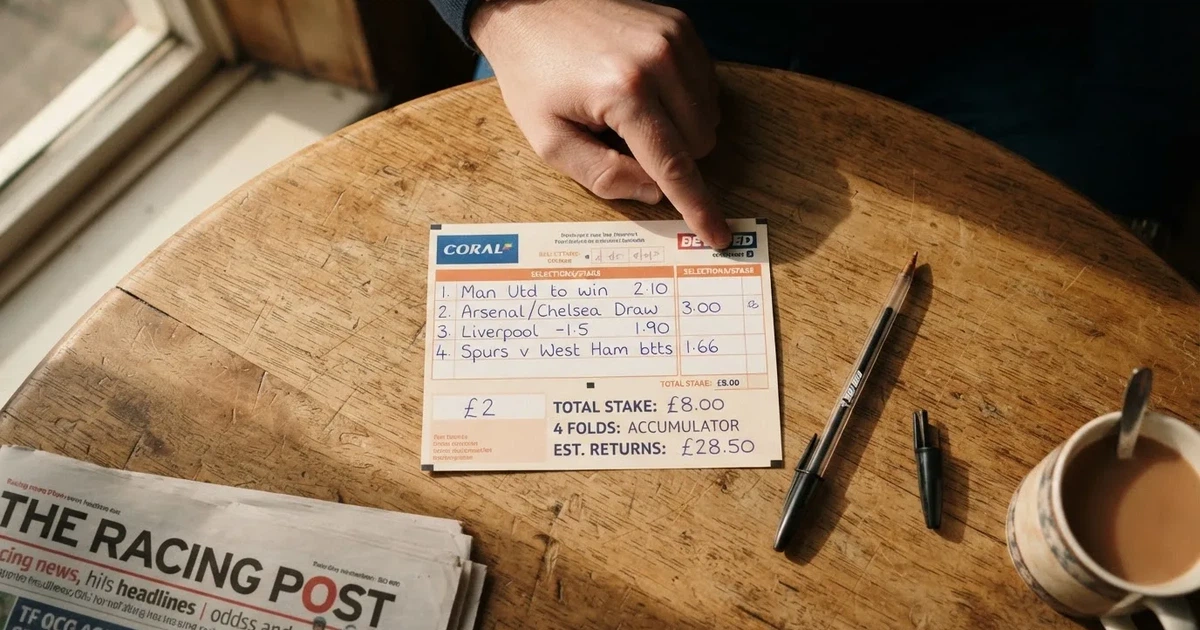
A football accumulator links two or more match outcomes into one stake. Each leg must win, or the whole bet loses, which is why the return on a winning acca can dwarf the return on any single leg while the probability of winning collapses with every selection added. This page walks through how accas are constructed, how the price is calculated, what the bookmaker’s margin does to a multi-leg payout, and which licensed operators in Great Britain offer the product, with a verdict on each.
How a football accumulator bet works
A punter picks a set of outcomes from one or several matches and asks the bookmaker to price them as one bet. Two selections make it a double; three, a treble; four and above, an accumulator or “acca”. A single price is quoted, equal to the product of the individual decimal odds, so a four-fold at 1.50, 2.00, 2.00 and 3.00 prices at 18.00. The whole bet is lost if any leg loses; one losing selection wipes the stake.

A leg that ends in a tie, called a push in American usage, is removed from the acca and the combined price is recalculated on the legs that remain. Voided selections are treated the same way by most licensed operators. Cash-out, where the bookmaker offers a live price to settle the bet before the final leg, is offered as a feature rather than a settlement rule, and the offer to cash out is at the operator’s discretion; if it is not available, the bet stands.
Each-way accumulators double the stake because the bettor is placing one accumulator “to win” and one accumulator “each-way”, typically used when one or more legs are short-priced favourites in a horse race rather than a football match. In football the each-way toggle applies to outright markets such as tournament winner, league winner or top scorer, where the place terms depend on the field size and are stated in the market rules. Each-way doubles the unit stake and the return on the place portion is calculated against the reduced place price, not the win price.
Building an acca: selections, stakes and the price
Most bookmakers list an “acca” or “multiples” tab on the bet slip. Selections are added one at a time; the slip recalculates the combined price each time a new pick lands on it. The punter enters the stake, confirms the price, and the bet is placed.

A few rules of thumb matter before a stake is typed in:
- The combined price is the product, not the sum. Two legs at 3.00 and 4.00 are not a 7.00 acca; they are a 12.00 acca.
- The margin is paid on every leg, so a five-fold carries five embedded margins. The bigger the price, the harder the bookmaker’s take is to see.
- Correlated outcomes, such as backing the same team to win and to lead at half-time, may be restricted by the operator’s terms.
What an acca pays when it wins
A winning acca pays stake × combined price. Stake £10 on a four-fold at 18.00 and the return is £180, of which £170 is profit. If the same acca is placed each-way on an outright market, the stake is £20 (£10 to win, £10 to place) and the place portion pays at the place fraction stated in the market rules.
A working example: three Premier League selections at decimal prices of 1.50 (1/2), 2.00 (evens) and 2.50 (6/4) on a £10 stake. The combined price is 1.50 × 2.00 × 2.50 = 7.50. Return on a win is £10 × 7.50 = £75, profit £65. Placed as three singles, the returns would be £15, £20 and £25 against a £30 total stake; the acca pays more when it wins, and pays nothing at all if any one leg loses.
Settlement, voids and cash out
Settlement follows the result the operator publishes. If a match is abandoned or a selection is declared void, the leg is removed and the price recalculated; the rest stands or falls on its own merits. Cash out is a separate feature, settled at a price the bookmaker quotes at that instant, which is below the theoretical true price because the bookmaker is buying the bet back from the punter; if the cash-out button is grey, the bet runs to its natural settlement.
Full-cover bets and other multiples
An accumulator is one shape of multiple; the bookmaker offers several others, called full-cover bets, where every combination of the chosen selections is staked.
A Trixie covers three selections in four bets (three doubles and one treble). A Yankee covers four selections in eleven bets. A Lucky 15 covers four selections in fifteen bets, adding four singles. A Canadian or Super Yankee covers five selections in twenty-six bets. A Heinz covers six selections in fifty-seven bets. A Goliath covers eight selections in two hundred and forty-seven bets. In each case the unit stake is multiplied by the number of bets: a £1 Trixie costs £4, a £1 Lucky 15 costs £15, a £1 Heinz costs £57.
Full-cover bets let the punter win something even when not every selection lands, which an accumulator does not. A Yankee returns a profit if at least two of the four selections win; a Lucky 15 returns a profit on as few as one winner thanks to the singles. The downside is the stake: a £1 Lucky 15 on four legs at evens each costs £15 and pays £15 if all four singles win, but only one treble and the four singles if three of the four win, and just one single if only one wins. The trade-off is between concentrating the stake on one outcome at a fat price, and spreading it across combinations for a steadier, smaller payout.
A Heinz on six legs at unit stake £2 costs £114 and produces 57 bets; a Super Heinz on seven legs at the same unit stake costs £240 and produces 120 bets. For the punter choosing between them, the deciding factor is the number of selections worth backing, not the number of bets the bookmaker is willing to write.
The accumulator insurance and the price boost
Two features ride on top of an acca at most licensed UK bookmakers. Acca insurance refunds the stake, typically as a free bet, if one leg of a multi-leg acca lets the bet down. Price boosts raise the price of a named acca for a limited window, sometimes on a daily basis. Both features are governed by the operator’s own terms; the size of the refund, the minimum number of legs, the minimum price per leg and the expiry of any free bet are stated on the coupon or in the rules.
Neither feature changes the fundamental mathematics. An insured acca with five legs at average price 2.50 carries the same expected loss as an uninsured five-fold at the same price; the insurance adds variance reduction on the small chance of a one-leg miss. A price boost raises the price on a specific combination the bookmaker has chosen; the boosted legs were priced with the operator’s usual margin before the boost, and the boost is paid from the marketing spend rather than from a thinner margin.
The bookmaker’s margin and how it sits inside an acca
Every price carries the bookmaker’s margin, also called the overround. For a three-way football market such as the match result (home / draw / away) the margin is calculated as 1 − (1 ÷ (1/odds_home + 1/odds_draw + 1/odds_away)). If the three outcomes are priced at 2.10, 3.40 and 3.60, the sum of reciprocals is 0.4762 + 0.2941 + 0.2778 = 1.0481, the payout share is 0.9542 (95.42 %), and the margin is 4.58 %.
A four-fold accumulator carries four embedded margins, one per leg. The combined margin is not the sum of the four, because the reciprocals multiply rather than add, but it is strictly larger than any single leg’s margin: a four-fold of four legs each at 5 % margin carries a combined margin of roughly 18.6 %, before any feature such as a price boost or acca insurance. The bigger the acca, the more the margin compounds. This is why a 50/1 acca on paper feels generous and yet on average returns less than its true probability would imply; the bookmaker’s take grows with the size of the bet.
The point is not that accas are a bad product. A long-odds bet is a legitimate stake when the bettor understands that a higher headline price sits on a thinner expectation. It is that the headline price is not the same number as the probability implied by the prices once the margin is removed, and the two diverge faster the more legs the acca carries.
Where football accumulator bets can be placed in Great Britain
Any bookmaker offering bets to customers in Great Britain needs a Gambling Commission licence, by sections 33 and 36 of the Gambling Act 2005 as amended by the Gambling (Licensing and Advertising) Act 2014. A Curaçao, Maltese or Gibraltar licence is not a substitute, though several operators in this comparison are based in Gibraltar and serve Great Britain under a Commission licence. A licensed brand may use .co.uk or .com, so the domain alone proves nothing; the test is the Commission’s public register, searchable by business name, trading name, domain or account number.
Every operator reviewed here holds a remote general betting standard (real events) licence, the right category for sports betting including football. Several are run by larger groups: BetMGM’s UK sportsbook is published by LeoVegas Gaming PLC, for instance, and Ladbrokes’ UK site sits under LC International Limited alongside other Group brands. The remote licence number on the Commission’s register is the figure to quote.
Offshore operators without a Commission licence accept customers from Great Britain at their own legal risk and the bettor’s. No statutory offence aimed at a customer was found, but the protections of a GB licence do not apply: no GAMSTOP coverage, no Commission complaints route, no approved dispute-resolution body, no British consumer redress, no binding by the 10x bonus cap or the £150 vulnerability check, and no recourse if funds are withheld. That is the whole of the difference, and it is enough to make a licensed bookmaker the default choice.
Comparing the licensed bookmakers that offer accas
The ten brands below all hold a Gambling Commission remote licence. The table shows the licence account number (searchable on the register), the licence holder, and a short note on what the operator’s own published terms say about accumulators and related products.
| Bookmaker | Licence account | Licence holder | What the terms say about accas |
|---|---|---|---|
| Betfred | 39544 | Petfre (Gibraltar) Limited | Bet Builder, Sub Switch and acca features in the app |
| Lottoland | 38991 | EU Lotto Limited | Sports betting alongside lottery, casino and scratchcards on the UK app |
| Sporting Index | 27343 | Sporting Index Limited | Fixed-odds free bets tied to a qualifying £10 single at minimum price 1/2 |
| Swifty Sports | 58957 | Swifty Global (UK) Ltd | Cash Out, price boosts, live streaming; Bet Builder marked as coming soon |
| BetMGM | 39198 | LeoVegas Gaming PLC | Welcome offer splits into four £10 free bets including two football accas of 4+ legs |
| Fafabet | 57385 | Taichi Tech Limited | Best Odds Guaranteed on UK and Irish racing; football acca features in the app |
| Ladbrokes | 54743 | LC International Limited | Acca Boosts on football multiples alongside odds boosts and Best Odds Guaranteed |
| DAZN Bet | 48756 | DZBT Limited | Bet Builder, daily bet boosts and in-play; cash out subject to availability |
| Dabble | 65677 | Dabble Sports UK Ltd | Welcome offer of £10 in free bets on a first £10 bet at minimum odds |
| Fitzwilliam Sports | 48760 | SBKI Limited | Prices aligned to Oddschecker’s average per selection |
Several brands are large enough to dominate on features and marketing, but dominance is not the same as suitability. The verdict on each is below.
Betfred
Betfred’s sportsbook is the UK-facing arm of Petfre (Gibraltar) Limited under Commission account 39544. The app ships Bet Builder, Sub Switch and racing-data feeds, and the product set covers the full range of football multiples from doubles through Heinz and Goliath. The bookmaker’s heritage is in horse racing, where Extra Places and Best Odds Guaranteed are headline offers; on football the proposition is a mainstream one.
A punters who values acca insurance and acca boosts alongside a single login for sports, casino and bingo will find Betfred a reasonable default. One whose betting is concentrated on long-odds football multiples without the racing side has little the others do not also offer.
Lottoland
Lottoland’s UK app covers casino, scratchcards, lottery betting and sports betting from one account. The football product is competent rather than specialist; the operator’s reputation sits with jackpot betting on lottery draws, and the sportsbook is a complement to that core.
A bettor who plays the lottery side and wants a single wallet for occasional football accas will not be put off. A bettor whose main interest is the football acca itself has no particular reason to choose Lottoland over a sports-first operator.
Sporting Index
Sporting Index runs both fixed-odds sports betting and financial spread betting, the latter regulated by the Financial Conduct Authority rather than the Commission. The fixed-odds welcome offer unlocks three £10 fixed-odds free bets, three £5 Total Goals spread bets, three £5 Winning Favourites spread bets and a £1 Race Index spread bet off the back of a £10 qualifying fixed-odds bet at minimum odds of 1/2; the qualifying bet cannot be placed in-play or cashed out.
A bettor curious about spread betting on football goals and willing to read the spread product’s terms before staking will find Sporting Index a sensible place to start. Spread-betting losses can exceed deposits, and that warning is on the homepage for a reason.
Swifty Sports
Swifty Global (UK) Ltd runs Swifty Sports under Commission account 58957. The product set is modern: Best Odds Guaranteed, Cash Out on selected markets including horse racing and football, daily price boosts, live streaming, and in-play betting; the app listing notes that Bet Builder is on the way.
A bettor who wants a clean app, modern features and a small-stakes welcome will be comfortable. One who relies on Bet Builder today needs to look elsewhere until that feature ships.
BetMGM
BetMGM’s UK sportsbook is published by LeoVegas Gaming PLC under Commission account 39198. The welcome package splits into four £10 free bets (two for football accumulators of 4+ legs and two for sports multiples of 2+ legs), each valid for 7 days, on a £10 minimum deposit and a sports bet within 7 days; minimum odds apply and opt-in is required. The acca-specific allocation in the welcome package is unusual and tells a bettor where the operator’s focus sits.
A bettor building four-fold and longer football multiples will find the welcome allocation well-matched to their staking pattern. One who bets singles or short trebles leaves half the welcome on the table.
Fafabet
Fafabet’s UK product is run by Taichi Tech Limited under Commission account 57385. Best Odds Guaranteed applies to UK and Irish horse racing win and each-way bets from 9am on race days; the football product is mainstream, with multiple-leg accas, cash out on selected markets and price boosts.
A racing-led bettor who also wants a competent football acca product will be served. A football-only bettor gains nothing here that a sports-first operator does not also offer.
Ladbrokes
Ladbrokes sits under LC International Limited alongside other Group brands; the Commission account is 54743, with both remote general betting standard and remote betting intermediary categories on the register. The product set is broad: odds boosts on horse and greyhound bets, Best Odds Guaranteed on UK and Irish racing, in-play betting, and Acca Boosts on football multiples.
A bettor who values acca boosts on long-odds football multiples and trades in and out via cash out will find Ladbrokes competitive. The breadth of the product set does not translate into the best price on any given leg, and the diligent shopper still compares legs across operators.
DAZN Bet
DAZN Bet is operated by DZBT Limited under Commission account 48756. The product set covers Cash Out, Bet Builder, daily bet boosts and in-play betting; cash-out availability is not guaranteed and any bet stands if cash out is unavailable at the moment the punter tries to use it.
A bettor who plans a staking plan that depends on cashing out mid-match should read the rules and accept that the button can be grey. A bettor happy to let accas settle naturally at the final whistle loses nothing here.
Dabble
Dabble’s UK product is run by Dabble Sports UK Ltd under Commission account 65677. The welcome offer pays £10 in free bets on a £10 first bet at minimum odds, with a 7-day free-bet expiry and the stake not returned on a free-bet win.
A small-stakes bettor who values a simple welcome and a social-betting product will find Dabble a fit. The free-bet stake is not returned, so the headline £10 in free bets is worth the free-bet value rather than £10 of cash; the bettor who reads that line gets the right expectation.
Fitzwilliam Sports
Fitzwilliam Sports is operated by SBKI Limited under Commission account 48760. Prices are aligned to Oddschecker’s average per selection rather than set by an in-house trader, and the product ships on iOS and Android. The pitch is transparency on price rather than breadth of features.
A bettor who cares more about getting the best of the day’s available price than about acca insurance or boosts will find Fitzwilliam’s approach refreshing. One whose staking depends on a particular feature, such as Bet Builder, should check the feature list before depositing.
Responsible gambling at licensed bookmakers
Every GB-licensed online operator is part of GAMSTOP, the national multi-operator self-exclusion scheme, which is a mandatory licence condition since 31 March 2020. Self-exclusion can run for six months, one year, five years, or five years with auto-renewal; after the minimum period the exclusion stays in place for a further seven years unless the customer asks GAMSTOP to remove it. The scheme covers online sites and apps; betting shops use a separate in-shop service.
A financial vulnerability check applies to licensed remote betting when a customer’s deposits minus withdrawals exceed £150 in a rolling 30 days; the check is a public-record check, looking for markers such as bankruptcy or county court judgments, not an income check or a credit reference check. Operators also run financial risk assessments under the Commission’s staged plan (announced 7 July 2026), with no start date. Identity verification before the first deposit is mandatory, so anonymous play is not available at a licensed site.
Deposit limits are a customer-set tool and a Commission licence condition. Limits are not state-set; each customer chooses what suits them, and operators must offer a gross deposit limit on a fixed time frame. Help is available through GamCare and the National Gambling Helpline, GambleAware, NHS gambling clinics, and Gamblers Anonymous. An accumulator with a long combined price is the same kind of product as any other for the purposes of these tools; a self-excluded customer cannot place an acca any more than a single.
If gambling stops being fun
A customer who feels their betting is no longer recreational can:
- Set a deposit limit at the operator under a shorter time frame than the default;
- Take a time-out at the operator, from 24 hours to several weeks;
- Self-exclude at the operator for six months or longer;
- Register with GAMSTOP to self-exclude across all GB-licensed online operators;
- Contact the National Gambling Helpline (GamCare) for confidential support.
Strategy and what an acca punter can actually do
The product is settled by results; no system of selection turns a losing sequence of legs into a winning one. That is the starting point. Three angles a recreational punter can use, all of them well understood:
Bankroll management
Stake a fixed unit per acca, typically 1 to 2 per cent of the betting bank, so that a run of losing accas does not exhaust the bank before a winner arrives. An acca that returns 50/1 on a winning £10 stake is the same proposition to the bank as a single at 2/1; the price is higher, the probability of winning is lower, and the unit stake should reflect that.
Leg selection
Each leg of an acca is itself a separate betting decision. The price on offer is the bookmaker’s view of the outcome, with the operator’s margin inside it; a punter who finds a leg where the price is larger than their own probability implies has an edge on that leg, and the acca magnifies the edge across the combination. The same is true in reverse: legs the punter has no view on contribute nothing but the margin.
Cash out and insurance as risk management
Cash out lets the punter settle an acca before the final leg kicks off, locking in a profit when the running price makes sense. Acca insurance refunds the stake if exactly one leg loses. Both are paid for by the bookmaker’s offer: the cash-out price is below the theoretical true price because the operator is buying the bet back; insurance reduces variance on a small chance rather than raising the long-run expected return. Used in moderation they make the betting bank less bumpy; used as a substitute for leg selection they cost the punter the long-run edge.
What no system can do
No staking system converts a sequence of losing bets into a winning sequence. One such method raises the stake after each loss on the assumption that a win will recover the run; the win does recover the stake, but the stake grows quickly and a long enough losing run empties the bank before it arrives. A different method raises the stake after each win; the stake grows on winners and shrinks on losers, which is the same as staking a smaller fixed unit and compounding. The product pays what its price says it pays; the staking method decides how the bank moves, and cannot make a negative-expectation proposition a positive one.
The regulatory frame for accas at UK-licensed bookmakers
The Gambling Commission licences the whole commercial market under the Gambling Act 2005, which covers Great Britain (England, Scotland and Wales); Northern Ireland is outside the Act and runs its own older law, so a “GB-licensed” bookmaker is licensed for Great Britain, not the United Kingdom as a whole. Sections 33 and 36 of the 2005 Act, as amended by the Gambling (Licensing and Advertising) Act 2014, require an operator whose remote facilities are used in Great Britain to hold a Commission licence wherever it is based. There is no state monopoly and no cap on the number of licences.
Licence types relevant to football accas are remote general betting standard (real events) for ordinary sports betting, remote betting intermediary for betting exchanges, and remote general betting standard (virtual events) for computer-simulated fixtures. Each operator in this comparison holds the real-events licence, which covers football outright.
The marketing of gambling is not licensed by the Commission. Non-broadcast advertising runs under the CAP Code and broadcast under the BCAP Code, enforced by the ASA. Promotion rules in force since 19 January 2026 cap wagering requirements on bonuses at 10x (a £10 bonus at 50x needed £500 of qualifying bets; under the cap, no more than £100) and ban mixed-product promotions that require play across two or more product types such as betting, casino, bingo and lottery in one offer. Whether the cap applies to free bets without a wagering condition is not established. The “whistle-to-whistle” rule on TV advertising around live sport is an industry code, not statute, since 1 August 2019.
The player pays no tax on betting winnings in Great Britain (general information, not tax advice; a professional gambler should ask HMRC or an adviser). General Betting Duty is the operator’s tax on gross profits, currently 15 per cent; a remote betting rate of 25 per cent applies from 1 April 2027 within it, while remote bets on UK horse racing, pool betting, in-person betting and self-service betting terminal bets stay at 15 per cent. Whether operators pass duty through odds is not established.
Identity verification before the first deposit has been mandatory since 7 May 2019, so anonymous staking is not possible at a GB-licensed site. Credit cards have been banned for gambling in Great Britain since 14 April 2020, including credit-card-funded e-wallet payments. Debit cards and bank-based payments are not covered by the ban. The minimum age is 18.
On offshore bookmakers without a GB licence
An offshore brand that accepts customers from Great Britain without a Commission licence commits an offence under section 33 of the Gambling Act 2005 (on summary conviction up to 51 weeks’ imprisonment, a fine up to level 5, or both; six months in Scotland) — the offence is aimed at the operator. No offence aimed at a customer who merely bets on an unlicensed site was found. What the customer loses is the British protective frame: no GAMSTOP coverage, no Commission complaints route, no approved dispute-resolution body, no British consumer redress if funds are withheld, no binding by the 10x bonus cap or the £150 vulnerability check. Honest framing: licensed means checks, limits, GAMSTOP, bonus cap and identity verification at the door; unlicensed means none of those protections and no recourse if the operator withholds funds. Neither is the “safe” choice by default; both carry risk.
Enforcement against unlicensed operators is disruption rather than blocking: cease-and-desist notices, search-engine referrals, work with registrars, hosts and payment providers, and the Commission has been given, or is about to receive, court-order DNS blocking powers. ISP blocking is not in operation; it is a power held or imminent.
Worked example: returns on a treble and a Lucky 15
A treble on three selections at decimal prices of 1.50, 2.00 and 2.50 at a £10 stake. The combined price is 1.50 × 2.00 × 2.50 = 7.50. Return is £10 × 7.50 = £75, profit £65. If one leg loses, the stake is lost.
The same three selections as a Lucky 15 would be 15 bets at unit stake, which at £1 each costs £15. The bets are four singles, six doubles, four trebles and one four-fold — except a Lucky 15 is a four-selection product, so this example needs a fourth leg. Add a fourth selection at decimal 3.00. The Lucky 15 bets are:
- 4 singles at the four individual prices,
- 6 doubles on every pair,
- 4 trebles on every triple,
- 1 four-fold on all four.
At unit stake £1 the total cost is £15. If all four legs win, the return is the sum of every winning bet: singles pay 1.50 + 2.00 + 2.50 + 3.00 = 9.00; doubles pay each pair’s product summed across all six pairs; trebles pay each triple’s product summed across all four; the four-fold pays the combined price 1.50 × 2.00 × 2.50 × 3.00 = 22.50. Total return on a unit stake of £1 with all four winners: 9.00 (singles) + the doubles + the trebles + 22.50 (four-fold) = a substantial return against a £15 outlay.
The point of the comparison is to make the trade-off visible. A £10 treble at 7.50 risks £10 to win £65 and pays nothing if any leg loses. A £1 Lucky 15 on four legs risks £15 to win a smaller amount when one or two legs lose, with a bigger return when all four win. A bettor choosing between them is choosing between concentrating the stake and spreading it.
Frequently asked questions about football accumulator bets
How do football accumulator bets work?
A football accumulator links two or more selections into one bet. Each leg must win, or the whole stake is lost. The combined price is the product of the individual decimal odds, so a treble at 1.50, 2.00 and 2.50 prices at 7.50 and a £10 stake returns £75 on a win. Cash out is a separate feature the bookmaker may offer mid-bet, and voided selections are removed without losing the rest.
Where can I place football accumulator bets in Great Britain?
Any bookmaker offering bets to customers in Great Britain needs a Gambling Commission licence. Several well-known names — Betfred, Ladbrokes, BetMGM, DAZN Bet, Dabble, Fafabet, Swifty Sports, Sporting Index, Fitzwilliam Sports and Lottoland — all hold a Commission licence on the public register and offer football accumulators. Offshore brands without a GB licence can accept bets at their own legal risk and the customer’s, with no GAMSTOP coverage and no British recourse.
How does an accumulator work in football betting?
The bettor adds selections to the slip; the bookmaker prices them as one bet. The combined decimal price is the product of each leg’s price. If every selection wins, the payout is stake × combined price. If any selection loses, the stake is lost. If a leg is voided, it is removed and the price recalculated. Cash out lets the punter settle the bet before the final leg, at a price the operator quotes at that instant.
How can I check that a bookmaker holds a Gambling Commission licence?
The Commission’s public register is searchable by business name, trading name, domain or account number and is the whole test of whether a brand holds a licence. The register lists the licence categories on the operator’s account and the licence holder, which may differ from the trading name. A licensed brand can use .co.uk or .com; the domain proves nothing on its own.
How is the return on a bet worked out from the stake and the odds?
For a single bet the return is stake × decimal odds. For an accumulator the return is stake × the product of the decimal odds of every leg, which is the combined price. Profit is return minus stake. For a combination bet such as a Lucky 15, the return is the sum of every winning combination priced at its own product, and the total stake is the unit stake multiplied by the number of bets in the combination (15 for a Lucky 15, 57 for a Heinz, 247 for a Goliath).
What is the bookmaker’s margin and how can it be seen in the odds?
The margin is the share of every unit staked that the bookmaker keeps on average. For a three-way market the margin is 1 minus the payout share, where the payout share is 1 divided by the sum of the reciprocals of each outcome’s decimal odds. The bigger the margin, the smaller the punter’s share. Every leg of an accumulator carries the margin of its own market, so a multi-leg acca carries several embedded margins and the combined margin grows with the number of legs.
Bet types & in-play – Darts betting
Content created by the «Darts betting» team
