
Greyhound racing odds: what the price really pays, and what the bookmaker keeps
 Available in US
27 October 2026 · cross-checked against the Gambling Commission’s public register
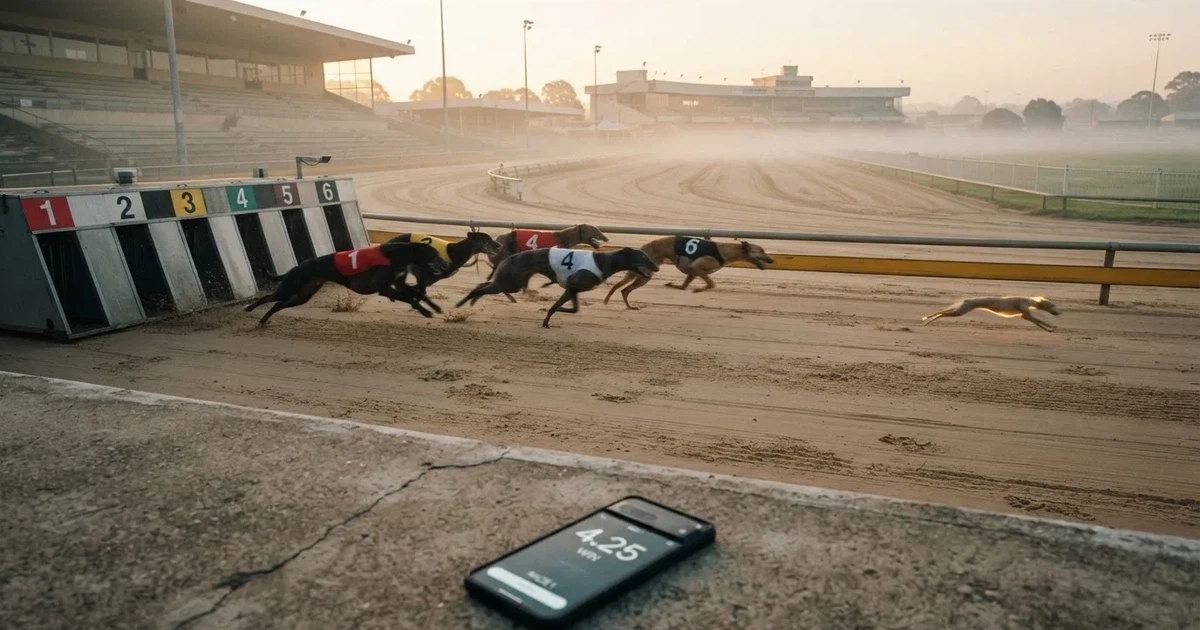
A six-dog race sets off once every few minutes somewhere in Britain, and a price on each runner is sitting on a slip before the traps spring. The price looks simple — a number, sometimes a fraction, often “evens” or close to it. It is not. That single number carries the bookmaker’s margin, the take from every pound that crosses the betting desk, baked in from the moment it is published. Reading greyhound racing odds well means seeing that margin for what it is: the difference between what the bettor receives and what the true probabilities would pay, taken off the top, every race, every market, no exceptions. This page walks through where British greyhound racing odds come from, who is allowed to take bets on them, what an offer from a licensed bookmaker actually pays out, and how the spread of prices between competing firms is itself a piece of information a reader can act on.
Greyhound racing in Britain and New Zealand: the fixture behind the betting
Greyhound racing in Great Britain runs under the Greyhound Board of Great Britain (GBGB), which licenses the sport across 18 stadia. The race itself is built around a mechanically operated artificial lure that runs along a rail ahead of the dogs, and races typically support both parimutuel and fixed-odds bookmaker betting — two different ways of forming a price, but both ending with a number the punter can take or leave. The starting price, the same convention that governs British horse racing, applies: the SP is the final fixed-odds price on a runner taken on-course when the race begins.
The picture across the Tasman is the opposite. Greyhound racing in New Zealand was ended by the Racing Industry (Closure of Greyhound Racing Industry) Amendment Act 2026, passed on 2 April 2026, with the phase-out set for 1 August 2026. The policy had been signalled earlier, when Winston Peters announced on 10 December 2024 that greyhound racing in New Zealand would be banned and phased out by 2026. Before the closure, Greyhound Racing New Zealand (GRNZ) ran seven affiliated clubs: Auckland, Waikato, Whanganui, Palmerston North, Canterbury, Otago and Southland. The British fixture is therefore the live one for UK-licensed bookmakers, while the New Zealand product — once part of the ante-post calendar — is closing.
The British calendar matters for a punter because it sets the volume. With 18 licensed stadia and races going off several times an hour across the country, in-play and pre-race markets are dense enough that a bookmaker’s greyhound book runs through most waking hours. That density is what gives British greyhound racing a depth of market the sport does not enjoy in smaller jurisdictions, and it is also what justifies the variety of bet types a licensed firm can offer: win and place markets, forecast and tricast combinations, ante-post on the major festivals, and in-running prices while a race is actually unfolding.
What the betting landscape looks like for licensed British bookmakers
A bookmaker taking bets from customers in Great Britain needs a Gambling Commission licence wherever it is based — that has been the position since the Gambling (Licensing and Advertising) Act 2014, which amended sections 33 and 36 of the Gambling Act 2005 to bring remote betting within British jurisdiction at the point of consumption. A Curaçao, Maltese or Gibraltar licence is not a substitute. There is no statutory list of permitted sports or markets; an operator licensed for remote general betting standard (real events) can offer greyhound racing under its own commercial rules, provided it stays inside the Licence Conditions and Codes of Practice (LCCP). The Commission’s public register is the whole test of whether a brand holds a licence, and the register can be searched by business name, trading name, domain or account number.

What a Commission licence buys the customer is a defined set of protections: GAMSTOP coverage, a complaints route through an approved alternative-dispute-resolution body, identity verification before the first deposit, mandatory social responsibility and affordability processes, and the bonus cap described later in this page. What it does not buy is a guarantee of a winning bet. The bookmaker’s margin is sitting inside every price regardless of the licence behind it, and the rest of this page is largely about seeing that margin clearly.
The categories of remote licence relevant to greyhound racing are general betting standard (real events) — the standard sportsbook licence — and betting intermediary, the licence under which a betting exchange operates. Pool betting on dog racing is a separate licence category; spread betting on a greyhound race is either a financial product regulated by the FCA or a general betting product, depending on whether it is structured as a financial spread. Several brands can run under one licensee, which means a Commission account number covers more than one site at a time — Ladbrokes and Coral share LC International Limited, Paddy Power and Betfair share PPB Counterparty Services Limited — and the same firm can run a sportsbook and an exchange under the same group.
The legal frame: who can take a greyhound bet and what they owe the customer
The Gambling Act 2005 governs betting in England, Scotland and Wales. Northern Ireland sits outside the Act and runs on older legislation; writing “GB-licensed” rather than “UK-licensed” is the accurate framing. There is no state monopoly, no statutory cap on the number of licences, and no statutory cap on stakes — operators set their own maximum stakes and may restrict customers. The minimum age is 18, and since 7 May 2019 every licensed remote operator has to verify the customer’s name, address and date of birth before a deposit can be made or a bet placed, including a bet made with a free bet or bonus. That step is what makes anonymous play impossible at a licensed site.
In-play betting on greyhound racing is offered by GB-licensed bookmakers; the controls sit in the operator’s licence conditions and customer-protection duties rather than in any statute specifically authorising live betting, and the legal conclusion to draw is that in-play is offered under licence, not that it is “unrestricted”. Esports and virtual events are treated as their own licence categories; politics, TV and novelty markets are routinely offered and no statutory prohibition has been made. The Commission’s advertising rules sit alongside the LCCP: the CAP Code (non-broadcast) and BCAP Code (broadcast), enforced by the ASA. Section 16 of the CAP Code limits who can be featured on camera — no one who is, or appears to be, under 25 may take a significant role in a betting advertisement — and the rule is about the advertisement, not about who is allowed to bet.
A separate British protection worth keeping in mind is the credit-card ban, in force since 14 April 2020: no gambling transaction can be funded by a credit card at a licensed operator, including a credit-card-funded payment through an e-wallet. Debit cards and bank-based payments are unaffected. The player pays no tax on betting winnings in Great Britain, although a professional gambler should ask HMRC or an adviser — the duty that funds the public purse is General Betting Duty on the operator’s gross profits, currently 15%, with a new remote betting rate of 25% scheduled from 1 April 2027 for most remote bets but not for remote bets on UK horse racing. Whether any of that duty ends up reflected in the prices the customer sees is not established in the public data, and the only honest framing is that duty is the operator’s tax, not the player’s.
Responsible gambling: the safeguards a Commission licence actually triggers
A licence is more than permission to take bets. It carries obligations, and the obligations that bite on a greyhound punter’s experience are the ones described here.
GAMSTOP is the national multi-operator online self-exclusion scheme, mandatory for online operators since 31 March 2020. Self-exclusion can run for six months, one year, five years, or five years with auto-renewal; once the minimum period has passed, the exclusion remains for a further seven years unless the customer asks GAMSTOP to remove it. GAMSTOP covers online sites and apps; the betting-shop service is separate. Self-exclusion is a clean break from licensed betting, and it is the single most powerful tool a customer who has lost control has at their disposal.
Financial vulnerability checks (LCCP condition 3.4.4, in force since 30 August 2024) apply at licensed remote operators when a customer’s deposits minus withdrawals exceed £150 in a rolling 30 days — the threshold was set on 28 February 2025. The check is a public-record check, looking for events such as bankruptcy or county court judgments; it is not an income check and not a credit reference check, and the data the operator pulls is a public-record trace rather than a credit file. Financial risk assessments — what the press calls “affordability checks” — have been announced in a staged plan (the Commission’s article of 7 July 2026) with no start date, and the right framing is “announced, staged, no start date”, not “in force”.
Deposit limits sit in the Remote Technical Standards (RTS 12): operators must offer a gross deposit limit on a fixed time frame. The first changes applied on 31 October 2025; a second phase was postponed to 30 September 2026, and whether the second phase is live is not established in the public data. Limits are the customer’s choice, not a state-set ceiling, and operators offer the controls but do not impose them.
Help is available through GamCare, which runs the National Gambling Helpline, GambleAware, the NHS gambling clinics and Gamblers Anonymous. Each licensed operator links to one or more of those services from its responsible-gambling page.
A licence does not make a bet safer in the sense of more likely to win. It makes the environment accountable: complaints routes, dispute resolution, identity verification, exclusion tools. A bettor using a licensed firm has somewhere to complain; using an unlicensed one, they do not.
Bonuses and free bets on greyhound racing: what the marketing word actually pays
Every licensed operator on this page describes its offer in its own words, and the words can mislead if read carelessly. “Free bet”, “risk-free”, “price boost”, “best odds guaranteed”, “enhanced odds” — each of these is a defined commercial product with its own structure, and the structure is the cost. Three rules to keep in mind before reading any specific offer below.
First, a free bet whose stake is not paid back with a win is worth less than its face value. On a market with a 5% margin, a £10 free bet at decimal odds of 6.00 returns £50 in profit, not £60 — the £10 stake is gone whether the bet wins or loses. The arithmetic: free-bet value = free-bet amount × (odds − 1) ÷ odds × payout share of that market. For a £10 free bet at 6.00 on a market paying 95% back, the expected value is roughly £10 × (6.00 − 1) ÷ 6.00 × 0.95 ≈ £7.92, against a face value of £10. The face value is the headline; the expected value is the honest number.
Second, wagering requirements on bonuses are capped. Since 19 January 2026, no licensed operator can attach a wagering requirement higher than 10x to a bonus — a £10 bonus at the old 50x would have needed £500 of qualifying bets; under the cap, no more than £100. The same rules ban mixed-product promotions, the “bet on football to get free spins” structures that link two product types. What the cap does not cover is the wagering requirement on a free bet issued as a bonus, where the requirement may be different, and the page notes each offer’s structure below.
Third, “best odds guaranteed” is a horse-and-greyhound concession that pays the starting price if the SP is higher than the price taken at bet placement. It is a real feature, it adds value on longshots whose price drifts after the bet is placed, and it has its own conditions — most BOG concessions exclude ante-post markets. “Price boost” is a one-off inflated price on a named selection: the stake is paid back as a normal bet and the additional payout is usually issued as a free bet or a capped enhancement, not as cash.
Every figure stated below for a specific offer is taken from the operator’s own terms, and the rule on this page is to describe what each offer costs in qualifying bets and time, not to recommend it.
Mobile and app betting on greyhound racing
A licensed British bookmaker’s app is, in practice, where most greyhound bets are placed. The greyhound market is dense and the calendar moves quickly; the slip is built in seconds on a handset. The features that matter for a greyhound punter are: in-play on dog racing, cash out on a greyhound market, Best Odds Guaranteed, Bet Builder (or “same-game multi”), live streaming of GBGB stadia, and quick deposit-and-withdraw flows.
Two technical points to keep in mind. First, an operator’s identity verification step is the same whether the bettor uses the app or the desktop site — the LCCP requirement is on the licensed remote operator as a whole, not on the channel. Second, the credit-card ban applies to in-app deposits exactly as it does on the website. An app store listing is not a licence check; the licence lives on the Commission’s public register, and the listing itself should be treated as a marketing surface.
Live greyhound betting and cash out
Live greyhound betting, in-play greyhound betting, greyhound in-play — the same product, three names. A licensed GB bookmaker offers it under its own licence conditions, and the controls sit in those conditions rather than in any statute specifically authorising live greyhound betting. Cash out, where the bookmaker offers to settle a bet before the race finishes at a price the firm sets, is a feature offered by some but not all licensed firms; the price offered is the bookmaker’s, and accepting it is the punter’s call.
A live market on a six-dog race opens when the traps spring and closes within a few seconds; the price on each runner moves in real time and the slip is built and accepted in the same breath. The bookmaker’s margin in an in-play market is typically wider than in the pre-race market, because the in-play bookmaker has to manage the risk of a fast-moving event with limited information. Reading in-play prices well means reading the margin wider, not narrower.
Greyhound betting tips, predictions and systems
A tip is an opinion. A system is a staking plan. Neither is a forecast of outcomes, and no system reliably turns a margin-loaded book into a winning one. That framing belongs at the top of any greyhound tips or strategy discussion, and the reason is mathematical: a margin is the cut taken off the top of every pound bet on the market, and a staking plan that does not change the price does not change the cut.
The honest frame for tips is that they are an opinion about a runner’s chance relative to the market’s view; the bettor’s job is to decide whether the price on offer is bigger than the chance justifies. A staking plan decides how much of a bank to risk on each bet; it does not change the expected value of the bet itself. A “system” that claims to overcome the margin is selling something the arithmetic cannot deliver.
Free tips and free predictions are marketing; the value they carry is whatever the tipster’s record actually shows, and a tipster’s record is the only measure worth checking before paying for any service. Greyhound tipsters publish strike rates and returns, and the honest ones make the basis of their tip auditable.
Greyhound bet types and how the odds are built
The odds on a greyhound race are a price the bookmaker publishes on each runner. The price carries two things: an estimate of the runner’s chance of winning, and the margin the bookmaker takes off the top. Seeing the margin requires comparing the prices across all runners to their true probabilities. The arithmetic: for a two-way market, payout share = 1 ÷ (1/odds₁ + 1/odds₂); margin = 1 − payout share.
Take an illustrative two-way market at decimal odds of 1.90 / 1.90. Payout share = 1 ÷ (1/1.90 + 1/1.90) = 1 ÷ (0.5263 + 0.5263) = 1 ÷ 1.0526 ≈ 0.9500. Margin ≈ 1 − 0.9500 ≈ 0.0500, or roughly 5%. The 5% margin sits inside every quote on the market; that is what the bookmaker keeps of every pound bet on this market. Real greyhound markets are six-runner, not two, but the principle is the same: the prices sum to a payout share below 100%, and the gap is the margin.
Win is the simplest market: pick the runner that finishes first. Each-way is two bets of equal stake — one on the runner to win, one on the runner to place — so the stake doubles. Place terms vary by race and by operator; the more runners in the race, the more generous the place terms. Forecast is a bet on the first two runners home in the correct order; tricast is on the first three in the correct order. Ante-post is a bet placed before the final declarations, where the price is bigger and the field less certain — the punter loses the stake if the runner is a non-runner. Spread betting on a greyhound race is structured either as a financial product regulated by the FCA or as a general betting product, and losses can exceed the original deposit in the financial form. Spreadex is regulated by the FCA for spread betting and by the Gambling Commission for fixed-odds betting, and states that spread betting losses can exceed the deposit.
Bet Builder, or “Same Game Multi”, combines markets from one race — or one meeting — into a single bet; the odds multiply together. The combined price carries the margin of each leg, and a Bet Builder on four legs at 5% margin per leg has an effective margin closer to 19% than 20% — close, but not exactly additive. Cash out is the bookmaker’s offer to settle a bet before the event has finished, at a price the firm sets. The cash-out price is built off the live market and is rarely as generous as the live price the punter could take on the same selection.
The conversion between fractional and decimal odds: a/b in fractional form becomes a ÷ b + 1 in decimal form. 5/1 in fractions is 6.00 in decimals; 11/4 is 3.75; evens (1/1) is 2.00. Decimal odds show the total return — stake plus winnings — in one number; fractional odds show the profit only. Punters comfortable with one form find the other easy to translate.
The licensed bookmakers: ten firms and what each one offers on greyhound racing
Each brand below is licensed by the Gambling Commission for remote general betting standard (real events). The licence number is the operator’s, on the Commission’s public register; the description is from each firm’s own terms, in its own words, as published on its site or in its app-store listing. Every operator in this section participates in GAMSTOP.
| Brand | Licence number and holder | What the operator’s own terms state on greyhound racing |
|---|---|---|
| Fitzdares | 000400-R-103839-030 (Fitzdares Limited, account 400) | App offers cash out, accumulators, Lucky 15s, specials and antepost markets on horse racing, football, tennis, rugby, cricket, golf and American football, with in-play live odds; greyhound racing is not named in the App Store description but ante-post and specials markets are a feature. |
| Geoff Banks | 054095-R-330366-010 (GB Sports Advisors Limited, account 54095) | App offers live in-play prices and ante-post prices on future events; greyhound ante-post and live markets available in the app. |
| Bar One Racing | 056516-R-332750-007 (Bar-One Racing Limited, account 56516) | Irish independent bookmaker with shops across Ireland and horse racing sponsorships at Dundalk, Fairyhouse, Navan, The Curragh, Curraheen Park and Cork; the GB-licensed online brand rebranded as BAR 1 Betting and offers greyhound markets on its race card. |
| Bet Ahoy | 100094-R-341742-003 (Bet Ahoy Ltd, account 100094) | Welcome offer is “Bet £10 & Get £10 in Free Bets”, made up of a £5 sports bet and a £5 acca; greyhound racing is offered on the race card, with full bonus terms available on the operator’s site. |
| Fitzwilliam Sports | 048760-R-335434-009 (SBKI Limited, account 48760) | Dublin bookmaker with capped membership; welcome is a “High Stakes Welcome” subject to compliance criteria; greyhound markets are offered and the firm offers instant deposits, fast withdrawals, timeouts and deposit limits, and links to GambleAware, GamStop and Gamblers Anonymous. |
| Paddy Power | 039439-R-319330-013 (PPB Counterparty Services Limited, account 39439) | App covers football, horse racing, boxing, rugby, tennis, golf, darts, snooker and F1; greyhound racing is part of the standard race-card product alongside horse racing. |
| Coral | 054743-R-330863-014 (LC International Limited, account 54743) | Sports welcome offer is “Get £40 in Free Bets when you bet £20”: a deposit and sports bet of £20 or more at minimum odds of 2.0 (1/1), with £40 in free bets issued within 7 days and expiring 7 days after issue, for new GB customers who opt in. |
| London Bet | 066162-R-340278-004 (Thistle Bet Limited, account 66162) | App combines sports betting (football, tennis, horse racing, greyhounds, darts, golf, cricket, NFL, NBA, MLB, snooker) with Pragmatic Play casino slots and live in-play betting; greyhound racing is a named market on the app. |
| Betmaster | 065699-R-339929-002 (BM Solutions GB Ltd, account 65699) | App covers football, cricket, horse racing, NFL and eSports (League of Legends, Dota 2) betting; greyhound racing is offered on the standards-compliant race card. |
| Swifty Sports | 058957-R-334734-006 (Swifty Global (UK) Ltd, account 58957) | Best Odds Guaranteed, Cash Out on markets including horse racing and football, daily price boosts, live streaming and in-play betting; Bet Builder is listed as coming soon; greyhound racing is offered with BOG and Cash Out. |
Fitzdares
Fitzdares trades as a premium British bookmaker and runs on a Commission account that has been on the register for years. The app carries the features a serious greyhound punter expects: cash out on the race card, accumulators with named leg counts (Lucky 15s and the standard multi-leg products), ante-post markets on future events, and in-play live odds. Greyhound racing sits inside the same race-card product as horse racing, and the ante-post specials are where the firm’s premium positioning tends to show — ante-post on the major greyhound festivals, ante-post on the bigger Saturday cards, and the named-runner specials around the televised meetings. The brand’s strength is the depth of its specials product; the trade-off is that the headline welcome offer is not the most generous in the licensed set.
Geoff Banks
A smaller British bookmaker with a focused app and a Commission account that covers remote general betting standard. The app’s two named features are live in-play prices and ante-post prices on future events, both of which are exactly the features a greyhound punter uses. Ante-post greyhound markets — on the English Greyhound Derby, the Scottish Greyhound Derby and the bigger festival cards — are a regular feature on the app, and the in-play product is built around the GBGB stadia calendar. The smaller scale of the firm means less liquidity on each race, which translates into slightly wider prices on the longshots and faster price moves when liquidity comes in. For a punter who trades ante-post rather than win markets, that profile is a feature rather than a bug.
Bar One Racing
Now trading as BAR 1 Betting, the firm is an Irish independent bookmaker with shops across Ireland and a long list of Irish racecourse sponsorships. The GB-licensed online brand sits alongside the shop business and offers greyhound markets on the standard race card. The pricing on the GB site reflects the firm’s Irish roots: a sharp shop-based book on Irish greyhound racing, with the British calendar covered through the standard fixtures. The rebrand from “Bar One Racing” to “BAR 1 Betting” is the headline change at the firm; the licence and the licence holder — Bar-One Racing Limited — are unchanged on the Commission’s register. For a punter with a focus on the Irish greyhound scene, the brand is one of the licensed options.
Bet Ahoy
The Bet Ahoy welcome offer is the cleanest example on this page of the headline-vs-cost point. “Bet £10 & Get £10 in Free Bets” reads as a 100% match; it is, in fact, a £5 sports free bet plus a £5 acca free bet. Both are free bets, so the stake is not paid back with the win. On a market at decimal odds of 4.00, a £5 free bet returns £15 in profit, not £20 — the £5 stake is gone whether the bet wins or loses. The arithmetic: free-bet value = free-bet amount × (odds − 1) ÷ odds × payout share of that market. On a 95% payout share market, the £5 sports free bet at 4.00 has an expected value of roughly £5 × (4.00 − 1) ÷ 4.00 × 0.95 ≈ £3.56, against a face value of £5. The total face value is £10; the total expected value is closer to £7. The bonus is genuine, the headline is the headline, and the cost is the gap between them.
Fitzwilliam Sports
A Dublin bookmaker running a capped-membership model, which means the firm is selective about who it takes on as a customer and the welcome offer is gated accordingly — “High Stakes Welcome” subject to compliance criteria is the firm’s own phrase for the membership conditions. The Commission account is held by SBKI Limited, which sits behind a small number of brands in the British market. The firm offers greyhound markets as part of its race-card product and the responsible-gambling page is well-developed: instant deposits, fast withdrawals, timeouts and deposit limits, with links to GambleAware, GamStop and Gamblers Anonymous. The capped-membership structure means a casual customer may not get through the welcome gate, and the right way to think about Fitzwilliam Sports is as a higher-stakes firm rather than a broad-appeal bookmaker.
Paddy Power
One of the largest licensed firms on the page, with the standard British bookmaker’s market coverage and a Commission account held by PPB Counterparty Services Limited, which also runs Betfair. The greyhound product sits inside the same race card as horse racing, with the firm’s standard pricing across win, each-way, forecast and tricast markets. The Paddy Power app carries football, horse racing, boxing, rugby, tennis, golf, darts, snooker and F1 in its named sports, and greyhound racing is part of the same race-card product rather than a separately promoted sport. The brand’s depth of liquidity means the prices on the bigger meetings tend to be sharp; the trade-off is that the welcome offer is structured around a smaller number of big-race free bets rather than a broad sportsbook credit.
Coral
The Coral welcome offer is “Get £40 in Free Bets when you bet £20”: a deposit and sports bet of £20 or more at minimum odds of 2.0 (1/1), with £40 in free bets issued within 7 days and expiring 7 days after issue, for new GB customers who opt in. The mechanics are specific. Minimum odds of 2.0 means any qualifying bet at a price below evens does not count; £40 in free bets issued within 7 days means there is a one-week window between qualifying bet and free-bet credit; the 7-day expiry after issue means a free bet that sits unused for a week is forfeit. The Commission account is held by LC International Limited, which also runs Ladbrokes, and the licensed product is the same group — but Coral is the brand name on the welcome and on the greyhound race card. The trade-off is the time pressure: the 7-day expiry on the free bet is the constraint, not the headline value.
London Bet
London Bet is one of the more open-name acknowledgements of greyhound racing on this page — the app’s sport list names greyhounds alongside football, tennis, horse racing, darts, golf, cricket, NFL, NBA, MLB and snooker. The app combines the sportsbook with Pragmatic Play casino slots and a live in-play product, which means the firm is running a mixed-product business under one licence. The Commission account is held by Thistle Bet Limited, and the licence covers remote general betting standard (real events). For a punter who wants a single app for greyhound racing and the standard British sports list, London Bet is one of the licensed options; the casino content is not relevant to greyhound betting but is part of the firm’s overall product.
Betmaster
The Betmaster app is published by BM Solutions GB Ltd and covers football, cricket, horse racing, NFL and eSports (League of Legends, Dota 2) in its named sports. Greyhound racing is offered on the standards-compliant race card alongside horse racing, with the standard win, each-way and forecast markets. The Commission’s licence register lists BM Solutions GB Ltd as the licence holder, and the brand is one of the smaller operators in the licensed set. The firm’s focus, judging by the named sports on the app store listing, is on the bigger British and eSports markets, with greyhound racing as part of the standard race-card coverage.
Swifty Sports
Swifty Sports is the operator where the standard BOG and Cash Out features are named explicitly on the app store listing. Best Odds Guaranteed applies to UK and Irish horse racing by convention; the firm’s listing names horse racing in the BOG context, with greyhound racing typically covered by the same concession where the operator runs BOG. Cash Out is named on horse racing and football; the operator’s own terms set out which markets the feature is enabled on, and greyhound markets tend to be included. Daily price boosts, live streaming and in-play betting round out the firm’s feature list, with Bet Builder listed as “coming soon”. The Commission account is held by Swifty Global (UK) Ltd, and the licence covers remote general betting standard (real events). The brand is one of the smaller licensed operators and the feature list on the App Store is a useful snapshot of what the firm currently offers.
Reading prices on a greyhound race: what the spread between bookmakers tells the punter
The single most useful thing a licensed bookmaker’s greyhound price tells a punter is what every other licensed bookmaker’s price says. Comparing the prices between firms is the cleanest read on the margin: if every firm has the favourite at 2.50 and the next runner at 4.00 and the field at 8.00, the spread is the market’s view of the race plus the firm’s margin. A firm that is 0.10 shorter on the favourite and 0.20 longer on the longshot has built a different margin profile across the field, and a punter who backs the favourite there is taking less margin on the favourite and more on the longshot — the firm is buying the favourite and selling the field.
The practical effect: a punter who backs favourites on every race and never takes a price-boost is paying the margin on every bet, with no offsetting value from any concession. A punter who takes a BOG concession on a longshot whose price drifts is being paid the difference between the placed price and the SP, and the BOG concession is real money added to the bet’s expected return. The licensed firms named above each offer some combination of BOG, price boosts and acca insurance, and the combination is the value the firm offers beyond the headline price.
The margin in a market is the only number a punter can compare across firms with confidence. A bookmaker’s strike rate — the percentage of bets that win — is a function of the price the punter took and the selection they chose; the strike rate is not the firm’s number, it is the punter’s. The margin is the firm’s.
Frequently asked questions on greyhound racing betting odds
How do you bet on greyhound racing?
A greyhound bet is placed with a Gambling Commission-licensed bookmaker, on the firm’s app or website, on a named race at a named meeting. Pick a market — win, each-way, forecast, tricast — and a selection; enter the stake; confirm the bet at the price displayed. The bookmaker settles the bet at the price taken or at the starting price where the firm’s rules allow, and pays returns to the account once the race is settled and the result confirmed.
How do you bet on greyhound dogs?
The mechanics are the same as betting on any other race: pick a licensed firm, fund the account by a payment method the firm accepts (debit card or bank-based payment; credit cards are banned for gambling), pick a race, pick a market, take a price and confirm the bet. Identity verification happens before the first deposit at a licensed firm — name, address and date of birth — and the verification step is the same on the app and the website.
How do you win at greyhound betting?
No system reliably turns a margin-loaded book into a winning one. A margin is the cut taken off the top of every pound bet on a market; it sits inside every price the bookmaker offers and does not move with the punter’s staking plan. A punter wins at greyhound betting when the price they took was bigger than the true chance of the runner they backed — that is, when the price carried positive expected value rather than the negative expected value the margin normally delivers. The arithmetic is the test; the staking plan is a separate decision about how much of a bank to risk on each bet.
How do you check that a bookmaker holds a Gambling Commission licence?
The Commission’s public register can be searched by business name, trading name, domain or account number, and is the whole test of whether a brand holds a licence. Each brand on this page has a Commission account number listed above, and the same number can be searched directly on the register. The register is the test; a firm’s own claims about holding a licence are not.
How is the return on a bet worked out from the stake and the odds?
Return = stake × odds, where odds are in decimal form. Net profit = stake × (odds − 1), the difference between the total return and the stake. A £10 bet at decimal odds of 4.00 returns £40 in total, of which £30 is profit. A combination bet — a double, treble or accumulator — multiplies the odds of each leg together, so a double at 2.50 and 3.00 has combined odds of 7.50, and a £10 double returns £75 in total.
What is the bookmaker’s margin, and how can it be seen in the odds?
The margin is the cut the bookmaker takes from every pound bet on a market. For a two-way market at decimal odds of 1.90 / 1.90, the payout share = 1 ÷ (1/1.90 + 1/1.90) ≈ 0.95, and the margin ≈ 1 − 0.95 ≈ 0.05, or roughly 5%. The margin sits inside every quote on the market; it is the gap between what the bettor receives back and what the true probabilities would pay. On a six-runner greyhound race the arithmetic is the same in shape — payout share = 1 ÷ (1/odds₁ + 1/odds₂ + … + 1/odds₆) — and the margin is whatever the gap to 1 comes out as.
Horse racing & greyhounds – Darts betting
Content created by the «Darts betting» team
