
American football betting odds 2026 — what the numbers actually mean
 Available in US
American football draws a UK audience that already understands fractional odds on horse racing and decimal prices on football coupons — but the markets themselves work differently. A spread, a total and a moneyline all settle on the same game, yet they ask the bettor to read three different questions about it. The arithmetic underneath is the same in every case, and so is the built-in commission that sits inside every price a bookmaker quotes. The rest of this page walks through what those markets are, where they live on a UK operator’s site, and what the odds are really saying — line by line, market by market, over the course of the 2026 season.

Snapshot current as of 27 October 2026 and cross-checked against the Gambling Commission’s public register of licence holders and operators’ own published terms.
How American football is played, scored and structured
American football puts 11 players from each side on the field at any moment. Professional and college games last 60 minutes in four 15-minute quarters; the clock stops far more often than in association football, which is why a fixture billed at “60 minutes” often takes three hours to finish, and why in-play markets behave quite differently from a 90-minute football match.
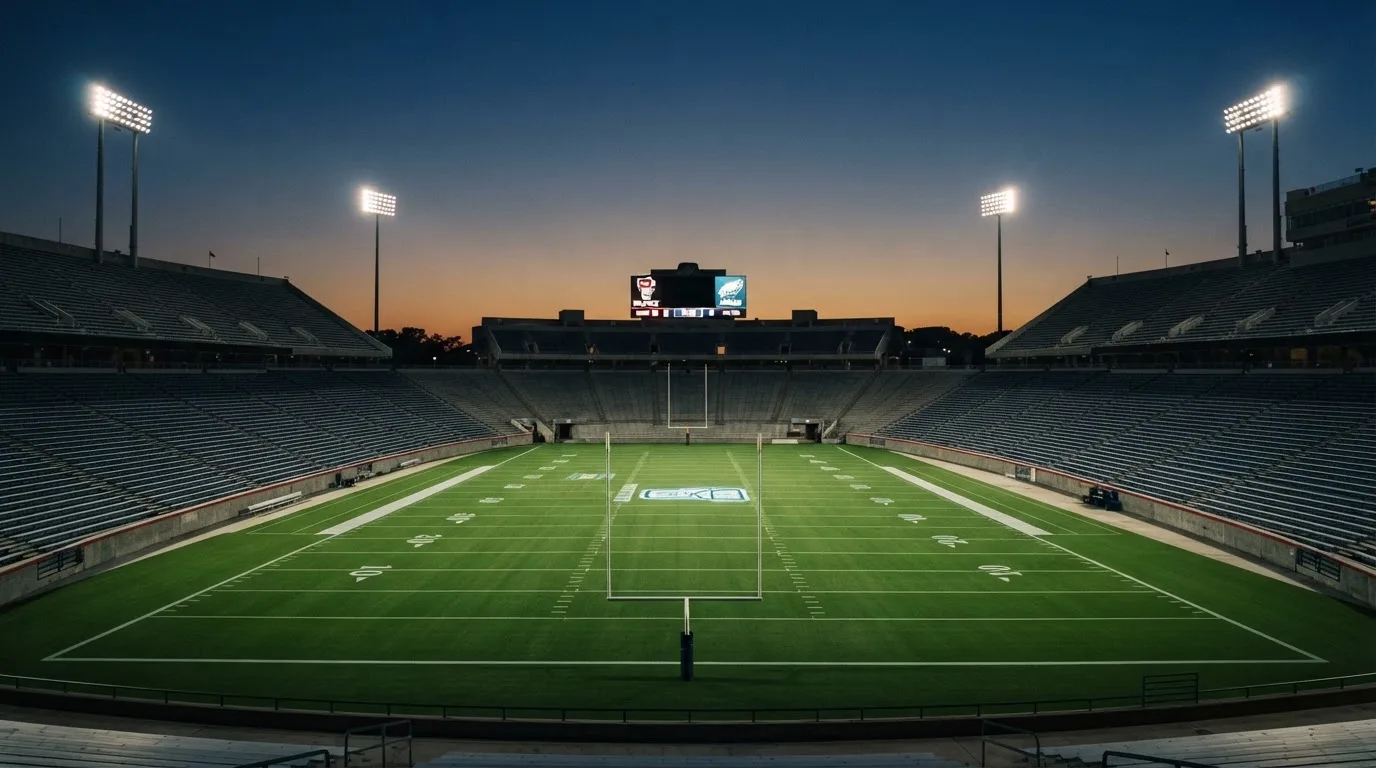
Scoring rewards offence and punishes defence in ways that shape the betting menu. A touchdown scores 6 points; the scoring team then chooses between an extra-point kick worth 1 or a two-point conversion attempt. A field goal adds 3. A safety — tackled in your own end zone — gives 2 points to the defending side, which is the unusual case of a score credited to the team that did not have the ball. That spread of values — 1, 2, 3, 6, 7 and 8 — is why every bookmaker’s total line on an NFL game settles on multiples of half a point rather than a round number, and why a single score late in a game can flip a handicap on either side of the line.
The NFL fields 32 teams, split evenly between the AFC and the NFC. Each team plays 17 games across an 18-week regular season, and 14 teams — seven per conference — reach a single-elimination post-season that finishes at the Super Bowl. Super Bowl LX was played on 8 February 2026 at Levi’s Stadium in Santa Clara; the Seattle Seahawks beat the New England Patriots 29–13, with Kenneth Walker III named MVP. That fixture, and the divisional round above it, are the markets that drew the heaviest handle of the 2025/26 season — and they set the template UK bookmakers now carry over into the season that follows.
Why quarter-by-quarter scoring matters for spread bettors
A two-score lead is rarely safe in the NFL. The three points from a field goal and the seven from a touchdown-plus-kick are close enough in value that a single drive can wipe out a spread. Most pre-match handicaps are quoted at half-point increments — 3.5, 7, 10.5 — precisely because bookmakers do not want a push on the most common score margins. A line of 6.5 exists, but it is rarer than 7 for a reason: the most likely outcomes cluster near 3, 7 and 10.

When a line lands exactly on the number
A handicap or a total that finishes on the quoted number is a push, and the stake is returned. The Sky Betting & Gaming American Football rules for NFL, CFL and NCAA confirm that wagers settle as void when the result lands precisely on the line — unless the bookmaker has offered a “tie” or “push” as a separate selection. In practice that means a closing line of Kansas City –3 with a 3-point Kansas City win returns every stake rather than paying either side, and the reader should expect the same rule at every UK-licensed operator unless its own terms say otherwise.
The UK betting landscape for American football
The UK regulator is the Gambling Commission, and it licenses the whole commercial market under the Gambling Act 2005. There is no statutory list of permitted sports or markets: an operator may offer American football, college football, the CFL, the XFL or any other gridiron competition provided its licence covers the activity and the markets sit inside its own published rules. Every UK-facing online bookmaker is also a GAMSTOP participant, which means the self-exclusion tool covers American football just as it covers Premier League football and horse racing.
American football is a niche product on British screens. The Sunday, Monday and Thursday night NFL games run through the small hours of the UK morning, which is why operators invest more heavily in pre-match pricing than in live markets for all but the highest-profile fixtures. For the Super Bowl itself — and to a lesser extent the conference championships and the divisional round — every UK-licensed bookmaker will run a full menu of pre-match markets, in-play markets and proposition bets. For a mid-season Sunday game between two non-playoff teams, the menu tends to shrink to the spread, the total and the moneyline, and live markets may not run at all.
Where the fixtures come from
The 18-week regular season runs from early September to early January. The post-season fills January, and the Super Bowl lands in early February. After that, the draft in April and pre-season activity from August are the next markers on the calendar. The college football season — bowl games in December, the College Football Playoff in January — runs on a similar arc and is offered by most major UK bookmakers, though liquidity is much thinner. The UFL, the spring league that replaced the XFL and USFL, runs from March to June and is treated as a small, specialist market.
The licence test — what a Gambling Commission licence actually does
A bookmaker offering American football to customers in Great Britain needs a remote general betting standard (real events) licence from the Gambling Commission. Since the Gambling (Licensing and Advertising) Act 2014 that requirement applies wherever the operator is based — a Curaçao, Malta or Gibraltar licence is not a substitute. The Commission’s public register is the whole test of whether a licence is held: the register can be searched by business name, trading name, domain or account number, and the search result carries the licence categories, the licence holder and the trading site.
Identity verification runs before the first deposit. Since 7 May 2019 licensed operators must verify name, address and date of birth before a customer can deposit, stake or claim a bonus — including a free bet. No anonymous play exists at a licensed site, which is a sharp break from the early years of online betting and the reason a UK bettor cannot open an account the way a US bettor can in states that allow registration without full KYC.
Credit cards are banned for gambling in Great Britain since 14 April 2020, including credit-card-funded payments through an e-wallet. Debit cards and bank-based payments are not covered by that ban. Cryptocurrency sits in a grey zone: there is no Commission rule against accepting crypto at a licensed site, but the same KYC and source-of-funds duties apply, so a deposit in Bitcoin still goes onto a verified, named account.
What protection a GB licence actually buys
The practical content of a GB licence for an American football bettor is the safety net, not the catalogue of markets. It means deposits and withdrawals are ring-fenced, customer funds are held in accordance with the Commission’s rules, complaints can be escalated to an approved alternative dispute resolution body, and self-exclusion through GAMSTOP works across the whole licensed market. It does not mean the odds are better than at an unlicensed site, that the limits are higher, or that the markets are wider.
A bettor who chooses to use an unlicensed site loses that safety net. No GAMSTOP coverage, no Commission complaints route, no British consumer redress if funds are withheld, and the 10x bonus cap and the £150 financial vulnerability check do not apply. Enforcement against unlicensed operators is disruption, not blocking — cease-and-desist notices, search-engine referrals and work with registrars and payment providers — and the player is not committing an offence by placing a bet, but is giving up the protections a GB licence provides.
Responsible gambling tools for American football bettors
American football is a high-variance sport to bet on: the regular season has only 17 games per team, which makes sample sizes small, and the season concentrates handle into a few marquee weeks. That makes the responsible-gambling toolkit more important than for a sport the bettor follows year-round.
GAMSTOP is the national multi-operator online self-exclusion scheme and a mandatory licence condition for every GB-licensed online operator since 31 March 2020. Self-exclusion periods are six months, one year, five years, or five years with auto-renewal. After the minimum period the exclusion stays in place for a further seven years unless the customer asks GAMSTOP to remove it. GAMSTOP covers online sites and apps; betting shops use a separate, multi-operator self-exclusion process.
Deposit limits are a customer-set tool, not a state-set ceiling. The Commission has set a staged rollout of a mandatory gross deposit limit framework — first changes since 31 October 2025, a second phase postponed to 30 September 2026 — but there is no state-imposed cap on stakes or losses in sports betting. Operators must offer a deposit limit; what that limit is, is the customer’s choice.
Financial vulnerability checks run on a rolling 30-day window once deposits minus withdrawals exceed £150. The check looks at public records — bankruptcies, county court judgments — not at income and not at credit files. Financial risk assessments, often referred to in the press as “affordability checks”, were announced in a staged plan on 7 July 2026 with no start date set.
Help is available outside the operator. GamCare runs the National Gambling Helpline; GambleAware funds treatment and education; the NHS runs specialist gambling clinics in several regions; Gamblers Anonymous runs peer-support meetings. A bettor who feels the wagering has slipped can reach any of these without going through the bookmaker.
Crypto, anonymity and American football betting
No anonymous play exists at any GB-licensed American football bookmaker, regardless of how the deposit is funded. Identity verification runs before the first deposit, and source-of-funds questions are normal at higher spend under the money-laundering rules. A deposit in Bitcoin, Ethereum or any other cryptocurrency still lands on a verified, named account, and the operator treats it as a deposit for the purposes of the £150 vulnerability-check threshold and the deposit-limit framework.
Crypto-funded accounts do appear at some sites that operate outside the GB licensing regime. The trade is straightforward: faster settlement and the absence of a card transaction on the bank statement, in exchange for the loss of every protection a GB licence provides — no GAMSTOP coverage, no Commission complaints route, no approved alternative dispute resolution, no British consumer redress if funds are withheld, and no application of the bonus cap or the vulnerability check. For most UK bettors that trade is unfavourable; for the small minority with a specific reason to keep gambling off the bank statement, it remains a route that exists.
What a crypto deposit changes in practice
On a licensed site, very little. The deposit converts into sterling or whatever currency the account runs in at the operator’s rate, the same KYC and source-of-funds rules apply, and a withdrawal goes back to a verified account in the customer’s name. On an unlicensed site, the absence of the Commission’s customer-funds rules means the customer carries the credit risk of the operator, and any complaint runs through the operator’s own customer service with no UK regulator behind it.
Bonuses and free bets on American football
The bonus market for American football in the UK is dominated by welcome offers and weekly price boosts, with acca insurance as the recurring workhorse product. The Commission has tightened the terms a bonus can carry since 19 January 2026: wagering requirements on bonuses are capped at 10x (a £10 bonus at 50x is illegal; under the cap, no more than £100 of wagering is required), and mixed-product promotions — an offer that requires gambling on two or more product types such as betting, casino, bingo and lottery, “bet on football to get free spins” — are banned.
A welcome offer is a deposit-and-bet match expressed as a free bet or a bonus. Unibet’s GB sports welcome is “Get £40 in Free Bets when you bet £20”: the customer deposits and stakes £20 or more at minimum odds of 2.0 (1/1), and receives £40 in free bets that expire within 7 days. BetTom’s GB sports welcome is 50% back as a free bet up to £50, with a parallel 50% back up to £50 in free slot funds — the second half is the kind of mixed-product structure the January 2026 rules constrain. VBet’s GB sports welcome is a £10 free bet if a new, verified customer stakes £10 or more on a first bet that loses, framed as a one-shot refund rather than a deposit match.
A free bet has its own arithmetic. The stake is usually not paid back with a win — a £10 free bet at 2.0 returns £10 in profit, not £20 — which is the structural reason a free bet is worth less than its face value. The value of a free bet at fair odds, before the bookmaker’s margin, is the free-bet amount multiplied by (odds − 1) divided by odds; on a typical NFL spread priced at 1.90 the £10 free bet is worth roughly £4.74 in expected value, before any minimum-odds restriction is layered on. A minimum-odds clause on a free bet — “winnings from free bets paid in cash if the price is 2.0 or greater” — is the standard way an operator controls which lines the free bet can be used on, and the figure a sharp bettor checks before claiming.
A price boost is a single-market uplift on a known selection: a moneyline moved from 2.10 to 2.50 for one fixture, or a same-game multi pushed from 5.00 to 7.00. The boost is genuinely worth the headline figure when the underlying price was already fair; it is worth less when the boost is on a market the bookmaker has priced tightly in the first place. Acca insurance refunds a losing accumulator as a free bet if exactly one leg lets the customer down — a popular structure for the Saturday football coupon that has carried over into American football. Each product is different, and each product’s headline price carries its own conditions.
What the bonus cap actually costs the reader
The 10x cap is the rule the industry pushed back hardest against, and the reason the cost falls on the operator’s marketing rather than the bettor’s wallet. A £100 bonus with a 25x wagering requirement was a £2,500 turnover requirement before the cap; under the 10x cap it is £1,000. The cap makes offers with very high headline values — “£1,000 bonus” — commercially impractical at the rate the operator can give value back, which is why welcome offers have skewed smaller and more conditional. The bettor sees more “bet £10, get £30 in free bets” and fewer “100% up to £1,000”.
Live betting and cash out on American football
In-play betting on American football runs at every GB-licensed bookmaker, though depth varies by fixture. For a Sunday or Monday night NFL game the in-play menu will typically include the spread, the total, the moneyline and a handful of derivative markets — next score type, result of the current drive, total points by quarter. For a mid-week college fixture the menu may be empty entirely.
Cash out lets the customer close a position before the event settles. It is offered on most pre-match markets and a smaller set of in-play markets. The cash-out price the operator shows is the current price at a compressed margin — the operator is offering to take the other side of the bet at a worse-than-market price, and the difference between the cash-out value and the true market value is the operator’s cut. On an NFL spread at 1.90 − 1.90 the true mid is 1.90, but the cash-out value may quote 1.80 to close a back bet and 2.00 to close a lay. That spread is the cost the customer pays for the convenience of closing early.
Bet Builder — sometimes called a same-game multi — is the other live feature worth knowing. bet365’s Bet Builder+ combines markets from one event into a single bet available pre-match and in-play. The structure is the same as an accumulator: the legs multiply into one price, and the margin is layered onto the combined price. The benefit for the customer is correlated selection — backing Kansas City to win, Patrick Mahomes to throw over 2.5 touchdowns and the total to go over 47.5 as one price, with the legs chosen because they tend to land together. The cost is that Bet Builder margins are higher than the equivalent singles, often by three to five percentage points, which is the trade for the convenience of a single wager.
Streaming and in-play data
Live streaming of US sport is patchy in the UK. NFL games are broadcast on Sky Sports and, on selected fixtures, on ITV and Channel 5; streaming rights are held by the broadcaster, not the bookmaker, so a UK-licensed bookmaker offering “live NFL streaming” is most often reselling a feed it has sub-licensed from a US or UK rights holder, or showing an alternative data feed with on-screen odds. Betfair’s app offers free live streaming of UK and Irish horse racing and football as part of the Betfair product; coverage of US sport is a smaller piece of that offer. The bettor should treat any “watch every NFL game live” marketing line with caution and check the actual fixture list before staking.
Predictions, tipsters and the analytics market
American football has one of the deepest public-analytics markets in any sport. The NFL publishes play-by-play data; advanced metrics such as DVOA (defense-adjusted value over average) and EPA (expected points added) are public; tipster services sell pre-game and in-play picks. The UK betting audience can find them at three levels: free social-media picks with no track record, paid tipster services with published records that may or may not survive scrutiny, and professional sportsbooks’ own model outputs.
The honest framing for a UK bettor is that no public tipster clears a bookmaker’s full margin after fees over a sample of NFL games large enough to be statistically meaningful. The bookmaker’s margin is baked into every price; the tipster’s fee is on top; the variance of an 18-week season is high. A model or tipster that shows a profit over a calendar year may be running on luck as much as skill, and the cleanest test is the long-run record after the closing line — whether the picks consistently beat the price available at kickoff, not just the price available 48 hours earlier.
For bettors who want to build their own model, the public data is real and useful. Drive-by-drive expected points added, red-zone conversion rate, third-down success, pressure rate on the quarterback, and pace of play (plays per game) are the inputs that move lines at the sharp end of the market. The bettor who builds even a simple version of those inputs will read a betting line more sharply than one who relies on form and reputation.
Why “best bets today” lists are usually marketing
Tipster lists titled “American football best bets today” or “NFL locks of the week” are rarely what they claim to be. They are content-marketing pieces that drive traffic to a tipster’s subscription service or to a sportsbook affiliate. A handful are genuinely useful, but the signal-to-noise ratio is poor, and the bettor who treats any of them as a source of value rather than a source of ideas is paying for marketing material.
How American football odds work — the markets and the math
Three markets carry almost all the handle on an NFL game: the spread (handicap), the total (over/under) and the moneyline (outright winner). Each asks a different question of the same fixture, and each is priced on the same two-way basis — back one outcome, lay the other.
The spread (handicap)
The favourite is credited a number of points; the underdog is credited the inverse. A line of Kansas City −3.5 means Kansas City must win by four or more; New York +3.5 means New York can lose by three or fewer, or win outright. Half-point lines eliminate the push on whole-number margins, which is why most pre-match NFL lines settle at half-point increments. A line of −7 is rarer than −6.5 or −7.5 because bookmakers do not want the push that a three-point win would create.
The total (over/under)
A single number, quoted at half-points. The bettor backs the combined score of both teams to go over or under the line. A total of 47.5 on Kansas City at New York means the combined score must be 48 or more to go over, 47 or fewer to go under. The total tends to move with team news, weather (a windy or snowy game suppresses totals) and pace of play (two pass-heavy teams push totals up).
The moneyline
The outright winner. No handicap. The favourite’s price is shorter than evens because the favourite wins more often than it loses; the underdog’s price is longer than evens because the underdog wins less often. A moneyline of 1.40 on Kansas City and 2.90 on New York means a £10 stake on Kansas City returns £14 if Kansas City wins, and a £10 stake on New York returns £29 if New York wins. The two prices sum to an implied probability greater than 100 per cent, and the excess is the bookmaker’s margin.
The combination bet (accumulator)
A combination bet multiplies the prices of its legs into one. A double at 2.0 and 3.0 is a 6.0 accumulator; a treble at 2.0, 3.0 and 4.0 is a 24.0 accumulator. The stake is multiplied by the combined price to give the return; the profit is the return minus the stake. The same margin that sits inside every leg sits inside the combined price, and the margin grows as the number of legs grows because the operator’s edge compounds. A four-fold at fair prices (a 4.0 accumulator on four 2.0 legs) carries roughly 10 per cent of margin, against 5 per cent on the single 2.0 line.
How the margin sits inside the price
Consider a two-way market priced at decimal odds 1.90 and 1.90 — the example below assumes an illustrative line, not a quoted price, and is intended to show the arithmetic the bookmaker runs. The implied probability of each side is 1 ÷ 1.90, which is roughly 52.63 per cent. The two probabilities add to 105.26 per cent; the excess over 100 per cent — 5.26 per cent — is the bookmaker’s margin, also called the overround. For real NFL lines the margin on the spread and the total typically sits between 4.5 and 6 per cent on liquid fixtures, with a few percentage points of variance by bookmaker and by time of week; prices tighten close to kickoff as liquidity arrives.
A bookmaker’s margin of 5 per cent on a £100 stake means the operator expects to keep £5 of every £100 wagered across that market, on average, before any consideration of the bettor’s skill. The bettor who beats the closing line over a sample of bets is taking that margin back from the operator, bet by bet; the bettor who does not is paying it. The arithmetic the page runs below gives a tighter number for an illustrative 1.90 / 1.90 line.
The illustrative calculation
Take the illustrative two-way market priced at 1.90 on each side. The implied probability of each side is 1 ÷ 1.90, or about 52.63 per cent. Add the two probabilities and you get 105.26 per cent. The excess over 100 per cent is the bookmaker’s margin — in this illustrative case, about 5.26 per cent of turnover, or just over 5p in the pound. A real NFL spread at the same price would carry a margin inside the same band, with the exact figure moving with liquidity and time to kickoff. The headline point for the reader: every price carries a margin, the margin compounds in accumulators, and the only way to recover it is to beat the closing line over a sample of bets.
Where to find the best American football odds in 2026
No single UK bookmaker carries the best price on every NFL market across every week of the season. The spread is sharpest at a different operator from one week to the next, and the best price on the total can sit at a third operator entirely. The bettor who wants the best price on a given fixture checks three or four operators before staking — the price difference between 1.90 and 1.95 on the same spread is 2.6 per cent of stake, which compounds over a season.
The table below covers the ten GB-licensed bookmakers this page reviews. The columns name the matters a reader comparing operators cares about: the brand, the Gambling Commission licence that authorises it to take bets from customers in Great Britain, and what the operator’s own published terms say about the markets and offers this page covers.
| Brand | Gambling Commission remote licence (account) | What the operator’s own terms state |
|---|---|---|
| Star Sports | 009177-R-104555-019 (9177), Star Racing Limited | Customers can open an account, place bets and ask queries by speaking to a trader directly on 08000 521 321 or by email at [email protected] |
| Bar One Racing | 056516-R-332750-007 (56516), Bar-One Racing Limited | Irish independent bookmaker rebranded as BAR 1 Betting, with horse-racing sponsorships at Dundalk, Fairyhouse, Navan, The Curragh, Curraheen Park and Cork |
| Fafabet | 057385-R-333191-006 (57385), Taichi Tech Limited | Best Odds Guaranteed on UK and Irish horse racing win and each-way bets from 9am on race days — the bigger of the original price or the SP is paid |
| BetTom | 064959-R-339314-003 (64959), Bet Tom Limited | Sports welcome offer is 50% back as a free bet up to £50, with a parallel 50% back up to £50 in free slot funds; full terms apply |
| Fitzwilliam Sports | 048760-R-335434-009 (48760), SBKI Limited | Self-describes as a Dublin bookmaker with capped membership; welcome is a “High Stakes Welcome” subject to compliance criteria; offers instant deposits, fast withdrawals, timeouts and deposit limits, and links to GamCare, GAMSTOP and Gamblers Anonymous |
| Betfair | 039439-R-319330-013 (39439), PPB Counterparty Services Limited | In-play betting, Bet Builder, free live streaming of UK and Irish horse racing and football within the app, and a 90 Minute Payout market |
| Unibet | 045322-R-324275-019 (45322), Platinum Gaming Limited | Sports welcome offer is “Get £40 in Free Bets when you bet £20”: deposit and bet £20 or more at minimum odds of 2.0 (1/1), free bets expire within 7 days, for new GB customers using a debit card or instant bank transfer |
| Swifty Sports | 058957-R-334734-006 (58957), Swifty Global (UK) Ltd | Best Odds Guaranteed, Cash Out on horse racing and football markets, daily price boosts, live streaming and in-play betting; Bet Builder listed as coming soon |
| bet365 | 055148-R-331498-002 (55148), Hillside (UK Sports) ENC | Official global betting partner of the UEFA Champions League; Bet Builder+ combining markets from one event into a single bet pre-match and in-play; Super Boosts, Winnings Boosts on Bet Builders and selected singles, daily Bet Boosts; in-play betting and live streaming; Bet Track, Match Live and Live Golf Tracker |
Every licence in this table is held by a different licensee; several of the brands sit on the same platform, but each is licensed separately and each carries its own published terms. The Betfair card sits on the PPB Counterparty Services Limited licence, which is shared with Paddy Power Sportsbook — both brands are run by the same licensee and are not independent operators, which is a fact the Commission’s register shows and a reader comparing books should track that distinction. None of the operators in this table is the only GB-licensed brand offering American football; the Commission’s register lists many more, and the ten above are this page’s reviewed set, not the licensed market as a whole.
Star Sports
Star Racing Limited operates Star Sports on Gambling Commission account 9177, with remote general betting standard (real events) as the licensed activity. The operator runs a direct-trader model that is unusual for an online bookmaker: customers can open an account, place a bet or ask a query by phoning 08000 521 321 or by emailing [email protected], rather than working through the standard online-only sign-up. For an American football bettor who wants a named contact at the bookmaker, that is a real point of difference against the online-only operators in the table. The published terms do not name American football-specific features, so the menu is best confirmed at the operator’s own sportsbook before staking.
The verdict: Star Sports targets those who prefer phone-based account management over self-service; it is less optimal for bettors who rely on advanced Bet Builder and price-boost features, as they are not the primary focus here.
Bar One Racing
Bar-One Racing Limited holds Gambling Commission account 56516 for remote general betting standard (real events) and operates Bar One Racing, recently rebranded as BAR 1 Betting. The brand is an Irish independent bookmaker with shops across Ireland and horse-racing sponsorships at Dundalk, Fairyhouse, Navan, The Curragh, Curraheen Park and Cork. The horse-racing identity is the visible centre of the brand; American football is offered under the standard sportsbook menu rather than as a featured product.
The verdict: Bar One Racing appeals to punters diversifying between horse racing and American football who prefer Irish independent operators; for bettors prioritising NFL depth and aggressive price boosts, larger global platforms may prove more suitable.
Fafabet
Taichi Tech Limited holds Gambling Commission account 57385 for remote general betting standard (real events) and operates Fafabet. The published terms name Best Odds Guaranteed on UK and Irish horse racing win and each-way bets from 9am on race days: if the starting price is bigger than the original price, the bigger odds are paid. That is the headline feature on the racing side. The American football menu is offered under the standard sportsbook, and the bettor who wants a sharp price on a Sunday NFL game should check the Fafabet line as one of the three or four operators compared before staking.
The verdict: Fafabet fits the bettor who values Best Odds Guaranteed on racing and wants a competitive American football line as part of a broader sportsbook; it is not the brand that leads the market on US-sport-specific features such as Bet Builder and live streaming.
BetTom
Bet Tom Limited holds Gambling Commission account 64959 for remote general betting standard (real events) and operates BetTom. The sports welcome offer is 50% back as a free bet up to £50, with a matching 50% back up to £50 in free slot funds for casino play. That dual structure — half sports free bet, half casino free spins — is the kind of mixed-product promotion that the Commission’s January 2026 rules constrain; the bettor should read the qualifying terms before claiming, since the casino half is what the rule targets. The American football menu is offered under the standard sportsbook.
The verdict: BetTom appeals to bonus-focused players comfortable with mixed sports and casino offers; for those seeking a straightforward sports-only free bet, other bookmakers present clearer terms.
Fitzwilliam Sports
SBKI Limited (account 48760) operates Fitzwilliam Sports. The brand describes itself as a Dublin bookmaker with capped membership; the welcome is a “High Stakes Welcome” subject to compliance criteria, which sets it apart from the open-membership model of the larger operators. Fitzwilliam offers instant deposits, fast withdrawals, timeouts and deposit limits, and links to GamCare, GAMSTOP and Gamblers Anonymous on its site. For an American football bettor at higher stakes, the “capped membership” structure is worth understanding: not every applicant will be accepted.
The verdict: Fitzwilliam Sports fits the higher-stakes bettor who wants a curated bookmaker with a direct relationship and is comfortable with the compliance criteria that capped membership implies; for the recreational bettor, the open-membership operators carry fewer steps.
Betfair
PPB Counterparty Services Limited (account 39439) operates Betfair. The sportsbook arm offers in-play betting, Bet Builder, free live streaming of UK and Irish horse racing and football within the app, and a 90 Minute Payout market. The Betfair exchange — a separate product running under the same licence — is the betting exchange the market reaches for liquidity on NFL and college football, particularly in the hours before kickoff when sharp money arrives. For an American football bettor, Betfair’s strength is the combination of the sportsbook and the exchange on one app: a back bet at the sportsbook and a lay bet at the exchange is a structure no pure sportsbook supports.
The verdict: Betfair fits the bettor who uses both sportsbook and exchange; for the bettor who only wants a sportsbook, the exchange is a distraction and the Betfair Sportsbook product competes with the rest of the table on the same terms.
Unibet
Platinum Gaming Limited (account 45322) operates Unibet. Unibet states it has operated since 1999. The sports welcome offer is “Get £40 in Free Bets when you bet £20”: the customer deposits and stakes £20 or more at minimum odds of 2.0 (1/1), with free bets expiring within 7 days of issue, for new GB customers using a debit card or instant bank transfer. The 7-day expiry is the headline condition: a bettor who claims and forgets about the free bet loses it. American football is offered under the standard sportsbook menu.
The verdict: Unibet fits the bettor who values a £20-stake welcome with a clean 1/1 minimum and is willing to use the free bets within a week; the 7-day expiry is short, and the bettor who claims late leaves money on the table.
Swifty Sports
Swifty Global (UK) Ltd (account 58957) operates Swifty Sports under a remote general betting standard (real events) licence. The published terms name Best Odds Guaranteed, Cash Out on horse racing and football markets, daily price boosts, live streaming and in-play betting; Bet Builder is listed as coming soon. The combination of BOG, Cash Out, price boosts and live streaming on a single platform is what the larger operators offer, and the Swifty proposition reads as a leaner version of the same bundle. For an American football bettor, the Cash Out and price-boost features are the practical ones; the “coming soon” on Bet Builder is the gap.
The verdict: Swifty Sports provides a comprehensive BOG and Cash Out bundle on a boutique platform; the “coming soon” label on Bet Builder, however, remains a notable limitation for active market participants.
bet365
Hillside (UK Sports) ENC (account 55148) operates bet365 under a remote general betting standard (real events) licence. The brand is the official global betting partner of the UEFA Champions League and its app is described as the most-downloaded sports betting app in the UK. The American football product is the deepest in this set: Bet Builder+ combining markets from one event into a single bet pre-match and in-play, Super Boosts, Winnings Boosts on Bet Builders and selected singles, daily Bet Boosts, in-play betting, live streaming of events worldwide, Bet Track, Match Live and a Live Golf Tracker. For a serious American football bettor who uses Bet Builder and wants the deepest menu, bet365 is the reference point the rest of the table is compared against.
The verdict: bet365 is tailored for high-volume bettors requiring deep markets, live streaming and aggressive price-boost schedules; the tradeoff for such expansive service is a less personalised feel than smaller operators provide.
VBet
SCGO Limited (account 44662) operates VBet under a remote general betting standard (real events) licence. The sports welcome offer is a £10 free bet if a new, verified customer stakes £10 or more on a first bet that loses. The structure is a one-shot refund rather than a deposit match — the bettor who wins the first bet gets no free bet, the bettor who loses gets £10 back as a free bet. American football is offered under the standard sportsbook. The Commission’s January 2026 cap on wagering requirements and the ban on mixed-product promotions govern how VBet structures its ongoing offers; the headline welcome is unaffected because it carries no wagering requirement on a bonus.
The verdict: VBet fits the bettor who wants a low-stakes, low-friction welcome and a smaller sportsbook; for the bettor who wants the deepest American football menu, bet365 and Betfair carry more weight, and the welcome at either of those is the comparison VBet is measured against.
How a winning American football bet pays back
The arithmetic of a single bet is the same on every market and at every bookmaker. The return is the stake multiplied by the decimal odds. The net profit is the stake multiplied by (decimal odds minus 1). A £10 stake at decimal odds 2.90 returns £29; the £10 stake plus £19 in profit. A £10 stake at 1.40 returns £14; the £10 stake plus £4 in profit. The arithmetic does not change for a spread, a total, a moneyline or a combination bet — it changes only the price.
For a combination bet the legs multiply into one price. A treble at 2.0, 3.0 and 4.0 is a 24.0 accumulator; a £10 stake returns £240 if all three legs win, with £230 of profit. The risk is that one leg lets the customer down and the entire bet loses. The benefit is that the price compounds, and the bettor’s view of one game can be combined with their view of others into a single wager. The margin also compounds, which is the trade for the higher headline price.
The same arithmetic underpins the free-bet calculation. A £10 free bet at 2.90 returns £19 in profit, not £29, because the £10 stake is not paid back. The expected value of the free bet at fair odds, before the bookmaker’s margin, is the free-bet amount multiplied by (odds minus 1) divided by odds. On a typical NFL spread priced at 1.90 a £10 free bet is worth roughly £4.74 in expected value, before any minimum-odds restriction. A minimum-odds clause on the free bet shrinks the pool of eligible prices and reduces the expected value further.
The calculation the page has just run is a statistical estimate, not a guaranteed outcome. It assumes the bettor chooses prices that reflect the underlying probability, which is what the bettor does when they are reading a line sharply; it does not assume any specific bet wins. A free bet at fair odds returns its expected value across many uses, not on the first use.
The bookmaker’s margin and how it shows in the odds
The bookmaker’s margin is the excess over 100 per cent when the implied probabilities of all outcomes are added. A two-way market at 1.90 / 1.90 implies 52.63 per cent on each side; the sum is 105.26 per cent, and the excess is 5.26 per cent. The same market at 1.95 / 1.95 implies 51.28 per cent on each side; the sum is 102.56 per cent, and the excess is 2.56 per cent. The lower the margin, the sharper the price.
The page ran the calculation above on an illustrative 1.90 / 1.90 line. The implied probability of each side is 1 ÷ 1.90, or 52.63 per cent. The two probabilities add to 105.26 per cent. The bookmaker’s margin on this illustrative line is 5.26 per cent — just over 5p in the pound of turnover. A real NFL spread on a liquid fixture typically sits between 4.5 and 6 per cent; a moneyline on a heavy favourite runs higher because the underdog’s longer price contributes more to the overround. A pre-match NFL total on a high-liquidity fixture carries similar margin to the spread, in the same 4.5 to 6 per cent band.
The margin compounds across legs of an accumulator. A double at fair 2.0 / 2.0 carries roughly 10 per cent of margin against 5 per cent on each single; a treble at fair 2.0 / 2.0 / 2.0 carries roughly 15 per cent. The headline price on an accumulator looks attractive — 8.0 on a treble at three 2.0 legs — but the margin inside the price is three times the margin on a single, which is the structural reason accumulators are profitable for the operator and rarely profitable for the recreational bettor.
The bettor who beats the closing line over a sample of bets recovers the margin bet by bet. The bettor who does not pays the margin, plus variance, plus any subscription fee to a tipster. The arithmetic is straightforward; the discipline is harder.
Frequently asked questions about American football betting odds
How is American football bet on in the UK?
American football is bet on at UK-licensed bookmakers under the same remote general betting standard (real events) licence that covers football, tennis and horse racing. The customer opens a verified account, deposits by debit card or bank transfer, and stakes on the spread, the total or the moneyline — the three markets that carry almost all the action on an NFL fixture. In-play betting and Bet Builder are available at the larger operators on the marquee fixtures. Every GB-licensed bookmaker is a GAMSTOP participant, so the responsible-gambling toolkit applies to American football in the same way it applies to any other sport.
What is American football betting?
American football betting is wagering on the outcome of an NFL, college, CFL or UFL fixture using one of three core markets. The spread (handicap) asks the bettor to pick which team covers a quoted margin; the total asks whether the combined score of both teams goes over or under a quoted line; the moneyline asks the bettor to pick the outright winner. All three markets are priced on a two-way basis with a built-in margin, and all three settle at the end of regular time — overtime counts at most UK bookmakers, but the bettor should check the operator’s own rules.
Where can the best American football betting odds be found?
No single UK bookmaker carries the best price on every NFL market across every week. The spread is sharpest at a different operator from one week to the next, and the best price on the total can sit at a third operator entirely. The bettor who wants the best price checks three or four operators before staking — bet365, Betfair and Unibet are the natural starting points at the larger end, with Fafabet, Swifty Sports and VBet worth a look as alternates. A price difference between 1.90 and 1.95 on the same spread is 2.6 per cent of stake, which compounds over a season.
How is a Gambling Commission licence verified?
The Gambling Commission’s public register can be searched by business name, trading name, domain or account number. The search result shows the licence categories, the licence holder and the trading site. Every operator in this page’s reviewed set holds a remote general betting standard (real events) licence, and the table earlier on the page names the account number and the licence holder for each. The register is the whole test of whether a brand holds a licence — a Curaçao, Malta or Gibraltar licence is not a substitute, since the Gambling (Licensing and Advertising) Act 2014 requires a Commission licence wherever the operator is based.
How is the return on a bet worked out from the stake and the odds?
The return is the stake multiplied by the decimal odds. A £10 stake at decimal odds 2.90 returns £29, with £19 in profit and £10 in stake. A £10 stake at 1.40 returns £14, with £4 in profit and £10 in stake. The arithmetic does not change for a spread, a total, a moneyline or a combination bet. For a combination bet the legs multiply into one price: a treble at 2.0, 3.0 and 4.0 is a 24.0 accumulator, and a £10 stake returns £240 if all three legs win.
What is the bookmaker’s margin and how does it show in the odds?
The bookmaker’s margin is the excess over 100 per cent when the implied probabilities of all outcomes are added. The implied probability of a decimal price is 1 divided by the price; for a two-way market at 1.90 / 1.90 the implied probability of each side is roughly 52.63 per cent, the sum is 105.26 per cent, and the excess — 5.26 per cent — is the margin. The margin sits inside every price a bookmaker quotes, and it compounds across the legs of an accumulator. A treble at three 2.0 legs carries roughly 15 per cent of margin against 5 per cent on a single 2.0 line. The bettor who beats the closing line over a sample of bets recovers the margin; the bettor who does not pays it.
US & other team sports – Darts betting
Content created by the «Darts betting» team
