
Handball betting in Great Britain: who offers it, what it costs and how the odds work
 Available in US
Handball is a niche in British betting. The men’s and women’s world championships run every odd-numbered year under the International Handball Federation, the European leagues draw modest attention outside Germany, France, Denmark and Spain, and the only place a British punter meets the sport in any depth is the in-play corner of a big bookmaker’s app. That makes the choice of operator more important than the choice of selection: the long tail of fixtures is unevenly priced, the in-play lines move quickly and the welcome offers on handball are thinner than they are on football.

The shape of this page is consequence. What follows from picking a particular bookmaker, a particular market and a particular offer — for whom, at what cost, and where the arithmetic works against the punter.
Data current as of 27 October 2026. Licence claims were verified against the Gambling Commission’s public register.
Tournaments and fixtures a Great Britain bookmaker covers
The IHF runs men’s and women’s world championships in odd-numbered years. The men’s event has been held every two years since 1995; Denmark took the 2025 men’s tournament and France the 2023 women’s title. Olympic handball is older than most people expect — men first played at the 1936 Berlin Games outdoors, the sport returned indoors at the 1972 Munich Games and women were added at the 1976 Montreal Games. Every two summers, handball is the second-biggest indoor sport in the Olympic programme by team count.

For a British bettor that history is mostly context. What matters is the calendar. The European men’s and women’s Champions League runs through the autumn and spring; the Bundesliga, Ligue 1 and Liga Asobal run in parallel through the European season; the IHF World Championship slots into January in odd years; the European Championship slots into January in even years; the Olympics sit in late July and early August of every Leap Year. A serious handball calendar therefore never has fewer than two top-flight competitions running at once, and in any given week a GB-licensed bookmaker’s handball lobby will show somewhere between 30 and 200 fixtures depending on the time of year.
The shape of the British bookmaker’s handball lobby is fairly consistent across the ten brands reviewed further down. Pre-match match winner, handicap and totals cover every listed fixture. Outright winner and to reach the final appear from the group stages of the major championships. Player props — top scorer, total goals — thin out at the knockout rounds of the World Championship and reappear during the Olympic handball tournament. Markets tied to a specific phase of play (first-half winner, second-half handicap) appear on the bigger events and disappear on the small ones. The smaller the fixture, the smaller the market list — a League Asobal mid-table match between two obscure clubs will typically be match winner and a small handicap, nothing more.
That tapering of the market list is where the consequence lives. A punter who bets on handball every week quickly learns which bookmakers actually carry the Greek league, the Portuguese Liga and the second tier of the German Bundesliga — and which ones merely carry the Champions League group stage and call it handball.
Ten bookmakers serving Great Britain and what each one is for
This is not a ranking. It is a comparison of ten brands that hold a Gambling Commission remote licence and offer handball at the time of writing, in the order they appear on the Commission’s public register as encountered for this subject. The columns used further down — licence, holder, and what the operator’s own terms say on the subject — apply to all ten.
| Brand | Gambling Commission licence | Licence holder | What the operator’s own terms say on handball |
|---|---|---|---|
| Betway | 039372-R-319367-029 (account 39372) | Betway Limited | Free Bet Club: opt-in, spend £25+ on sports to earn two £5 free bets that week |
| Paddy Power | 039439-R-319330-013 (account 39439) | PPB Counterparty Services Limited | App covers football, horse racing, boxing, rugby, tennis, golf, darts, snooker and F1; handball is carried through the sportsbook lobby rather than a dedicated tab |
| BetMGM | 039198-R-319450-029 (account 39198) | LeoVegas Gaming PLC | Sports welcome offer for new UK customers: deposit £10+ and place a sports bet within 7 days to receive four £10 free bets — two football accas of 4+ legs and two sports multiples of 2+ legs, valid for 7 days, minimum odds apply, opt-in required |
| VBet | 044662-R-324273-022 (account 44662) | SCGO Limited | Sports welcome offer for new, verified customers: a £10 free bet if the first-ever stake of £10+ loses |
| bet365 | 055148-R-331498-002 (account 55148) | Hillside (UK Sports) ENC | Bet Builder+ combines markets from one event into one bet, available pre-match and in-play; Super Boosts, Winnings Boosts on Bet Builders and selected singles; daily Bet Boosts; in-play betting and live streaming of events worldwide; Bet Track, Match Live and a Live Golf Tracker |
| Kwiff | 044448-R-323408-017 (account 44448) | Eaton Gate Gaming Limited | Licensed by the UK Gambling Commission; trademark of Spryme Ltd |
| Matchbook | 039504-R-319407-024 (account 39504) | Triplebet Limited | Betting exchange: customers bet against other users; Bet Builder, multiples, in-play betting and live streaming of horse racing and greyhounds |
| Hollywoodbets | 053028-R-330019-013 (account 53028) | Hollywoodbets International UK Limited | Sports welcome offer: deposit £10+ by card to receive the stake back as a free bet of up to £30 on the first qualifying losing accumulator (£10+, 3+ legs, odds of 4/1 or greater, settled within 7 days); one free bet per customer |
| Ladbrokes | 054743-R-330863-014 (account 54743) | LC International Limited | App published by Entain Operations Limited; 4.66 average rating across more than 100,000 App Store ratings |
| Spreadex | 008835-R-104580-022 (account 8835) | Spreadex Limited | Combines fixed-odds and spread betting in one app; one-click, auto and partial cash out; Bet Builder across fixed odds or spreads; live streaming of UK and Irish horse racing, greyhounds, tennis, NFL and selected football; spread betting losses can exceed the deposit |
Betway
Betway runs the standard big-bookmaker handball lobby: match winner, handicap and totals on every fixture the IHF calendar shows. The Free Bet Club is the operator’s own hook — opt in, turn over £25 or more on sports in a week and pick up two £5 free bets. £10 a week for what is, in effect, a refund on a tenth of the qualifying turnover is a thin offer against the headline terms, and the qualifying stake has to be on sports with minimum odds. For a handball punter who also has a football or a tennis interest the club is money for nothing; for one who bets only on handball it is a reason to look elsewhere. The app is steady rather than spectacular, and Betway’s pricing on niche sports sits in the middle of the market. Punters who already bet on the Premier League will not notice anything different about the handball pricing here.
Paddy Power
Paddy Power’s app covers nine named sports — football, horse racing, boxing, rugby, tennis, golf, darts, snooker and F1 — with handball carried through the general sportsbook lobby rather than a dedicated tab. The market list on the bigger handball events is competitive: match winner, a generous handicap range, totals and a small set of team props. On small events it narrows to match winner and a single handicap, as it does everywhere. The Paddy Power price-boost mechanic — a one-off enhanced price on a named selection — does appear on the bigger handball events and is worth a check before laying a bet elsewhere. The price is usually the kind that looks generous on the face of it and moves quickly once other punters pile in.
BetMGM
BetMGM runs the LeoVegas Gaming PLC licence and prices a competitive handball lobby. The welcome offer is structured rather than simple — four £10 free bets split between two football accas of 4+ selections and two sports multiples of 2+ — and the way it splits limits a handball punter’s use of it: only the two sports multiples (and only those at 2+ legs) can be cleared on handball. The 7-day validity window is short enough that a punter who wants to use the offer has to plan their handball weekend in advance. Outside the welcome, BetMGM’s pricing on handball sits close to the major operators and the in-play offering is solid on the bigger events.
VBet
VBet’s sports welcome offer is the simplest in the comparison: a £10 free bet if the first-ever £10+ stake loses. One bet, one outcome, one token. The simplicity is the point — there are no multi-leg rules and no minimum-odds trapdoors beyond the basics. Handball coverage is thinner than bet365 or Paddy Power but the prices on what is offered tend to be competitive. For a punter who only wants to back a couple of selection across a weekend, VBet is the easiest brand in the table to use cleanly.
bet365
bet365 carries the deepest handball lobby in British betting. Match winner, handicap, totals, team props, player props where the data exists, half markets, race-to-X-goals markets and outright winner markets across the world championships and the Olympics — all of it is there. Bet Builder+ combines markets from one event into a single bet, both pre-match and in-play, which on handball means a single selection can string together match result, total goals and a player to score a hat-trick into one price. Super Boosts and daily Bet Boosts push selected prices above the market, and the live-streaming offering covers the bigger handball events when feed rights allow. The cost of all this is that bet365’s headline margin on niche sports is not always the lowest, and price-boosted markets sometimes carry a stake cap that bites at the small punter. For a punter who bets across many sports and wants one app to do the lot, bet365 is the default; for one who only bets handball, the rest of the lobby is dead weight.
Kwiff
Kwiff is the surprise name on a handball page. The operator brands itself around “surprise” boosts — randomly enhanced odds on selected markets — and the boost mechanic sometimes lands on handball. Kwiff is fully GB-licensed and the app is rated for 17+ in the App Store, which puts it in line with the rest of the market on age gating. Handball coverage is narrower than bet365 or Paddy Power but the boosted prices can move the value calculation sharply when they hit. Worth keeping the app installed even if the punter’s main account is elsewhere.
Matchbook
Matchbook is the only betting exchange in this comparison — a marketplace where customers back and lay against each other rather than against a bookmaker, on a betting-intermediary licence held by Triplebet Limited. The consequence is a different price structure: Matchbook’s commission is lower than a bookmaker’s overround on liquid events, which on a big handball fixture means better prices for both back and lay. The trade-off is that Matchbook’s market list on handball is smaller than bet365’s, the Bet Builder and multiples are thinner, and live streaming is limited to horse racing and greyhounds rather than handball. In-play on handball is available and prices move quickly. A serious price-taker will keep a Matchbook account alongside a bookmaker account for the bigger events; a casual handball punter will find the exchange harder to use than a conventional sportsbook.
Hollywoodbets
Hollywoodbets is a newer name in the British market than the others in this comparison. The welcome offer is accumulator-shaped — a free bet of up to £30 if the first qualifying acca loses, 3+ legs, odds of 4/1 or greater, settled within 7 days — which makes it useful only for a punter willing to put together a multi-leg handball bet on their first weekend. The offer does not help a single-selection backer. Handball coverage is fair but not exceptional; the prices on the bigger events tend to sit in line with the rest of the market. The £30 cap on the free bet is generous against VBet’s £10, but the accumulator requirement costs the casual punter more in complexity than the extra £20 is worth.
Ladbrokes
Ladbrokes is the heritage brand in this list — LC International Limited’s licence, Entain Operations Limited’s app, and more than 100,000 App Store ratings averaging 4.66. Handball coverage is solid on the bigger events and the price-boost mechanic (a named daily boost on a selected market) appears regularly on the world championships and the European leagues. The welter’s in-play offering is competitive. The book’s handicap on handball sits in the middle of the market and the app’s reliability is one of its selling points. For a punter who already has a Ladbrokes account from the high street, the move from counter to app is frictionless.
Spreadex
Spreadex is the only dual product in this comparison — fixed odds and financial spread betting in one app, on the same Spreadex Limited licence. The FCA regulates the spread-betting side and the Gambling Commission regulates the fixed-odds side, and Spreadex’s own terms state that spread-betting losses can exceed the deposit. That is the only product in this comparison where a losing position can cost more than the punter put in, and it is worth repeating: fixed-odds punters are not exposed, but anyone who clicks on the spread side needs to read it. Handball coverage is narrower than the pure fixed-odds books but the Bet Builder works across both fixed odds and spreads, and the live-streaming offering covers selected football in addition to horse racing and greyhounds. A punter who has never used a spread product should not start on Spreadex; a punter who already spreads will find the handball lobby a useful addition.
How handball betting actually works
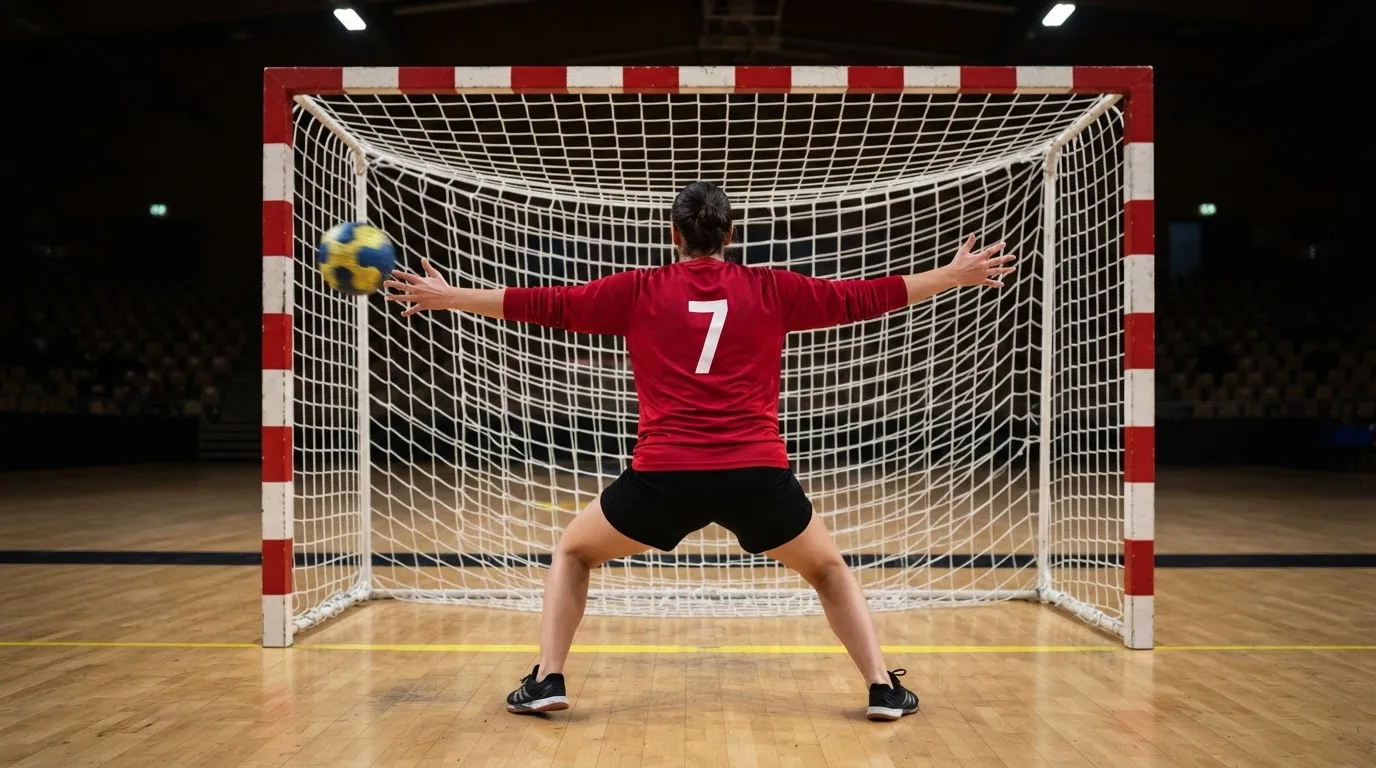
Handball is a high-scoring, fast-moving indoor sport. A team has seven players on court — six outfield plus a goalkeeper — and a match is two 30-minute halves. The court is 40 metres by 20, the goals are 3 metres wide and 2 metres high, and professional teams typically score between 20 and 35 goals each. That is the frame on which every handball market is built.
A match winner market prices three outcomes — home win, draw or away win — at decimal odds that look like 1.90, 3.40, 4.50 on a balanced fixture. A handicap market gives one side a goal advantage (typically ±2.5 or ±3.5) and prices two outcomes. A totals market prices over and under a given goal count (typically 55.5, 56.5 or 57.5) at two prices. Player markets — top scorer, first to score, total goals — appear on the bigger events and price individual players at decimal odds that range from 1.50 on a heavily favoured scorer to 50.00+ on a long shot.
Decisive matches handle a draw differently from league matches. Up to two 5-minute overtime periods follow a tied knockout match, and if the teams are still level a penalty shootout decides it. Most bookmakers settle match-winner bets on the result after overtime and penalties, with a separate “to qualify” market for the team that advances. A punter who backs the draw on a knockout match and the match goes to extra time has lost the bet, even if the match is technically “drawn” after 60 minutes.
The pace of the sport shapes how the markets behave. A handball match can swing by three or four goals in two minutes, which means in-play prices move faster than football prices do on a goal-for-goal basis. Cash out is useful on handball in a way it rarely is on football — a five-goal swing in the second half is enough to make a pre-match handicap look very clever or very stupid, and the ability to lock in a partial position before the swing matters.
Legality and the licence test
There is no statutory list of permitted sports or markets in Great Britain. The Gambling Act 2005 — covering England, Scotland and Wales but not Northern Ireland — licenses the whole commercial market through the Gambling Commission, a non-departmental public body sponsored by the Department for Culture, Media and Sport. Since the Gambling (Licensing and Advertising) Act 2014 an operator whose remote facilities are used in Great Britain needs a Commission licence wherever it is based; a Curaçao, Maltese or Gibraltar licence is not a substitute. Sections 33 and 36 of the 2005 Act set out the offence of providing unlicensed gambling facilities.
Betting exchanges run under a separate licence category — remote betting intermediary — and pool betting on horse and dog racing sits under a third. The Commission’s public register is the whole test of who holds a licence: it can be searched by business name, trading name, domain or account number, and a brand that does not appear on it is unlicensed. The licence types are remote general betting standard (real events), remote general betting standard (virtual events), remote general betting limited, remote pool betting and remote betting intermediary.
The minimum age is 18. Name, address and date of birth are verified before a customer can deposit or gamble, since 7 May 2019, including with a free bet or a bonus. There is no anonymous play at a licensed site. Credit cards are banned for gambling in Great Britain since 14 April 2020, including credit-card-funded payments through an e-wallet; debit cards and bank-based payments are not covered by that ban. The player pays no tax on betting winnings in Great Britain — General Betting Duty is the operator’s tax, currently 15%, on gross profits. From 1 April 2027 a new remote betting rate of 25% applies within it, on remote bets other than UK horse racing, self-service betting terminal stakes, pool betting and in-person betting. Whether operators pass duty on through odds is not established.
To check a brand against the Commission’s register, search by domain or business name. If the brand appears with a current status and one of the remote betting licence categories, it is licensed. If it does not appear, it is unlicensed, and the consequence is the loss of every protection described in the next section.
Responsible gambling and the limits a British punter actually meets
GAMSTOP is the national multi-operator online self-exclusion scheme, and a mandatory licence condition for every online operator since 31 March 2020. The exclusion periods are six months, one year, five years, or five years with auto-renewal; after the minimum period the exclusion stays in place for a further seven years unless the customer asks GAMSTOP to remove it. GAMSTOP covers online sites and apps; betting shops use a separate service. Every GB-licensed online operator takes part in GAMSTOP, and the consequence for a punter who has self-excluded is that the exclusion follows them across every licensed brand, not just the one that took the request.
A financial vulnerability check applies to licensed remote betting under LCCP condition 3.4.4, in force since 30 August 2024, when a customer’s deposits minus withdrawals exceed £150 in a rolling 30 days (since 28 February 2025). The check is a public-record check — bankruptcy or county court judgments — not an income check and not a credit reference check. Financial risk assessments, the “affordability checks” of the press, are announced in a staged plan with no start date; the Commission’s article of 7 July 2026 sets out the stages, and they should be written as “announced, staged, no start date” rather than “in force”.
Deposit limits under RTS 12 require operators to offer a gross deposit limit on a fixed time frame. The first changes have applied since 31 October 2025, a second phase was postponed to 30 September 2026 and whether it is live is not established. There is no state-set deposit or loss ceiling for betting: limits are the customer’s choice. Help is available through GamCare and the National Gambling Helpline, GambleAware, NHS gambling clinics and Gamblers Anonymous.
For a handball punter specifically, the practical consequence of these rules is that every licensed operator will ask for a name, an address and a date of birth before a first deposit, will ask for a source-of-funds check at higher spend, and will refuse a credit card. A punter who wants to stay anonymous cannot do so on a licensed site.
Crypto and anonymity in handball betting
The Commission’s licence is the test of who is licensed, and no GB-licensed brand is anonymous: name, address and date of birth are verified before a first deposit. Bitcoin, ethereum and other cryptocurrency deposits are not in themselves banned at licensed operators, but the verification process is the same regardless of payment method, and source-of-funds checks apply. A punter who funds an account with bitcoin still has a named account; the cryptocurrency is a payment rail, not an identity. A betting exchange does not change this either — the exchange holds the customer’s identity even when the counterparty on a market does not know it.
The “best bitcoin handball betting sites” framing in the market comes from offshore operators licensed in Curaçao or Malta, none of which is on the Commission’s public register. A British punter on such a site has no GAMSTOP coverage, no Commission complaints route, no approved dispute-resolution body, no British consumer redress if funds are withheld, and is not bound by the 10x bonus cap or the £150 vulnerability check. Section 33 of the Gambling Act 2005 makes providing unlicensed gambling facilities in Great Britain an offence; no offence aimed at a customer who merely bets on an unlicensed site was found in the framework, but the loss of protection is real. Honest framing: licensed sites offer checks, limits, GAMSTOP and a bonus cap, but also verification before the first bet; unlicensed sites offer none of those protections and the real risk of losing the funds in the account. Neither is the safe choice by default.
Bonuses and free bets on handball
The promotion rules in force since 19 January 2026 cap wagering requirements on bonuses at 10x — a £10 bonus at 50x wagering would need £500 of qualifying bets; under the cap no more than £100 of qualifying bets is needed. Mixed-product promotions are banned — an offer that requires gambling on two or more product types such as betting, casino, bingo and lottery cannot be marketed to a British punter. Whether the cap applies to free bets with no wagering condition, and any cap on the money value of a bonus, are not established.
The welcome offers in this comparison vary sharply in how they apply to a handball punter. BetMGM’s four £10 free bets split between two football accas and two sports multiples can only be cleared on the sports-multiples side through handball. Hollywoodbets’ £30 free bet on a losing 3+ leg accumulator requires a multi-leg handball bet on the first weekend. VBet’s £10 free bet on a losing first bet is the simplest — one bet, one outcome, no multi-leg requirement. Betway’s Free Bet Club is recurring rather than one-off, paying £10 a week for £25 of qualifying sports turnover, which suits a regular handball punter who also bets on football or tennis.
Each operator’s offer keeps the type it is. A free bet stays a free bet whose stake is usually not paid back with a win. A price boost stays a one-off enhanced price on a named selection. A cashback stays a refund on a losing bet, paid as a free bet rather than cash. A “risk-free” bet refunded as a free bet is not a refund in money. Each of these is worth something different to a handball punter, and the arithmetic of a £10 free bet at decimal odds of 2.50 is what it is regardless of the marketing name on the front.
A £10 free bet at decimal odds of 2.50, settled as a winner, returns £25 of profit to the punter — the stake is not paid back on a free bet that wins. The same £10 free bet at decimal odds of 1.50 returns £5 of profit. The offer’s value to the punter depends entirely on the price they take and on whether the bet wins; the marketing name does not move that arithmetic.
The wagering requirement on a bonus is the harder cost to see. A £10 bonus with a 10x wagering requirement needs £100 of qualifying bets at minimum odds. The Commission caps the requirement at 10x and bans mixed-product rollover; under the cap, no more than £100 of qualifying bets is needed for a £10 bonus, which is the floor rather than the ceiling. On a market with a 5% bookmaker margin, the £100 of qualifying bets costs the punter about £5 of expected value — the margin is what the bookmaker keeps of every unit bet on that market, and over £100 of turnover the bookmaker keeps about £5 on average. The bonus pays £10 and the qualifying bets cost £5 of expected value, so the net value of the offer is £5. The marketing language rarely mentions the £5, which is the reason the cap exists.
Live betting, cash out and streaming on handball
In-play betting on handball is available at every GB-licensed bookmaker in this comparison, and the controls are the operator’s licence conditions and customer-protection duties rather than a statutory framework. The pace of the sport is what makes in-play interesting on handball: a five-goal swing in two minutes is unusual in football and routine in handball, and the in-play price moves accordingly.
Cash out — the operator’s offer to settle a bet before the match has finished — is useful on handball in a way it is rarely useful on football. A pre-match handicap on a tight match can look settled at half-time and turn inside the last ten minutes; the ability to lock in a partial position before the swing matters. Spreadex offers one-click, auto and partial cash out across both fixed odds and spreads. bet365 offers cash out on selected markets and in-play. Ladbrokes and Paddy Power offer cash out across the major sports. The marketing word “cash out” is the same across every brand; the markets on which it is offered and the speed at which it settles differ.
Live streaming on handball is patchier than it is on football or tennis. bet365 streams a selection of events worldwide when feed rights allow; Spreadex streams selected football, horse racing, greyhounds, tennis and NFL; Matchbook streams horse racing and greyhounds. Handball-specific streaming at a GB-licensed bookmaker is typically limited to the bigger events — the world championships, the Champions League knockout rounds, and the Olympic handball tournament when the Games are on. A punter who relies on live pictures to follow an in-play position will find the streaming offering thin outside those events.
Predictions, tips and the limits of strategy
The market for “handball betting tips”, “handball betting predictions” and “handball betting strategy” runs hot at the start of every major tournament and cools within a fortnight of the first upset. The reason is that handball is structured enough to model — two halves, a small number of possessions per match, a stable set of national teams at the top of the world rankings — and random enough at the bottom of the market that no model survives contact with a bad day. A 1.90 / 1.90 match-winner line on a balanced European league fixture has roughly a 50/50 outcome, and the bookmaker’s margin is what separates that 50/50 from the actual return on a winning bet.
The honest framing of any “strategy” sold on a handball page is that no system wins. The bookmaker’s margin sits inside every price, and the long-run return on any betting strategy that does not change the price is the price minus the margin. A punter who can regularly take a better price than the closing line — for example by betting early on a fixture where the line will move — can hold an edge, but the edge is small and requires discipline. A punter who follows a tipster’s picks at the tipster’s prices is paying the tipster’s margin on top of the bookmaker’s margin.
The bankroll mechanics are the part the strategy pages usually skip. A flat-stake approach — the same stake on every selection regardless of confidence — protects the punter from the swings that a variable-stake approach amplifies. A stop-loss — a maximum amount the punter will lose in a day or a week before they stop — protects the punter from themselves on the bad days. Both are worth more than any tipster.
Bet types and how the odds work
A single bet is a stake on one selection at one set of odds; the return is stake times odds, and the net profit on a win is stake times (odds − 1). A £10 single at decimal odds of 2.50 returns £25 if it wins — £15 profit plus the £10 stake — and loses the £10 if it loses. The decimal odds form is the default in British online betting; fractional odds (5/1, 11/4, evens) are converted to decimal by dividing the numerator by the denominator and adding one, so 5/1 becomes 6.00, 11/4 becomes 3.75 and evens (1/1) becomes 2.00.
An accumulator — colloquially an “acca” — is a single bet that combines four or more selections into one price. The odds of the legs multiply into one price: four legs at decimal odds of 1.50, 2.00, 3.00 and 4.00 produce an accumulator price of 36.00. A £10 accumulator at 36.00 returns £360 if all four legs win and loses the £10 if any one leg loses. A treble is a three-leg accumulator; a Trixie is four bets (three doubles and a treble); a Patent is seven bets (three singles, three doubles and a treble); a Yankee is eleven bets; a Lucky 15 is fifteen; a Super Yankee or Canadian is twenty-six; a Heinz is fifty-seven; a Goliath is two hundred and forty-seven. The unit stake is multiplied by the number of bets in the system: a £1 Patent costs £7.
Each-way betting is two bets of equal stake — a win bet and a place bet — and the stake doubles. A £10 each-way single is £20 of stake in total: £10 on the win and £10 on the place. Place terms vary by sport, event and operator. Handball does not have a standard each-way place terms convention in the way horse racing does.
A bet builder or same-game multi is a single bet that combines multiple markets from one event into one price. The odds of the selections multiply into one price, with the bookmaker’s margin layered on top. Bet Builder+ at bet365 combines markets from one event into a single bet, available pre-match and in-play; the same mechanic at Spreadex works across both fixed odds and spreads.
The bookmaker’s margin — sometimes called the overround — is the difference between the true probability of all outcomes and the implied probability of those outcomes at the book’s prices. An illustrative example at decimal odds 1.90 / 1.90 on a two-way market, after the draw is removed (handball’s three-way match-winner market needs a three-way treatment), shows the mechanic clearly. Implied probability from a decimal price is one divided by the price — 1.90 implies a probability of roughly 52.6% — and the sum of implied probabilities across all outcomes of a market is the overround. A two-way market at 1.90 / 1.90 has an overround of about 5.3%, which means a margin of about 5.0%: the bookmaker keeps about 5.0% of every unit bet on this market, on average, over the long run. The market’s payout share — the share of stakes returned to winning bettors — is therefore about 94.7%.
The same mechanic applies to a three-way handball match-winner market. A balanced match at decimal odds of 1.90 home / 3.40 draw / 4.50 away, where the implied probabilities are roughly 52.6% / 29.4% / 22.2%, gives a total implied probability of 104.2% — a margin of 4.0%, which is a typical margin on a handball match-winner market at a major operator. A tighter market — 1.70 / 3.60 / 5.00 — has implied probabilities of 58.8% / 27.8% / 20.0%, totalling 106.6% — a margin of 6.2%, which is typical on a smaller event with less liquidity. The margin a punter pays is the difference between a 94% return and a 100% return on every unit staked.
Frequently asked questions about handball betting in Great Britain
Is a handball a foul in betting?
No. In betting a “handball” is the offence in football of handling the ball with the hand or arm; in handball the sport itself is what is bet on. The two uses of the word are entirely separate, and a handball betting market refers to the sport. A foul in handball is a personal or technical foul called by the referees, settled by a free throw or a seven-metre throw depending on the infraction.
Does a handball count as a foul in betting?
A handball in football is a foul and the punter’s selection is unaffected unless the bet is on a market tied to the foul count. The most common market affected is “total cards” or “total fouls” in a football game — a handball may or may not be counted depending on whether the referee cautions the player, and the settlement rule varies by bookmaker. Outside those markets, a handball in a football match does not change the settlement of any other selection.
How can it be checked that a bookmaker holds a Gambling Commission licence?
The Commission’s public register at its website can be searched by business name, trading name, domain or account number. If the brand appears with a current status and one of the remote betting licence categories, it is licensed. If it does not appear, it is unlicensed. No other test is reliable — licensed operators use .com as well as .co.uk, so the domain proves nothing on its own.
How is the return on a bet worked out from the stake and the odds?
The return on a winning single bet is the stake multiplied by the decimal odds. A £10 stake at decimal odds of 2.50 returns £25 if it wins — £15 net profit plus the £10 stake — and loses the £10 if it loses. For an accumulator the odds of the legs multiply into one price and the return is stake times that single price. Each-way bets double the stake to cover the win and place bets at the same time.
What is the bookmaker’s margin and how can it be seen in the odds?
The margin is the share of every unit staked on a market that the bookmaker keeps on average. It is the difference between 100% and the sum of the implied probabilities of all outcomes, where the implied probability of a decimal price is one divided by the price. A two-way market at decimal odds of 1.90 / 1.90 implies a margin of about 5.3%; a three-way handball match-winner market at 1.90 / 3.40 / 4.50 implies a margin of about 4.2%. The punter’s expected return on a market is one minus the margin, and finding markets with low margins is one of the few edges a punter can take into a sportsbook.
US & other team sports – Darts betting
Content created by the «Darts betting» team
